
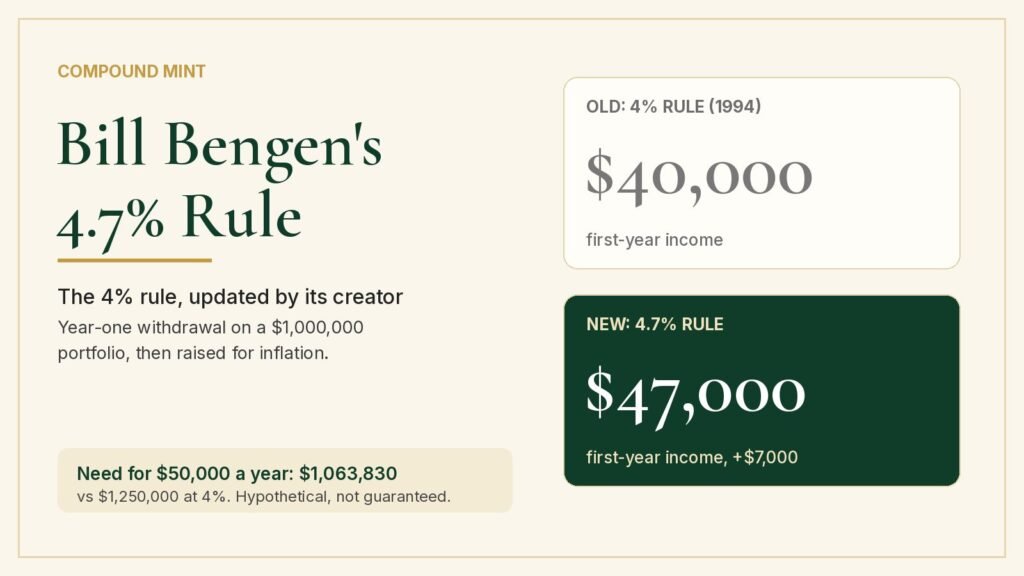
Short answer: The Bill Bengen 4.7 percent rule is the updated version of the 4% rule, from the financial planner who created it. Withdraw 4.7% of your portfolio in your first year of retirement, then raise that dollar amount each year with inflation, and in Bengen’s historical research the money lasted at least 30 years. On $1,000,000 that is $47,000 in year one instead of $40,000. Flip it around and $50,000 of yearly spending needs about $1,063,830 instead of $1,250,000. Examples are hypothetical, not guaranteed. Educational content only. Not financial advice.
Few money rules are as famous as the 4% rule, so when the person behind it says the number should be higher, it is worth understanding exactly what changed, what did not, and whether the new figure fits your plan.
Where the 4% rule came from
In 1994, Bengen published research that tested withdrawal rates against the real history of US stocks, bonds and inflation going back to 1926. He found that a 4.15% first-year withdrawal, adjusted for inflation each year after, never ran out of money in less than 30 years. That worst case was a single retiree who started in late October 1968, just ahead of several bear markets and the high inflation of the 1970s. The 4.15% was later rounded down to the “4% rule.” Bengen explains the history on his own site.
What changed: why it is now 4.7%
The original study used a simple portfolio of large US company stocks and government bonds. Since then, Bengen has widened his research to include more asset classes, such as small and mid-sized company stocks and international stocks alongside bonds and cash, and he now studies almost 400 historical retirees. With that more diversified mix, the worst-case safe starting rate rose to about 4.7%. He lays this out in his 2025 book, A Richer Retirement: Supercharging the 4% Rule to Spend More and Enjoy More, and says some techniques in it push the figure toward about 5%, but not much further.
What did not change: the rule is still about the worst historical starting year, it still assumes a 30-year retirement, and it still means a fixed first-year amount raised with inflation, not 4.7% of whatever your balance happens to be each year.
Worked example: $1,000,000 under the 4.7% rule
Inputs: a $1,000,000 portfolio, a 4.7% first-year withdrawal, and a hypothetical 3% inflation raise every year after.
| Retirement year | Withdrawal under 4.7% | Withdrawal under 4% |
|---|---|---|
| 1 | $47,000 | $40,000 |
| 2 | $48,410 | $41,200 |
| 3 | $49,862 | $42,436 |
| 10 | $61,324 | $52,191 |
| 20 | $82,415 | $70,140 |
| 30 | $110,759 | $94,263 |
The first-year gap is $7,000, and because each year’s amount grows from the year before, the gap grows too. In practice the withdrawal follows real inflation, so your own numbers will differ.
How much you need: 4% vs. 4.7%
To find your target, divide your yearly spending by the withdrawal rate. At 4% that is 25 times spending; at 4.7% it is about 21.3 times.
| Yearly spending | Needed at 4% | Needed at 4.7% | Difference |
|---|---|---|---|
| $40,000 | $1,000,000 | $851,064 | $148,936 |
| $50,000 | $1,250,000 | $1,063,830 | $186,170 |
| $60,000 | $1,500,000 | $1,276,596 | $223,404 |
| $80,000 | $2,000,000 | $1,702,128 | $297,872 |
| $100,000 | $2,500,000 | $2,127,660 | $372,340 |
What that means in time: saving $2,000 a month from $0 at a hypothetical 7% return (monthly compounding), you would pass $1,063,830 after 243 months and $1,250,000 after 265 months. The 4.7% target arrives about 22 months sooner. Try your own spending with a 4.7% rate in the FIRE number calculator, or switch it back to 4% to compare.
Assumptions: end-of-month deposits, monthly compounding, a constant 7% yearly return, 3% yearly inflation in the withdrawal table, no taxes or fees. Examples are hypothetical, not guaranteed.
Who the 4.7% rule fits, and who should be careful
- Fits: someone retiring around a typical age who expects about 30 years of withdrawals and holds a broadly diversified portfolio similar to the one Bengen studied.
- Be careful if you are retiring early. A retirement that starts at 45 or 50 may need to last 40 years or more, and the 4.7% figure was not built for that. Many early retirees still plan around 3.5% to 4%. Our guide on how to retire at 50 runs those numbers.
- Be careful with a very different portfolio. All cash, all bonds or a single stock behaves nothing like the mix behind the research.
- Remember it is a worst-case floor. In most historical periods, retirees following the rule ended up with more money than they started with. Being willing to trim spending after a bad market year gives you extra room either way.
If you are still building toward your number, the Coast FIRE calculator shows when your savings could grow into it on their own, and Coast FIRE and the 4% rule, explained covers the original rule in more depth. Planning to live on a set monthly amount? See how much you need to invest to make $1,000 a month.
Books that explain this well
- The Simple Path to Wealth by JL Collins (affiliate link): a complete, simple index fund plan, including how to draw it down later.
- Die With Zero by Bill Perkins (affiliate link): a different view on spending your savings in retirement instead of hoarding it.
- Quit Like a Millionaire by Kristy Shen and Bryce Leung (affiliate link): how one couple reached early retirement, with the withdrawal math explained.
As an Amazon Associate I earn from qualifying purchases.
Educational content only. Not financial advice. Examples are hypothetical, not guaranteed. Past market history does not guarantee future results; taxes and fees reduce what you can withdraw.
Questions people ask
What is the Bengen 4.7% rule?
It is Bill Bengen's updated safe withdrawal rate. You withdraw 4.7% of your portfolio in the first year of retirement, then raise that dollar amount each year for inflation. In his historical research using a diversified portfolio, that starting rate lasted at least 30 years even for the worst starting year. On $1,000,000 that is $47,000 in year one. Examples are hypothetical, not guaranteed.
Is the 4% rule outdated?
Not outdated, but conservative. Its creator now says 4.7% is a safe starting rate for a 30-year retirement with a broadly diversified portfolio. The 4% figure still makes sense as a cushion for longer retirements, such as retiring in your 40s or early 50s, or for people who want extra safety.
How long will $1,000,000 last using the 4% rule?
In the historical data behind the rule, at least 30 years: you would take $40,000 in the first year and raise it with inflation after that. In many historical periods the money lasted far longer and the balance grew. Future returns may differ. Examples are hypothetical, not guaranteed.
Does the 4.7% rule work for early retirement?
It was designed for a 30-year retirement. If yours could last 40 or 50 years, a lower starting rate such as 3.5% to 4% is more cautious, and flexible spending in bad market years adds safety. Educational content only, not financial advice.
Why did Bill Bengen raise the 4% rule to 4.7%?
His original 1994 study used only large US company stocks and government bonds. His newer research adds more asset classes, including small and mid-sized company stocks and international stocks, and that wider diversification raised the worst-case safe starting rate from about 4.15% to about 4.7%.
Run the numbers yourself
Compound interest calculator
“$X a month for Y years”: see exactly what it turns into, with a chart you can share.
Open calculator →$1M or…? dilemma calculator
A lump sum today vs. payments over time (or a penny doubled). The channel’s signature question, with real math.
Open calculator →S&P 500 “what if I invested” calculator
What $100 a month in an S&P 500 index fund would have grown to, using honest historical averages.
Open calculator →