
Short answer: Neither is better on its own. A Roth IRA wins if your tax rate in retirement will be higher than today; a Traditional IRA wins if it will be lower; if the rate is the same, they tie to the dollar. The money grows the same way in both (about $869,000 from $7,000 a year for 30 years at 8%); the only difference is when you pay the tax. Hypothetical, not guaranteed. Educational content only. Not financial advice.
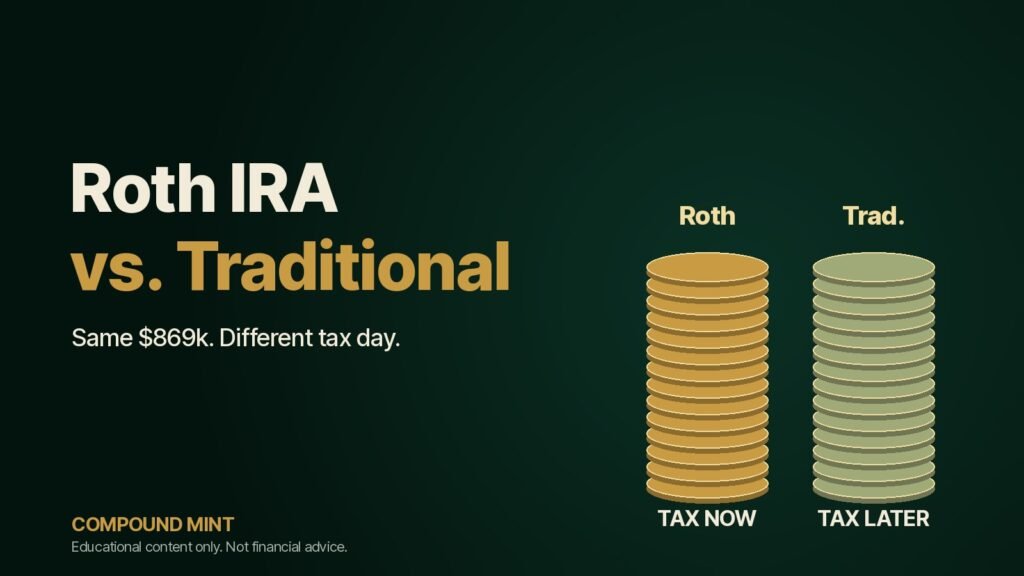
Most comparisons list ten differences. Only one of them moves the final number much: the tax rate you pay on the way in versus the tax rate you pay on the way out. Here is that one difference, with the math shown.
What is the difference between a Roth IRA and a Traditional IRA?
- Traditional IRA: tax later. Contributions may be tax-deductible now, the money grows untaxed, and withdrawals in retirement are taxed as ordinary income.
- Roth IRA: tax now. You contribute money you already paid tax on, it grows untaxed, and qualified withdrawals in retirement are tax-free.
Both share one annual contribution limit (it is a combined limit across all your IRAs, not one per account). Roth contributions phase out above an income limit, and the Traditional deduction can shrink if you or your spouse have a workplace plan. Those limits change most years, so check the current year’s IRS figures before you act.
Worked example: same paycheck, two accounts
Say you set aside $7,000 of salary a year ($583.33 a month) for 30 years, earning a hypothetical 8% a year, compounded monthly, and your tax rate today is 22%.
- Traditional: the full $7,000 goes in before tax. It grows to about $869,376. That balance has not been taxed yet.
- Roth: 22% tax comes out first, so $5,460 a year ($455 a month) goes in. It grows to about $678,114, and that balance is already yours, tax-free.
Now pay the Traditional account’s tax in retirement and compare what you actually get to spend:
| Your tax rate in retirement | Traditional, after tax | Roth, tax-free | Winner |
|---|---|---|---|
| 12% (lower than today) | $765,051 | $678,114 | Traditional by $86,938 |
| 22% (same as today) | $678,114 | $678,114 | Tie |
| 32% (higher than today) | $591,176 | $678,114 | Roth by $86,938 |
Same contributions, same returns, same years. The whole result turns on one question: will your tax rate be higher or lower when you take the money out? Run your own amount, rate and years in the compound interest calculator. All projected balances are hypothetical, not guaranteed.
Assumptions: end-of-month deposits, 8% nominal annual return compounded monthly, a flat tax rate on the whole withdrawal, no fees. Real returns vary year to year and can be negative. Examples are hypothetical, not guaranteed.
When does a Roth IRA usually come out ahead?
- You are early in your career and in a low bracket now, with raises ahead.
- You expect tax rates in general to rise, or you want to hedge against that.
- You want flexibility: Roth contributions (not earnings) can be withdrawn at any time, and Roth IRAs have no required minimum distributions for the original owner.
When does a Traditional IRA usually come out ahead?
- You are in a high bracket now and expect a lower one in retirement.
- You need the deduction today to afford saving at all. A deduction you invest beats a Roth you never open.
- You plan to retire somewhere with lower or no state income tax.
Can’t decide? Split it
You do not have to pick one forever. Plenty of people put part of the year’s limit in each, or switch as their income changes. Since nobody knows future tax rates, holding some money in each kind of account gives you a choice later about which bucket to draw from. If your employer matches 401(k) contributions, that match usually comes first; see how to invest $100 a month for the order most beginners use.
The part that matters more than Roth vs. Traditional
The tax choice moved the result by about $87,000 in the example. Starting ten years later would cost far more: the same $583 a month for 20 years instead of 30 ends near $344,000, not $869,000. That is how compound interest works: time does most of the lifting. Pick the account that fits your best guess, then automate it. See how a fixed monthly amount grows over 10 to 40 years in the $500-a-month scenario, or check the compound interest calculator with your own numbers.
Educational content only. Not financial advice. Examples are hypothetical, not guaranteed. Contribution and income limits change; check the current year’s IRS figures, and consider a tax professional for your own situation.
5 days, 5 money moves
One short email a day: your money map, the debt rule, your emergency fund, Roth or traditional, and putting it all on autopilot. Free. Unsubscribe any time.
Questions people ask
Is it better to get a Roth IRA or a traditional IRA?
It depends on your tax rate now versus in retirement. If you expect a higher rate later, a Roth usually wins; if lower, a Traditional usually wins; if the same, they come out equal. Many people split contributions between both. Educational content only, not financial advice.
What is a traditional IRA vs Roth IRA?
Both are individual retirement accounts. A Traditional IRA may give a tax deduction now and taxes withdrawals later; a Roth IRA uses after-tax money now and qualified withdrawals in retirement are tax-free.
Can I contribute to both a Roth IRA and a traditional IRA in the same year?
Yes, but the annual IRA limit is shared: the total across all your Traditional and Roth IRAs cannot exceed that year's limit. Check the current year's IRS figures.
Do Roth IRAs have required minimum distributions?
Not for the original owner. Traditional IRAs require minimum withdrawals starting in your 70s; the exact age depends on your birth year, so check current IRS rules.
Run the numbers yourself
Compound interest calculator
“$X a month for Y years”: see exactly what it turns into, with a chart you can share.
Open calculator →$1M or…? dilemma calculator
A lump sum today vs. payments over time (or a penny doubled). The channel’s signature question, with real math.
Open calculator →S&P 500 “what if I invested” calculator
What $100 a month in an S&P 500 index fund would have grown to, using honest historical averages.
Open calculator →