
Short answer: A high-yield savings account is a regular, insured savings account that pays a much higher interest rate, usually because the bank is online and has lower costs. Your interest is added to the balance (often monthly), so it compounds. At a hypothetical 4.00% APY, $10,000 earns $400 in the first year and grows to about $12,167 in five years, versus about $10,005 at a 0.01% big-bank rate. Rates are variable, so treat these numbers as hypothetical, not guaranteed. Educational content only. Not financial advice.
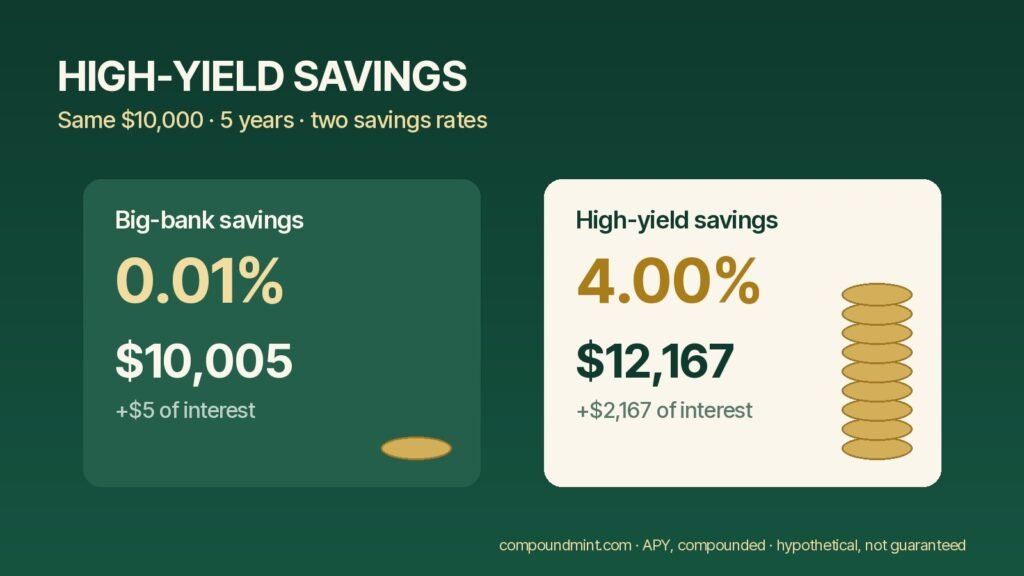
A high-yield savings account (HYSA) does the same job as the savings account attached to your checking: it holds cash you can reach. The difference is the rate, and over a few years that difference is real money.
Watch: $10,000 in a savings account vs investing, 30 years out (Short).
Watch (Short): What $10,000 Becomes in 30 Years: Savings Account vs Investing
How do high-yield savings accounts work?
- You open it and move money in. Most HYSAs are at online banks or credit unions. You link your checking account and transfer money in, usually free.
- The bank pays you interest. The rate is shown as an APY (annual percentage yield), which already includes the effect of compounding. Interest is typically calculated daily and paid monthly.
- The interest compounds. Each month’s interest joins your balance and earns interest itself. That is compound interest instead of simple interest, working for you.
- The rate can change. HYSA rates are variable. They tend to rise and fall with the Federal Reserve’s rate, and the bank can change yours at any time.
- You take money out when you need it. Transfers back to checking usually take one to three business days. Some banks still limit how many withdrawals you can make per month, so check the terms.
Why the higher rate? Online banks skip the branch network, and they compete for deposits by paying more. The account itself is not riskier when it is at an insured bank (more on that below).
Worked example: $10,000 at 4.00% APY vs 0.01%
One $10,000 deposit, nothing added, the rate held steady (in real life it will move):
| After | 0.01% APY (typical big-bank savings) | 4.00% APY (hypothetical HYSA) | Difference |
|---|---|---|---|
| 1 year | $10,001 | $10,400 | $399 |
| 5 years | $10,005 | $12,167 | $2,162 |
| 10 years | $10,010 | $14,802 | $4,792 |
Add $200 a month on top of the $10,000 and, at the same 4.00% APY, you would have about $25,402 after five years: $22,000 of your own deposits plus about $3,402 of interest. All projected balances are hypothetical, not guaranteed.
APY vs. APR, in one line: APR is the plain yearly rate; APY includes compounding. If you type 4% into the compound interest calculator, it treats 4% as a rate compounded monthly (an APY of about 4.07%) and shows about $25,470, slightly more than the $25,402 above. Use about 3.93% in the calculator to match a 4.00% APY.
Assumptions: a fixed APY for the whole period, interest left in the account, deposits at the end of each month, no fees, before taxes. Real savings rates change. Examples are hypothetical, not guaranteed.
Is a high-yield savings account safe?
At a bank insured by the FDIC (or a credit union insured by the NCUA), deposits are insured up to $250,000 per depositor, per insured institution, per ownership category. Within those limits you do not lose your balance if the bank fails. Two checks worth doing:
- Confirm the insurer. Look the bank up on the FDIC’s BankFind tool or the NCUA’s credit union locator.
- Know who actually holds the money. Some finance apps are not banks; they place your cash at a partner bank. Find out which bank that is and how the coverage applies to you.
What is the downside to a high-yield savings account?
- The rate is variable. The APY you sign up for can drop.
- Inflation can eat most of it. If prices rise 3% in a year, the $10,400 from the example buys about what $10,097 buys today.
- Interest is taxable. It is taxed as ordinary income in the year it is paid. In a 22% bracket, $400 of interest leaves about $312 after federal tax.
- It is not a growth engine. For money you will not touch for 10+ years, savings rates have historically lagged long-run stock market returns. Stocks can also fall, which is why short-term money belongs in savings.
- Transfers are not instant. Plan on a day or three to get cash back to checking.
What a high-yield savings account is good for
- An emergency fund (often 3 to 6 months of expenses).
- Short-term goals within a few years: a car, a move, a wedding, a down payment.
- Cash waiting to be invested on a schedule, like the plan in how to invest $100 a month.
For long-term money, the bigger lever is time and steady investing; see how compound interest works. To see what a small daily expense would grow to if it went into savings instead, try the daily habit cost calculator, or run your own numbers in the compound interest calculator.
Educational content only. Not financial advice. Examples are hypothetical, not guaranteed. Savings rates change often; check the current APY, fees and insurance details on the bank’s own site before you open an account.
Questions people ask
How much money will $10,000 make in a high-yield savings account?
At a hypothetical 4.00% APY, about $400 in the first year and about $2,167 over five years if the rate stays the same and you leave the interest in. Rates are variable, so real results will differ. Hypothetical, not guaranteed.
What happens if I put $1,000 in a high-yield savings account?
It earns interest that is added to your balance, usually monthly. At a hypothetical 4.00% APY that is about $40 in a year, compared with about 10 cents at 0.01%. The money stays accessible, and at an FDIC- or NCUA-insured institution it is insured within the limits.
What is the downside to a high-yield savings account?
The rate is variable and can drop, inflation can erase much of the real gain, interest is taxed as ordinary income, and transfers back to checking can take one to three business days. Over long periods, savings rates have historically trailed stock market returns.
Can you ever lose money in a high-yield savings account?
Not your insured balance, as long as the account is at an FDIC-insured bank or NCUA-insured credit union and within the $250,000 per depositor, per institution, per ownership category limit. You can lose buying power to inflation, and fees can reduce your balance, so read the account terms.
Are high-yield savings accounts worth it?
For an emergency fund or money you need within a few years, usually yes: same access and insurance as a regular savings account, with a much higher rate. For long-term goals, investing has historically grown faster, with more risk. Educational content only, not financial advice.
Run the numbers yourself
Compound interest calculator
“$X a month for Y years”: see exactly what it turns into, with a chart you can share.
Open calculator →$1M or…? dilemma calculator
A lump sum today vs. payments over time (or a penny doubled). The channel’s signature question, with real math.
Open calculator →S&P 500 “what if I invested” calculator
What $100 a month in an S&P 500 index fund would have grown to, using honest historical averages.
Open calculator →