
Short answer: Simple interest is paid only on the money you started with; compound interest is also paid on the interest you already earned. $10,000 at 5% for 10 years grows to $15,000 with simple interest and $16,289 with compound interest (compounded yearly), and the gap widens every year after that. Compounding helps you when you save and costs you when you borrow. Hypothetical, not guaranteed. Educational content only. Not financial advice.
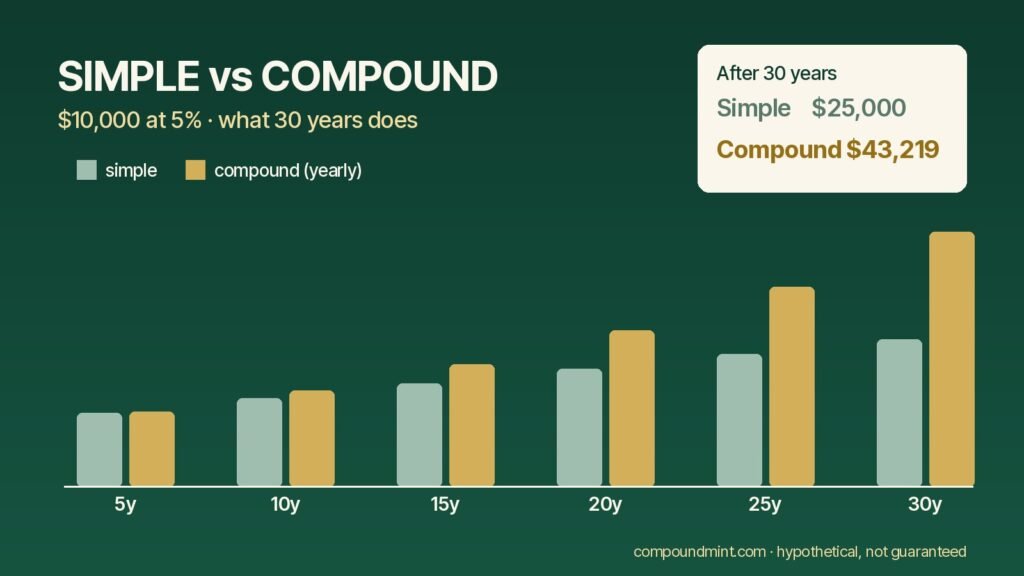
Both use the same three inputs: how much, what rate, how long. The only difference is what the rate is applied to. That one detail is worth $18,219 on a $10,000 deposit over 30 years.
Watch: the Rule of 72, the shortcut for how fast compounding doubles your money (Short).
Watch (Short): Rule of 72 Explained: How Fast Your Money Doubles
What is the difference between simple interest and compound interest?
- Simple interest: the rate applies to the original amount (the principal) every period. $10,000 at 5% earns $500 a year, every year, forever. Formula: Amount = P × (1 + r × t).
- Compound interest: each period’s interest is added to the balance, and next period’s rate applies to the bigger balance. Year 1 earns $500, year 2 earns $525, year 3 earns $551.25, and so on. Formula: Amount = P × (1 + r/n)n × t, where n is how many times a year interest is added.
In year one they are identical. The difference only shows up once interest starts earning interest, which is why compounding feels slow at first and then speeds up.
Worked example: $10,000 at 5%, side by side
One deposit of $10,000, no more money added, a hypothetical 5% a year. Simple interest versus interest compounded once a year:
| Years | Simple interest | Compound interest (yearly) | Compounding adds |
|---|---|---|---|
| 1 | $10,500 | $10,500 | $0 |
| 5 | $12,500 | $12,763 | $263 |
| 10 | $15,000 | $16,289 | $1,289 |
| 20 | $20,000 | $26,533 | $6,533 |
| 30 | $25,000 | $43,219 | $18,219 |
Simple interest adds the same $500 every year in a straight line. Compound interest adds $500 in year one and $2,058 in year thirty. By year 30 the compound balance has earned more than three times the interest ($33,219 vs $10,000).
Compounding more often adds a little more. Compounded monthly, the same $10,000 at 5% reaches about $16,470 after 10 years instead of $16,289. Check it yourself: open this example in the compound interest calculator (it compounds monthly), then change the years to 30. All projected balances are hypothetical, not guaranteed.
Assumptions: one $10,000 deposit, a fixed 5% nominal annual rate, no withdrawals, no taxes or fees. Real returns vary and investments can lose value. Examples are hypothetical, not guaranteed.
Which is better, simple interest or compound interest?
It depends on which side of the money you are on.
- Saving or investing: compound is better for you. Savings accounts, CDs and reinvested investment returns all compound, so your earnings start earning too.
- Borrowing: simple is better for you. Many auto loans and personal loans charge simple interest on the remaining balance, so each payment shrinks what you pay interest on. Credit cards compound: interest you don’t pay off gets added to the balance and charged interest itself.
A quick borrowing example: leave $5,000 on a card at a hypothetical 22% APR, compounded monthly, with no payments for a year, and you owe about $6,218. At 22% simple interest you would owe $6,100. The $118 gap looks small in one year; it is the same snowball as the savings table, just rolling against you.
Why compounding gets dramatic over time
Compounding is exponential, so time matters more than the rate. A handy shortcut is the Rule of 72: divide 72 by the yearly rate to estimate how many years it takes to double. At 8%, money roughly doubles every 9 years; at 5%, about every 14 years. Simple interest never “doubles again”. At 5% simple it takes 20 years to double once, and then it just keeps adding the same $500.
The same idea, applied to a penny instead of $10,000, is why a penny doubled for 30 days beats a big lump sum. For the step-by-step version with monthly deposits, read how compound interest works.
How to put compounding on your side
- Start early. In the table, years 20 to 30 added more interest ($16,686) than the first 20 years ($16,533).
- Leave the interest in. Withdrawing interest each year turns compound growth back into simple growth.
- Add a little every month. Small, regular deposits give compounding more to work with; see how to invest $100 a month.
- Pay off compounding debt first. A card charging 22% compounds faster than most savings can earn.
Try your own deposit, monthly amount, rate and timeline in the compound interest calculator.
Educational content only. Not financial advice. Examples are hypothetical, not guaranteed. Rates, loan terms and how interest is calculated vary by lender and account; read the terms of your own account.
Questions people ask
Which is better, simple interest or compound interest?
For savers, compound interest is better because your interest also earns interest. For borrowers, simple interest is better because you only pay interest on the amount you owe, not on past interest. Educational content only, not financial advice.
What is the difference between simple interest and compound interest?
Simple interest is calculated only on the original principal. Compound interest is calculated on the principal plus all interest already added. $10,000 at 5% for 10 years becomes $15,000 with simple interest and about $16,289 compounded yearly (hypothetical, not guaranteed).
How much is $10,000 at 10% interest for 10 years?
With simple interest it becomes $20,000. Compounded yearly it becomes about $25,937, and compounded monthly about $27,070. These are hypothetical, not guaranteed; real investment returns vary.
Why is compound interest more beneficial than simple interest?
Because growth builds on growth. Each year's interest is added to the balance, so the next year's interest is larger. Over long periods this gap becomes large: over 30 years at 5%, $10,000 earns $15,000 simple interest but about $33,219 compounded yearly (hypothetical).
How long will it take for $10,000 to double at 8% compound interest?
About 9 years. The Rule of 72 gives 72 ÷ 8 = 9, and the exact answer at 8% compounded yearly is 9.01 years. This assumes a steady 8% return, which is hypothetical, not guaranteed.
Run the numbers yourself
Compound interest calculator
“$X a month for Y years”: see exactly what it turns into, with a chart you can share.
Open calculator →$1M or…? dilemma calculator
A lump sum today vs. payments over time (or a penny doubled). The channel’s signature question, with real math.
Open calculator →S&P 500 “what if I invested” calculator
What $100 a month in an S&P 500 index fund would have grown to, using honest historical averages.
Open calculator →