
Short answer: By saving and investing alone, you would need to put away about $80,322 a month for 12 months at a hypothetical 8% return, and $963,864 of the million would be your own deposits. Growth adds only about $36,139 in one year. That is why one-year millionaires almost always come from a big income event, like selling a business or company stock, rather than from investing. The repeatable path is slower: about $5,467 a month gets there in 10 years at a hypothetical 8%. Educational content only. Not financial advice.
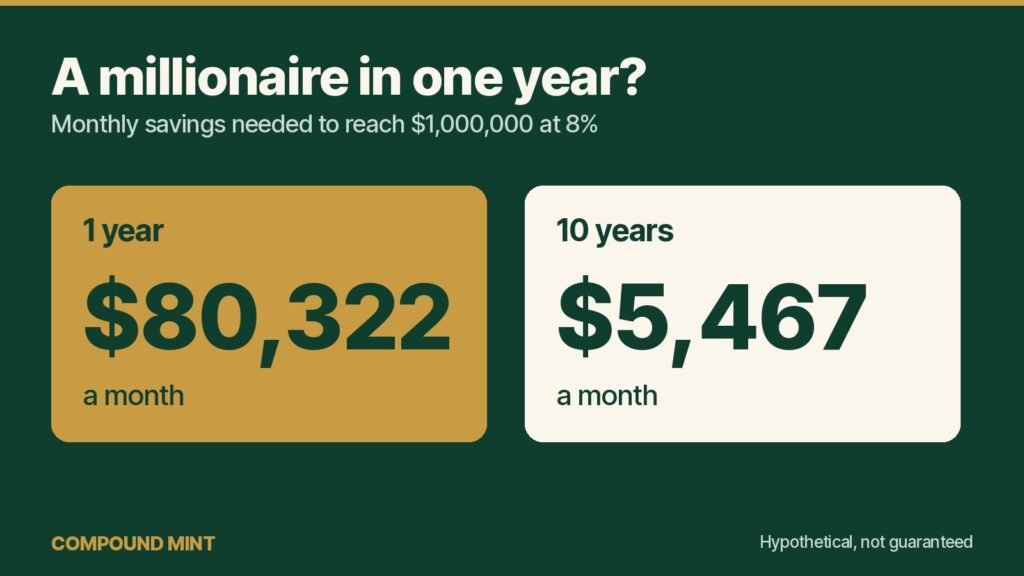
One year is too short for compounding to do much. Compounding pays you on past growth, and in twelve months there is barely any past growth to build on. So the question splits in two: how much money has to land in your hands this year, and what a realistic timeline looks like if it does not.
The one-year math, next to longer timelines
Here is the monthly amount needed to reach $1,000,000 from $0, with no growth and with a hypothetical 8% annual return compounded monthly, deposits at the end of each month:
| Timeline | Per month, no growth | Per month at 8% | Your deposits at 8% | Growth at 8% |
|---|---|---|---|---|
| 1 year | $83,334 | $80,322 | $963,864 | $36,139 |
| 3 years | $27,778 | $24,670 | $888,120 | $111,892 |
| 5 years | $16,667 | $13,610 | $816,600 | $183,420 |
| 10 years | $8,334 | $5,467 | $656,040 | $344,126 |
| 20 years | $4,167 | $1,698 | $407,520 | $592,637 |
| 30 years | $2,778 | $671 | $241,560 | $758,471 |
Read the top row and the bottom row together. In one year, your deposits make up about 96% of the million. Over 30 years, they make up about 24% and growth does the rest. Time, not a clever trick, is what shrinks the monthly number. All returns here are hypothetical, not guaranteed.
Check the one-year row in the millionaire calculator, then move the target age to see how fast the monthly figure falls.
Assumptions: start at $0, equal deposits at the end of each month, a constant hypothetical 8% annual return compounded monthly, before taxes, fees and inflation. Examples are hypothetical, not guaranteed.
What it takes in real life
- A huge income. $80,322 a month is $2,641 a day, saved after taxes and living costs. That takes an income well into seven figures.
- A head start. With no new deposits, you would need to start the year with about $923,361 to reach $1 million at a hypothetical 8%. Starting with $100,000, you would still need about $71,623 a month.
- Maxing every account is not close. For 2026 the IRS allows $24,500 in a 401(k) and $7,500 in an IRA. Together that is $32,000, or 3.2% of a million. Check the current year’s IRS figures.
The ways people actually hit $1 million in a year
- Selling a business or equity. A founder selling a company, or an early employee whose stock becomes sellable. This is real, but it is the payoff for years of earlier work, not one year of effort.
- A windfall. An inheritance, a legal settlement, or the lottery. The odds of a Powerball jackpot are 1 in 292,201,338 and a Mega Millions jackpot 1 in 290,472,336. Not a plan.
- High-risk bets. Leverage, options or a single hot asset can multiply money fast, and wipe it out just as fast. After a 50% loss you need a 100% gain to get back to even.
Viral claims about doubling money every day skip this math too. Daily doubling is a thought experiment, not a return; see what $1 doubled every day for a year really shows.
The realistic plan: shorten the timeline, not to one year
If one year is out of reach, the useful question is how to get there sooner. Three levers move it:
- Save more each month. $1,000 a month at a hypothetical 8% reaches $1 million in about 25 years and 7 months. $5,467 a month gets there in 10 years; the full breakdown is in how to save a million dollars in 10 years.
- Start earlier. At 8%, money doubles about every 9 years by the Rule of 72. A $125,000 balance becomes $1 million after three doublings, roughly 27 years, without adding a dollar. More on that in how to double your money.
- Grow income. A raise, a side business or a career move lifts the monthly number faster than trimming small expenses.
Curious what seven figures really means in practice? See how much 7 figures is, and our video How Much to Invest to Become a Millionaire? $200/Month Math for the slow-and-steady version.
Educational content only. Not financial advice. Examples are hypothetical, not guaranteed. Returns are not guaranteed and past market performance does not predict future results. Check the current year’s IRS figures.
Questions people ask
Is it possible to become a millionaire in 1 year?
Yes, but rarely by saving and investing. Reaching $1 million from $0 in 12 months takes about $80,322 a month at a hypothetical 8% return, so almost all of it is your own money. People who do it in a year usually sell a business or company stock, or receive a windfall like an inheritance.
How much do I need to save a month to be a millionaire in one year?
About $83,334 a month with no growth, or about $80,322 a month at a hypothetical 8% annual return compounded monthly. In one year growth adds only about $36,139, so the deposits do nearly all the work. These figures are hypothetical, not guaranteed.
How do you make $1 million in 1 year?
Realistically through a large income event: selling a business, cashing out equity, a very high salary or commissions, or a windfall. Investing alone cannot do it from a small balance, because compounding needs years. High-risk bets can grow money quickly but can also lose most of it.
How long does it take to become a millionaire investing $1,000 a month?
About 25 years and 7 months at a hypothetical 8% annual return compounded monthly, starting from $0. At a lower return it takes longer, and at a higher one it takes less time. Returns are not guaranteed.
How much do I need to invest to become a millionaire in 10 years?
About $5,467 a month from $0 at a hypothetical 8% return compounded monthly. You would deposit $656,040 and growth would add about $344,126. Starting with an existing balance lowers the monthly amount. These figures are hypothetical, not guaranteed.
Run the numbers yourself
Compound interest calculator
“$X a month for Y years”: see exactly what it turns into, with a chart you can share.
Open calculator →$1M or…? dilemma calculator
A lump sum today vs. payments over time (or a penny doubled). The channel’s signature question, with real math.
Open calculator →S&P 500 “what if I invested” calculator
What $100 a month in an S&P 500 index fund would have grown to, using honest historical averages.
Open calculator →