
Short answer: To see how long it takes to double your money, divide 72 by your yearly return. That is the Rule of 72. At a hypothetical 8% a year, money doubles in about 9 years; at 10% in about 7.2 years; at 4% in about 18 years. The realistic way to double money is time plus compounding, plus free money like an employer match. These are hypothetical examples, not guaranteed. Educational content only. Not financial advice.
Search “how to double your money” and you will find promises of doing it in a week. Real doubling is slower and far more reliable: a steady return, left alone long enough. Here is the quick math, the exact numbers by rate, and the few moves that genuinely speed it up.
The Rule of 72: years to double = 72 ÷ return
The Rule of 72 is a mental shortcut for compound growth. Divide 72 by the yearly return (as a whole number) and you get the approximate years for money to double. It is close to exact for returns between about 6% and 10%:
| Yearly return | Rule of 72 estimate | Exact years to double |
|---|---|---|
| 2% | 36 years | 35.0 years |
| 3% | 24 years | 23.4 years |
| 4% | 18 years | 17.7 years |
| 5% | 14.4 years | 14.2 years |
| 6% | 12 years | 11.9 years |
| 7% | 10.3 years | 10.2 years |
| 8% | 9 years | 9.0 years |
| 9% | 8 years | 8.0 years |
| 10% | 7.2 years | 7.3 years |
| 12% | 6 years | 6.1 years |
The exact formula is years = ln(2) ÷ ln(1 + return), with yearly compounding. You do not need it day to day; 72 gets you within a few months in the usual range. Watch the 40-second version on our channel: Rule of 72 explained.
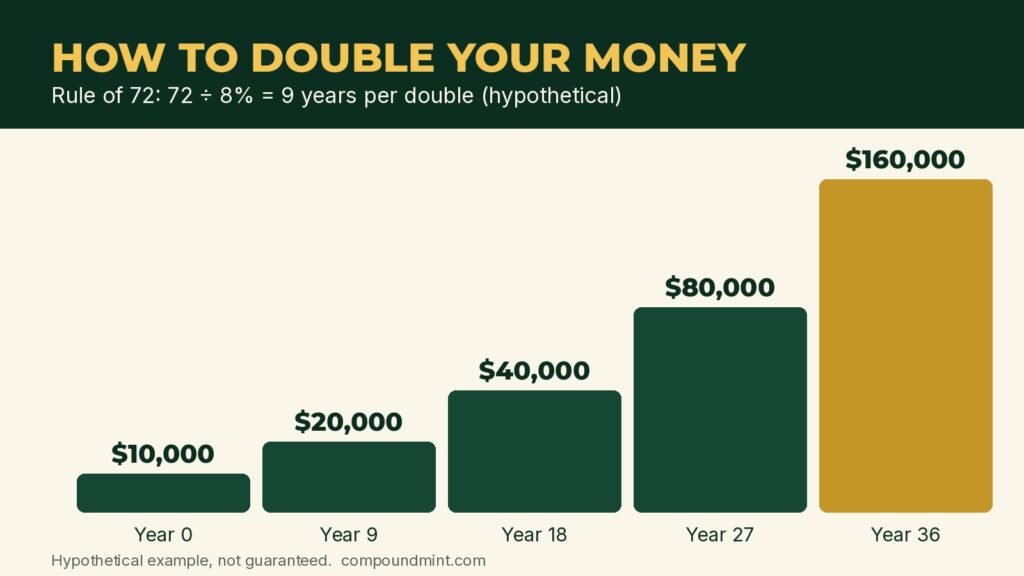
Worked example: $10,000 at 8%
Put $10,000 in an investment earning a hypothetical 8% a year, add nothing, and let it compound yearly:
| Year | Balance | Doublings |
|---|---|---|
| 0 | $10,000 | 0 |
| 9 | $19,990 | 1 |
| 18 | $39,960 | 2 |
| 27 | $79,881 | 3 |
| 36 | $159,682 | 4 |
The first double adds $10,000. The fourth adds about $80,000. Same rate, same patience, but each doubling works on a bigger base. That is the whole case for starting early, and it is why a dollar invested at 25 is worth so much more than one invested at 55; see the wealth multiplier by age table. Check the numbers yourself in the compound interest calculator.
Assumptions: a constant hypothetical return, yearly compounding, no deposits, withdrawals, taxes or fees. Real markets go up and down, sometimes for years. Examples are hypothetical, not guaranteed.
How long does it take to double your money in the stock market?
Nobody can promise a stock market return. If you assume a hypothetical 10% a year, a figure often used for the long-run average of large US stocks before inflation, the Rule of 72 says about 7.2 years. At a more cautious 7%, about 10.3 years. Real years swing far above and below the average, so treat these as long-run planning numbers, not a schedule. See how different returns play out in the S&P 500 calculator.
Realistic ways to double your money
- Take the full employer match. A 50% match on 6% of a $60,000 salary means your $3,600 a year comes with $1,800 extra before any growth. A 100% match doubles your contribution on day one. See whether the employer match counts toward the 401(k) limit.
- Invest for long periods in broad, low-cost funds. Time is the lever. At 8%, 18 years is two doublings.
- Keep fees low. Every percent of fees comes straight off the return in the Rule of 72. Going from 8% to 7% stretches a double from about 9 to about 10.3 years.
- Park cash where it earns something. At 0.01% interest, the Rule of 72 says money takes about 7,200 years to double. At a hypothetical 4% savings yield, about 18 years. Here is how high yield savings accounts work.
- Pay off high-interest debt. The rule works against you too. A balance growing at 22% doubles in about 3.3 years by the Rule of 72. Paying it off is a guaranteed “return” at that rate.
Doubling about every 9 years at 8% is realistic. Doubling every day is not: see a dollar doubled every day for a year for how fast that math leaves reality.
Beware of “double your money fast” offers
Doubling in a year means a 100% return. Anything promising that, or doubling in a week or a day, with no risk, is a classic warning sign of a scam. Real doubling at real rates takes years. For a picture of why steady compounding beats flat growth, see simple interest vs compound interest, and for a fun look at extreme doubling, the penny doubled for 30 days.
The Rule of 72 and inflation
The same rule tells you how fast prices double. At 3% inflation, prices double in about 24 years, which means cash sitting idle loses about half its buying power in that time. That is the quiet reason to invest money you will not need for a long while.
Helpful books and tools
- The Little Book of Common Sense Investing by John C. Bogle (affiliate link): the case for low-cost index funds, from the founder of Vanguard.
- The Psychology of Money by Morgan Housel (affiliate link): short chapters on why behavior and time matter more than picking winners.
- Texas Instruments BA II Plus financial calculator (affiliate link): a handheld calculator with time value of money keys, if you like checking math by hand.
As an Amazon Associate I earn from qualifying purchases.
Educational content only. Not financial advice. Examples are hypothetical, not guaranteed. Returns are not guaranteed and past market performance does not predict future results.
Questions people ask
How long does it take to double your money at 8 percent?
About 9 years. 72 divided by 8 is 9, and the exact answer with yearly compounding is 9.0 years. Examples are hypothetical, not guaranteed.
How long does it take to double your money at 10 percent?
About 7.2 years by the Rule of 72. The exact answer with yearly compounding is about 7.3 years.
How long does it take to double your money at 7 percent?
About 10.3 years by the Rule of 72, and about 10.2 years exactly with yearly compounding.
How can I double my money in 5 years?
You would need about a 14.4% yearly return (72 divided by 5), which is well above what most savings or diversified investments have earned over long periods and would carry high risk. Examples are hypothetical, not guaranteed.
Is the Rule of 72 accurate?
It is very close for returns between about 6% and 10%. At 8% it gives 9 years versus an exact 9.0. It drifts further at very low or very high rates; at 2% it says 36 years versus about 35.
Run the numbers yourself
Compound interest calculator
“$X a month for Y years”: see exactly what it turns into, with a chart you can share.
Open calculator →$1M or…? dilemma calculator
A lump sum today vs. payments over time (or a penny doubled). The channel’s signature question, with real math.
Open calculator →S&P 500 “what if I invested” calculator
What $100 a month in an S&P 500 index fund would have grown to, using honest historical averages.
Open calculator →