
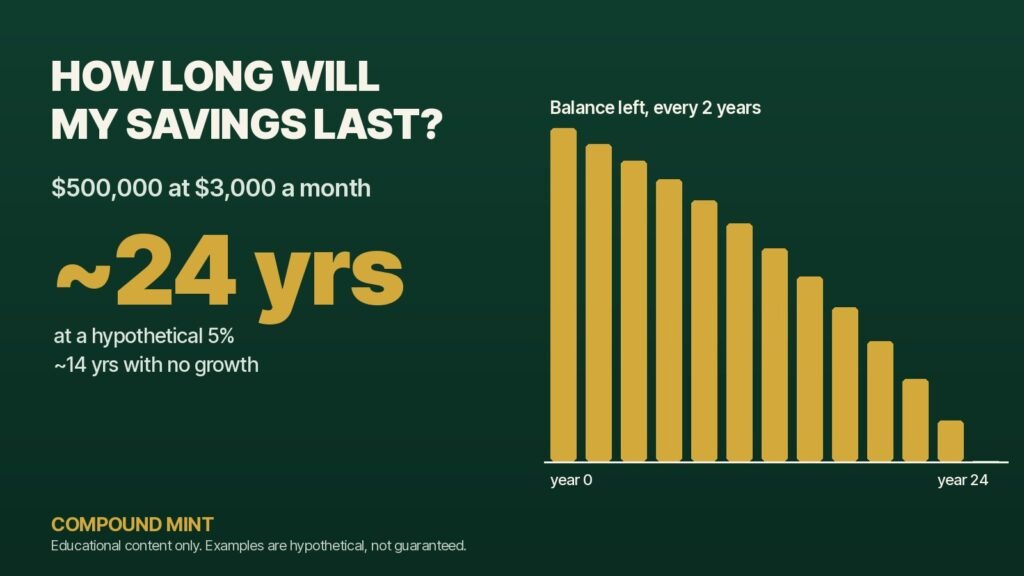
Short answer: Divide your savings by your monthly withdrawal to get the floor, then let growth stretch it. $500,000 at $3,000 a month lasts about 14 years with no growth at all, about 18 years at a hypothetical 3% return and about 24 years at 5%. If you raise the withdrawal 3% a year to keep up with inflation, the 5% case drops to about 17 years. These are hypothetical examples, not guaranteed. Educational content only. Not financial advice.
Three numbers decide how long savings last: how much you start with, how much you take out each month, and what the money earns while it waits. Inflation is the quiet fourth. Below are the tables for each, then a full worked example you can check in the calculators.
How long savings last at a hypothetical 5% return
Years until the balance reaches $0, with the same withdrawal at the end of every month and monthly compounding:
| Starting savings | $2,000/mo | $3,000/mo | $4,000/mo | $5,000/mo |
|---|---|---|---|---|
| $100,000 | 4 y 8 mo | 3 y 0 mo | 2 y 2 mo | 1 y 9 mo |
| $250,000 | 14 y 9 mo | 8 y 7 mo | 6 y 1 mo | 4 y 8 mo |
| $500,000 | Never* | 23 y 9 mo | 14 y 9 mo | 10 y 10 mo |
| $750,000 | Never* | Never* | 30 y 6 mo | 19 y 8 mo |
| $1,000,000 | Never* | Never* | Never* | 35 y 11 mo |
*”Never” means the hypothetical 5% earnings are larger than the withdrawal, so the balance does not shrink. $500,000 earns about $2,083 a month at 5%, which covers a $2,000 withdrawal. That only holds if the withdrawal never rises, which is why the inflation table below matters more.
Assumptions: withdrawals at the end of each month, a constant hypothetical yearly return compounded monthly, before taxes and fees. Real returns go up and down, and a bad stretch early on shortens these numbers. Examples are hypothetical, not guaranteed.
What the return does to the same $500,000
Same $500,000, same $3,000 a month. Only the hypothetical return changes:
| Hypothetical yearly return | Flat $3,000 a month | $3,000 rising 3% a year |
|---|---|---|
| 0% (cash under the mattress) | 13 y 11 mo | 11 y 10 mo |
| 3% | 18 y 0 mo | 14 y 2 mo |
| 5% | 23 y 9 mo | 16 y 8 mo |
| 7% | 51 y 4 mo | 20 y 11 mo |
Two lessons sit in this table. First, growth matters: going from 0% to 5% adds almost 10 years. Second, inflation takes a big bite back. A withdrawal that keeps its buying power at 3% inflation turns a 51-year run at 7% into about 21 years.
Worked example: $400,000 at $2,500 a month
Say you have $400,000 and plan to take $2,500 a month, a hypothetical 5% yearly return, compounded monthly. With no growth it would last exactly 160 months, about 13 years 4 months ($400,000 ÷ $2,500). Here is what the hypothetical 5% does, year by year:
| End of year | Flat $2,500 a month | $2,500 rising 3% a year |
|---|---|---|
| 0 | $400,000 | $400,000 |
| 5 | $343,328 | $333,348 |
| 10 | $270,598 | $219,141 |
| 15 | $177,259 | $39,338 |
| 20 | $57,472 | Ran out in year 16 |
| Runs out | about 22 years | about 16 years |
The flat plan pays out about $660,500 in total from a $400,000 start, so growth covered roughly $260,000 of it. The inflation-adjusted plan pays out about $598,200 before it runs dry, because each year’s withdrawal is bigger. Notice the balance falls slowly at first and fast at the end: in the flat plan it loses about $57,000 in the first 5 years and about $120,000 between years 15 and 20, because less money is left to earn anything.
Want a balance that never runs out? Work backward instead. The FIRE number calculator turns yearly spending into the savings target for a chosen withdrawal rate, and the compound interest calculator shows what a balance grows to before you start drawing on it.
Examples are hypothetical, not guaranteed. Taxes, fees and market swings change the real result.
The 4% rule as a shortcut
A common rule of thumb for retirement says you can take 4% of your starting balance in year one, then raise that dollar amount with inflation, and the money held up for about 30 years in historical U.S. market data. On $1,000,000 that is $40,000 a year, about $3,333 a month. In this site’s simpler model, at a constant hypothetical 5% with 3% yearly raises, that plan lasts about 36 years. The rule’s creator later updated his number; read the Bill Bengen 4.7 percent rule for the newer research, and Coast FIRE and the 4% rule for how it sets a savings target.
4 ways to make savings last longer
- Trim the withdrawal a little. On $500,000 at a hypothetical 5%, cutting $3,000 a month to $2,500 stretches about 24 years to about 36 years.
- Keep cash you need soon somewhere that pays. Money sitting at 0% runs out fastest; see how high yield savings accounts work.
- Clear high-rate debt first. Paying 22% on a card while drawing savings drains both ends; here is how to decide between paying off debt and investing.
- Plan for inflation from day one. Use the inflation column above, not the flat one, for anything longer than a few years.
Books that explain this well
- Die With Zero by Bill Perkins (affiliate link): a different view on spending your savings in retirement instead of hoarding it.
- The Simple Path to Wealth by JL Collins (affiliate link): a complete, simple index fund plan, including how to draw it down later.
- Quit Like a Millionaire by Kristy Shen and Bryce Leung (affiliate link): how one couple reached early retirement, with the withdrawal math explained.
As an Amazon Associate I earn from qualifying purchases.
Educational content only. Not financial advice. Examples are hypothetical, not guaranteed. Returns are not guaranteed and past market performance does not predict future results.
Questions people ask
How long does $1,000,000 last after retirement?
At $4,000 a month and a hypothetical 5% return, $1,000,000 lasts about 28 years if you raise the withdrawal 3% a year for inflation. At $5,000 a month with the same raises, about 21 years. With no growth at all, $4,000 a month lasts about 20 years 10 months. Examples are hypothetical, not guaranteed.
How long will $500,000 last using the 4% rule?
The 4% rule takes $20,000 in the first year from $500,000, about $1,667 a month, then raises it with inflation. It was built to last about 30 years in historical U.S. market data. In a simple model at a constant hypothetical 5% return with 3% yearly raises, it lasts about 36 years. Real results depend on market returns. Examples are hypothetical, not guaranteed.
How long can you live off the interest of $500,000?
Indefinitely, if you only spend the interest and it stays steady. At a hypothetical 4% yield, $500,000 pays about $20,000 a year, roughly $1,667 a month, without touching the principal. Inflation still shrinks what that buys each year, and yields change. Examples are hypothetical, not guaranteed.
How long will $100,000 last?
At $2,000 a month, $100,000 lasts about 4 years 2 months with no growth and about 4 years 8 months at a hypothetical 5% return. At $3,000 a month it lasts about 3 years at 5%. Smaller balances are mostly about the withdrawal, because growth has little time to help. Examples are hypothetical, not guaranteed.
How do I calculate how long my savings will last?
Start with savings divided by the monthly withdrawal: that is the number of months with no growth. With a return, the months are n = -ln(1 - P x r / W) / ln(1 + r), where P is savings, W is the monthly withdrawal and r is the monthly rate (yearly rate divided by 12). If P x r is larger than W, the balance never shrinks before inflation.
Run the numbers yourself
Compound interest calculator
“$X a month for Y years”: see exactly what it turns into, with a chart you can share.
Open calculator →$1M or…? dilemma calculator
A lump sum today vs. payments over time (or a penny doubled). The channel’s signature question, with real math.
Open calculator →S&P 500 “what if I invested” calculator
What $100 a month in an S&P 500 index fund would have grown to, using honest historical averages.
Open calculator →