
Short answer: Compare the interest rate on the debt with the return you could realistically expect from investing. Every dollar you put toward a 22% credit card earns a guaranteed 22%, which no investment reliably beats, so pay that off first. A debt near 8% is close to a tie with a hypothetical 8% return, and a low-rate debt around 4% usually lets investing come out ahead, though that gain is not guaranteed. One exception: grab any employer 401(k) match first. Educational content only. Not financial advice.
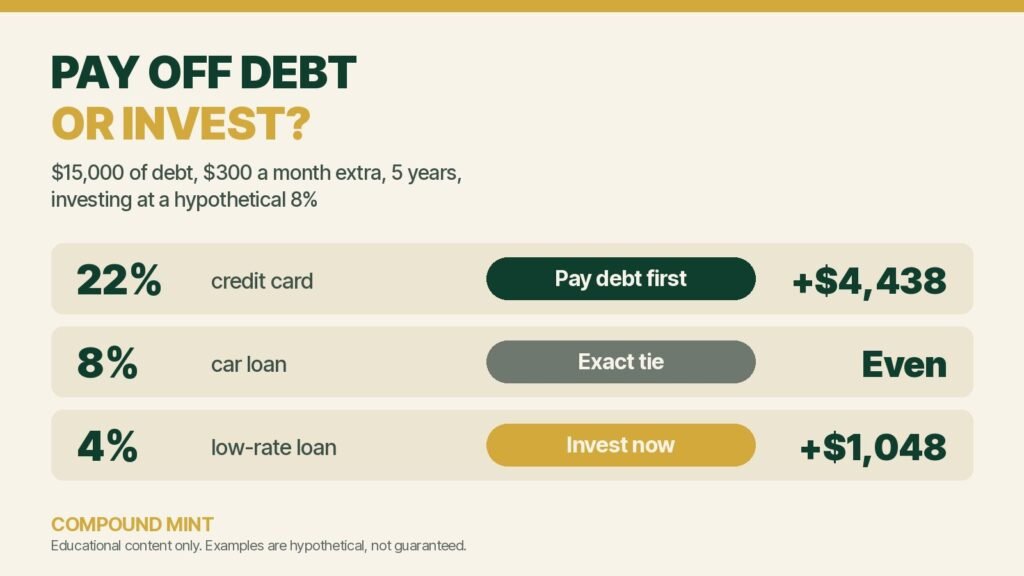
The question sounds like a values debate, but most of it is arithmetic. Paying off a debt early is a risk-free return equal to its interest rate. Investing has a higher expected return over long periods, with no promise. Put both on the same timeline and the answer usually falls out.
The rate test
Use the debt’s interest rate as the bar an investment has to clear:
| Debt rate | Typical example | Usual call |
|---|---|---|
| Above about 8% | Credit cards, personal loans | Pay it off first. The guaranteed return beats a hypothetical market return. |
| About 6% to 8% | Many car loans, some student loans | Close call. Split extra money, or lean toward paying it off if you want certainty. |
| Below about 5% | Older mortgages, low-rate student loans | Investing usually wins on paper, as long as the payment is comfortable. |
These bands line up with common guidance: Fidelity suggests that if your debt’s interest rate is 6% or higher, you should generally pay it down before investing extra money for retirement. For scale, the Federal Reserve reports that credit card accounts charged interest averaged 22.36% in August 2026, and 60-month new car loans at banks averaged 7.54%.
Worked example: $15,000 of debt and $300 a month extra
You owe $15,000 on a 5-year (60-month) payoff plan and have an extra $300 a month. Two choices, compared at the end of the same 5 years:
- Debt first: add the $300 to the payment until the debt is gone, then invest the whole payment plus the $300 every month.
- Invest now: make the regular payment for 60 months and invest the $300 every month from day one.
Investments earn a hypothetical 8% a year, compounded monthly. Both plans end debt free at month 60, so the investment balance is the whole score:
| Debt rate | Regular payment | Debt first: paid off | Interest saved | Debt first: invested at 5 y | Invest now: invested at 5 y | Winner |
|---|---|---|---|---|---|---|
| 22% | $414.28 | Month 27 | $5,742 | $26,481 | $22,043 | Debt first, by $4,438 |
| 8% | $304.15 | Month 28 | $1,796 | $22,043 | $22,043 | Exact tie |
| 4% | $276.25 | Month 28 | $858 | $20,995 | $22,043 | Invest now, by $1,048 |
Look at the middle row. When the debt rate equals the investment return, the two plans land on the same dollar. That is the whole rate test in one line. At 22% the card costs far more than the market is likely to pay, so killing it first leaves you $4,438 ahead. At 4% investing comes out about $1,048 ahead, but only if the hypothetical 8% shows up; the $858 of interest saved by paying early is certain.
The invest-now column is simply $300 a month for 60 months at 8%. Check it in the compound interest calculator, then try your own rate and amount.
Assumptions: fixed-rate debt on a 60-month amortized plan, payments and deposits at the end of each month, a constant hypothetical 8% return compounded monthly, before taxes and fees. Examples are hypothetical, not guaranteed.
Three things that change the answer
- An employer match. A match is an instant return on your contribution. If your employer adds 50 cents per dollar on the first 6% of a $60,000 salary, putting in $3,600 a year brings $1,800 of free money. Get the full match even while paying off a card; here is how the match fits the 401(k) limits.
- No emergency fund. Without cash for a surprise bill, the next emergency goes right back on the card. Build a starter cushion first, kept somewhere that pays interest; see how high yield savings accounts work.
- Taxes and the kind of debt. Interest on some student loans and mortgages can be tax deductible, which lowers the real rate a little, while investment gains in a taxable account are taxed. Federal student loans also have repayment options most debts do not; see how long it takes to pay off student debt.
A simple order that works for most people
- Pay every minimum on time.
- Build a small emergency fund.
- Collect the full employer match.
- Pay off debt above about 8%, highest rate first.
- Split extra money on debt between 5% and 8%, or pick the side that lets you sleep.
- Invest the rest and pay low-rate debt on schedule.
If you have several debts and want to see two payoff orders race each other, our video I Paid Off $18K Two Ways runs the numbers. And once the debt is gone and you are living on savings, see how long your savings will last.
Books that explain this well
- The Total Money Makeover by Dave Ramsey (affiliate link): a strict, step-by-step debt payoff plan built on the debt snowball.
- The Simple Path to Wealth by JL Collins (affiliate link): a complete, simple index fund plan, including how to draw it down later.
As an Amazon Associate I earn from qualifying purchases. Want more picks by goal? See our personal finance books and money tools.
Educational content only. Not financial advice. Examples are hypothetical, not guaranteed. Returns are not guaranteed and past market performance does not predict future results. Tax rules vary; check with a tax professional for your situation.
Questions people ask
Is it better to pay off debt or invest?
It depends on the interest rate. If the debt charges more than you could reasonably expect from investing, paying it off wins, because the saving is guaranteed. In our example, $15,000 at 22% paid off first left $4,438 more invested after 5 years than investing at a hypothetical 8%. At 4%, investing came out about $1,048 ahead, but that gain is not guaranteed.
Should I use my savings to pay off debt?
Use savings beyond your emergency fund for high-rate debt like credit cards, since that money likely earns far less than the card charges. Keep enough cash for a surprise bill first, or the next emergency can end up back on the card.
Should I invest if I have credit card debt?
Usually only enough to get a full employer 401(k) match. Credit card accounts that paid interest averaged 22.36% in August 2026 (Federal Reserve G.19), which is higher than the market can be expected to return. Paying the card off is the stronger move for most people.
Should I pay off my car loan or invest?
Car loans often sit in the close-call zone. Banks' 60-month new car loans averaged 7.54% in August 2026 (Federal Reserve G.19). Near 8%, paying off early and investing at a hypothetical 8% end up about even, so many people split extra money between the two or choose the guaranteed payoff.
Should I still contribute to my 401(k) while paying off debt?
Contribute at least enough to get the full employer match. A 50% match is an instant 50% return on those dollars, which beats paying off even a 22% card. Beyond the match, put extra money toward high-rate debt first.
Run the numbers yourself
Compound interest calculator
“$X a month for Y years”: see exactly what it turns into, with a chart you can share.
Open calculator →$1M or…? dilemma calculator
A lump sum today vs. payments over time (or a penny doubled). The channel’s signature question, with real math.
Open calculator →S&P 500 “what if I invested” calculator
What $100 a month in an S&P 500 index fund would have grown to, using honest historical averages.
Open calculator →