
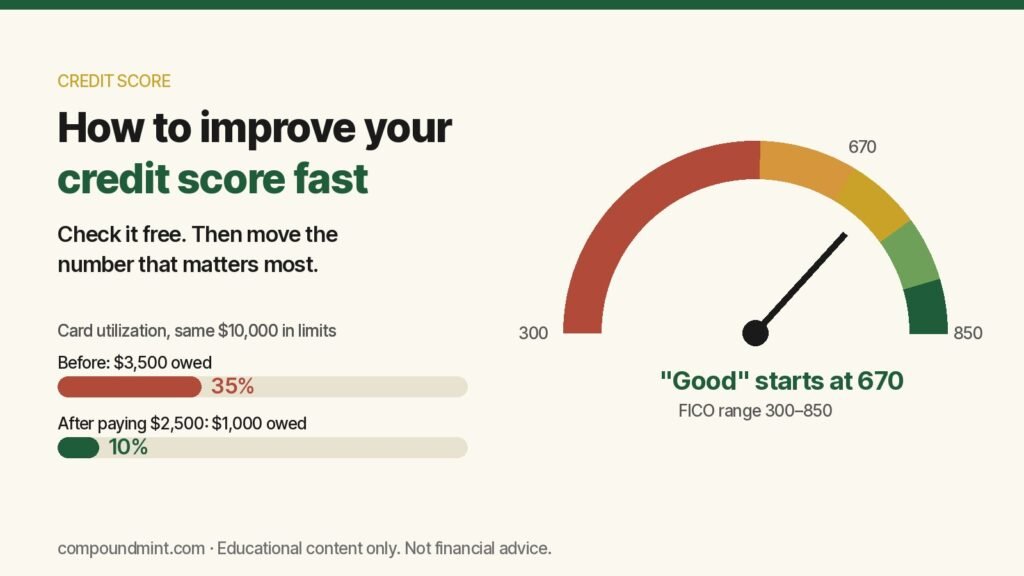
Short answer: To improve your credit score fast, pull your three credit reports for free, fix any errors, and pay your card balances down before the statement date so your utilization drops under 30% (under 10% is better). Then pay every bill on time. Dropping a $3,500 balance to $1,000 on $10,000 of limits takes utilization from 35% to 10%, and that change can show up after the next statement reports. Educational content only. Not financial advice.
Your credit score is a number from your credit reports, so the work has two halves: see what is on the reports, then change the inputs that move the score. Here is how to do both for $0, with the math on why it matters.
How to check your credit score for free
- Your 3 credit reports, free every week: Equifax, Experian and TransUnion each give you a free report every week at AnnualCreditReport.com, the site set up under federal law. Reports list your accounts, balances, limits, late payments and inquiries, but not a score.
- Your score, free: many credit card issuers and banks show a free FICO Score or VantageScore in their app or monthly statement. Check the cards you already have first.
- Checking does not hurt: looking at your own score or report is a soft inquiry. Only applications for new credit cause hard inquiries.
Check all three reports, not just one. Lenders do not all report to every bureau, so an error can sit on one report and not the others.
What is a good credit score?
| FICO Score | Rating |
|---|---|
| 800-850 | Exceptional |
| 740-799 | Very good |
| 670-739 | Good |
| 580-669 | Fair |
| 300-579 | Poor |
FICO weighs five things: payment history (35%), amounts owed (30%), length of credit history (15%), new credit (10%) and credit mix (10%). The two biggest, paying on time and how much of your limits you use, are also the two you control most this month.
7 ways to improve your credit score fast
- Pay balances down before the statement closes. Card issuers usually report the balance on your statement, not your balance after you pay. Paying early means a lower number reaches the bureaus.
- Get utilization under 30%, then under 10%. Utilization is your card balances divided by your card limits, both per card and in total. Lower is better, and people with top scores tend to stay in single digits.
- Never miss a payment again. Set autopay for at least the minimum on every account. A payment 30 or more days late can be reported and can stay on your report for up to seven years.
- Dispute errors with each bureau. A wrong late payment, a balance that is not yours or a duplicate account can all drag your score. Bureaus generally have 30 days to investigate a dispute.
- Ask for a higher limit. A higher limit with the same balance lowers utilization. Ask whether the issuer will do a hard inquiry first.
- Keep old cards open. Closing a card removes its limit (raising utilization) and, over time, can shorten your average account age.
- Pause new applications. Each hard inquiry can cost a few points; FICO counts inquiries from the last 12 months, and they stay on your report for two years.
Two more options for thin files: becoming an authorized user on a family member’s well-managed card, and services that add on-time rent, phone or utility payments to your report. Results vary by scoring model and bureau.
Worked example: utilization from 35% to 10%
Two cards with a combined $10,000 limit and $3,500 in balances. You pay $2,500 before the statement closing dates.
| Before | After | |
|---|---|---|
| Total card limits | $10,000 | $10,000 |
| Balances reported | $3,500 | $1,000 |
| Utilization | 35% | 10% |
Utilization has no long memory in most scoring models: once the lower balances report, the score can reflect them. How many points that is depends on your whole file, so treat any point estimate as a guess. Hypothetical, not guaranteed.
Why a better score is worth real money
Your score helps set the rate lenders offer. Take a $300,000, 30-year fixed mortgage at two hypothetical rates, 7.0% and 6.5%:
| Rate (hypothetical) | Monthly payment (principal + interest) | Total interest over 30 years |
|---|---|---|
| 7.0% | $1,995.91 | $418,527 |
| 6.5% | $1,896.20 | $382,633 |
| Difference | $99.71 a month | about $35,900 |
Half a percentage point on one loan is about $35,900 over its life in this example. Run your own loan in the 15 vs 30 year mortgage calculator. Rates are hypothetical, not quotes; the rate you are offered depends on your lender, loan and full credit profile.
How long does it take to improve your credit score?
| What you change | When it can show |
|---|---|
| Lower card balances | After the next statement reports, often within 30-45 days |
| Corrected report error | Usually within about a month of the dispute |
| New on-time payment history | Builds month by month |
| A past late payment | Fades over time; can stay on the report up to 7 years |
Educational content only. Not financial advice. Examples are hypothetical, not guaranteed. Scoring models, bureau rules and lender cutoffs vary and change; check the current terms with your card issuer, lender and the credit bureaus.
Questions people ask
How can I raise my credit score fast?
The fastest lever for most people is credit card utilization: pay balances down before the statement closing date so a lower balance is reported. Correcting a wrong late payment or balance on your report can also help within a month or two. Paying on time every month protects the biggest factor.
Does checking my own credit score lower it?
No. Checking your own score or report is a soft inquiry and does not affect your score. Hard inquiries come from applying for new credit, such as a card or loan.
How can I check my credit score for free?
Get your credit reports free every week from Equifax, Experian and TransUnion at AnnualCreditReport.com. For the score itself, many credit card issuers and banks show a free FICO Score or VantageScore in their app or statement.
What is a good credit score?
On the FICO scale of 300 to 850, 670 to 739 is considered good, 740 to 799 very good and 800 or higher exceptional. Lenders set their own cutoffs, so the score that gets the best rate differs by loan.
How long does it take to rebuild credit?
Lower utilization can show up after the next statement reports, often within 30 to 45 days. A corrected error can show within about a month of the dispute. A late payment stays on your report for up to seven years, though its effect fades as you add months of on-time payments.
Run the numbers yourself
Compound interest calculator
“$X a month for Y years”: see exactly what it turns into, with a chart you can share.
Open calculator →$1M or…? dilemma calculator
A lump sum today vs. payments over time (or a penny doubled). The channel’s signature question, with real math.
Open calculator →S&P 500 “what if I invested” calculator
What $100 a month in an S&P 500 index fund would have grown to, using honest historical averages.
Open calculator →