
Short answer: A backdoor Roth IRA is a two-step move, not a separate account: you put after-tax money into a Traditional IRA, then convert it to a Roth IRA. It exists because Roth IRAs have an income limit for direct contributions but conversions do not, so people who earn too much for a Roth can still end up with one. Done cleanly, $7,000 a year for 25 years at 8% grows to about $554,800 that you can later withdraw tax-free. Hypothetical, not guaranteed. Educational content only. Not financial advice.
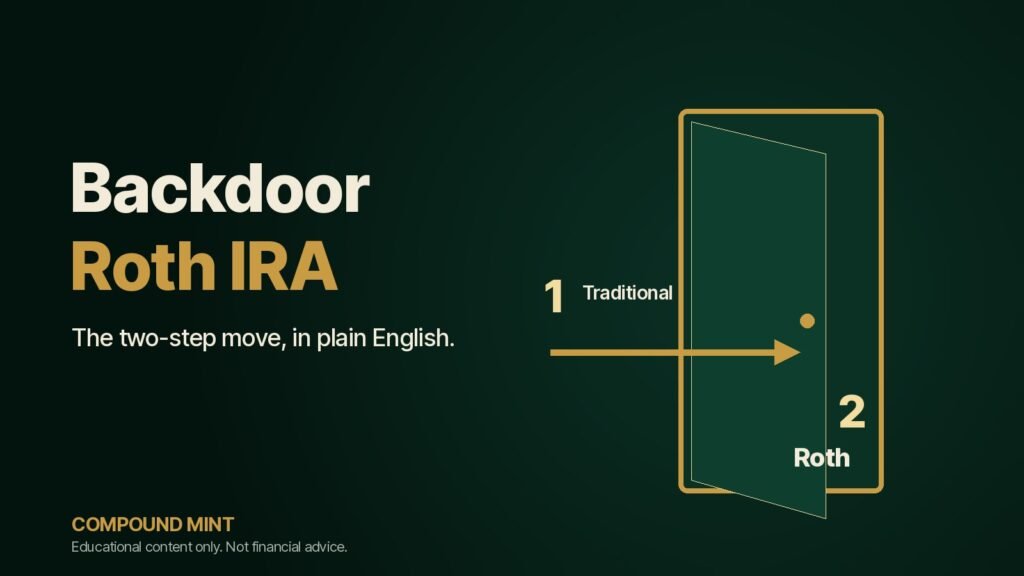
The name sounds like a loophole. In practice it is a well-known, widely used route that follows two ordinary IRS rules. Here is what it is, who it is for, and the one trap that catches people.
How does a backdoor Roth IRA work?
- Contribute to a Traditional IRA. Anyone with earned income can contribute, whatever their income. Above certain income levels the contribution is not tax-deductible, so you are putting in money you already paid tax on (a “nondeductible” contribution).
- Convert it to a Roth IRA. There is no income limit on conversions. Because the money was already taxed, converting it usually triggers little or no new tax, apart from any growth between the two steps.
The result looks the same as a direct Roth contribution: money that grows untaxed and, once qualified, comes out tax-free in retirement. The contribution limit is the regular IRA limit, and the income limits for direct Roth contributions change most years, so check the current year’s IRS figures before you act.
Who uses a backdoor Roth?
People whose income is above the Roth IRA limit, typically higher earners and dual-income couples. If your income is under the limit, you do not need the backdoor; you can contribute to a Roth IRA directly. Not sure which kind of IRA fits you at all? Start with which is better: Roth IRAs vs. Traditional IRAs.
Worked example: what the backdoor is worth
Say you move $7,000 a year ($583.33 a month) through the backdoor for 25 years, earning a hypothetical 8% a year, compounded monthly. Compare that with putting the same money in an ordinary taxable brokerage account:
| Backdoor Roth | Taxable account | |
|---|---|---|
| You put in | $175,000 | $175,000 |
| Balance after 25 years | $554,765 | $554,765 |
| Growth | $379,765 | $379,765 |
| Tax on the growth at 15% when you sell | $0 | $56,965 |
| Yours to spend | $554,765 | $497,801 |
The backdoor keeps about $57,000 more in this example, and that is the conservative version: it ignores the yearly tax on dividends in a taxable account and any state tax, both of which would widen the gap. Try your own amount, rate and years in the compound interest calculator. All projected balances are hypothetical, not guaranteed.
Assumptions: end-of-month deposits, 8% nominal annual return compounded monthly, a 15% long-term capital-gains rate applied once at the end, no fees. Real returns vary and can be negative. Examples are hypothetical, not guaranteed.
The trap: the pro-rata rule
When you convert, the IRS does not let you pick only the after-tax dollars. It looks at all your Traditional, SEP and SIMPLE IRA money together and treats each conversion as a proportional mix of taxed and untaxed dollars.
| No other IRA money | $63,000 already in a pre-tax IRA | |
|---|---|---|
| New after-tax contribution | $7,000 | $7,000 |
| Total IRA money | $7,000 | $70,000 |
| Share that is after-tax | 100% | 10% |
| Taxable part of a $7,000 conversion | $0 | $6,300 |
| Extra tax at a 32% rate | $0 | $2,016 |
That is why the backdoor works cleanly for people with no other pre-tax IRA balances, and gets messy for people with an old rollover IRA. Some people move pre-tax IRA money into a workplace 401(k) first, if their plan accepts it. The rules here are detailed and the paperwork matters, so this is a good moment to talk to a tax professional.
Is it worth the hassle?
For someone who cannot contribute to a Roth directly, has no other pre-tax IRA money and already gets any employer 401(k) match, the backdoor is one of the few remaining ways to add tax-free growth. The bigger lever is still time: how compound interest works shows why ten extra years usually beats any tax trick. If you are just getting started, how to invest $100 a month covers the order of accounts most beginners use. To see what a steady monthly amount becomes, open the compound interest calculator.
Educational content only. Not financial advice. Examples are hypothetical, not guaranteed. IRA limits and income thresholds change; check the current year’s IRS figures, and ask a tax professional before converting.
Questions people ask
What is the downside to a backdoor Roth?
The main one is the pro-rata rule: if you hold other pre-tax money in Traditional, SEP or SIMPLE IRAs, part of your conversion becomes taxable. It also takes two steps and extra tax paperwork, and mistakes can cost money. A tax professional can check your situation.
Can I do a backdoor Roth if I make $500,000 a year?
Yes. Conversions have no income limit, which is exactly why the backdoor exists. The contribution is still capped at the regular annual IRA limit; check the current year's IRS figures.
Is the backdoor Roth still legal?
Yes, under current law. It combines two allowed steps: a nondeductible Traditional IRA contribution and a Roth conversion. Lawmakers have proposed limiting it in the past, so check current rules before you rely on it.
Do you pay tax on a backdoor Roth conversion?
Usually little or none if the money was already taxed and you have no other pre-tax IRA balances. Any growth before the conversion, and any pre-tax IRA money pulled in by the pro-rata rule, is taxable.
Run the numbers yourself
Compound interest calculator
“$X a month for Y years”: see exactly what it turns into, with a chart you can share.
Open calculator →$1M or…? dilemma calculator
A lump sum today vs. payments over time (or a penny doubled). The channel’s signature question, with real math.
Open calculator →S&P 500 “what if I invested” calculator
What $100 a month in an S&P 500 index fund would have grown to, using honest historical averages.
Open calculator →