
Short answer: A dollar doubled every day for a year is $536,870,912 on day 30 and about 3.76 × 10109 dollars on day 365, a number 110 digits long. A penny doubled every day for 30 days is $5,368,709.12 (we count $1 or 1¢ on day 1, so day 30 is 29 doublings and day 365 is 364). No real investment does this. At a hypothetical 8% a year, $1 becomes $1.08 after a year and takes about 9 years to double once. Educational content only. Not financial advice.
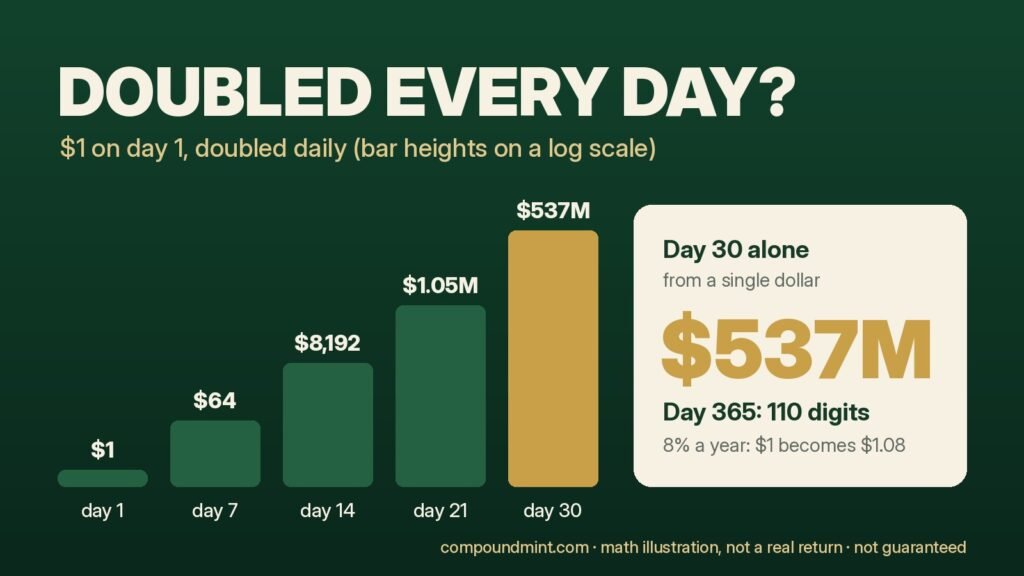
The “$1 doubled every day for a year” puzzle is a great way to feel how fast exponential growth runs away from you. It is also a great way to get the wrong idea about investing. Here is the full math, day by day, and then what doubling looks like with returns you could actually expect.
The math: day by day
We count the way most versions of the puzzle do: you hold $1 (or 1¢) on day 1, and the amount doubles overnight. So day n holds $1 × 2n−1. (If you count 365 doublings after day 1 instead, every day-365 figure below doubles again.)
| Day | Start with $1 | Start with a penny |
|---|---|---|
| 1 | $1 | $0.01 |
| 7 | $64 | $0.64 |
| 10 | $512 | $5.12 |
| 14 | $8,192 | $81.92 |
| 20 | $524,288 | $5,242.88 |
| 21 | $1,048,576 (first day over $1M) | $10,485.76 |
| 28 | $134,217,728 | $1,342,177.28 (first day over $1M) |
| 30 | $536,870,912 | $5,368,709.12 |
| 31 | $1,073,741,824 (first day over $1B) | $10,737,418.24 |
| 60 | about $5.76 × 10¹⁷ | about $5.76 × 10¹⁵ |
| 100 | about $6.34 × 1029 | about $6.34 × 1027 |
| 365 | about $3.76 × 10109 (110 digits) | about $3.76 × 10107 (108 digits) |
Two things jump out. First, the dollar passes a million in just three weeks (day 21) and a billion on day 31. Second, each day holds slightly more than every earlier day combined: on day 365 the balance is one dollar more than days 1 through 364 added together. That is the signature of doubling, and it is why the end of any doubling story feels so sudden.
The penny version runs exactly 100 times smaller, which costs it almost 7 doublings: it reaches $1 million on day 28, a week behind the dollar. For the 30-day version of the penny puzzle, see $1 million or a penny doubled for 30 days.
Worked example: doubling at a realistic speed
Doubling every day is a 100% return per day. Nothing you can buy does that. To see the same shape at a believable speed, use a hypothetical 8% average yearly return, compounded once a year:
| Years at 8% | $1 becomes | $1,000 becomes |
|---|---|---|
| 1 | $1.08 | $1,080 |
| 9 | $2.00 (one doubling) | $1,999 |
| 10 | $2.16 | $2,159 |
| 30 | $10.06 | $10,063 |
| 45 | $31.92 (about 5 doublings) | $31,920 |
At 8%, one doubling takes about 9 years (the exact figure is 9.0 years; the Rule of 72 gives 72 ÷ 8 = 9). The puzzle’s 364 doublings would take about 3,278 years at that speed. A 45-year working life gets you roughly 5 doublings, so $1 becomes about $32.
That still adds up. Investing $100 a month for 30 years at a hypothetical 8% (end-of-month deposits, monthly compounding) grows to about $149,036 from $36,000 of deposits. Try your own numbers in the compound interest calculator.
Assumptions: constant returns, no taxes, fees or inflation. Real returns vary from year to year and can be negative. Examples are hypothetical, not guaranteed.
Why daily doubling isn’t a real return
- It runs out of room. By day 60 the dollar is about $576 quadrillion (259 dollars). Nothing can keep absorbing growth at that pace, so it has to slow down long before.
- Real growth has a cost. Every return comes from a business earning profits, a borrower paying interest, or an asset rising in price. None of those can double daily for long.
- Offers that sound like this are a red flag. Anyone promising money that doubles in days or weeks is describing a scam, not an investment.
The lesson worth keeping is the shape of the curve: slow, then sudden. In a hypothetical plan of $100 a month at 8%, the balance is about $149,036 after 30 years and about $349,101 after 40, so the last 10 years add about $200,065, more than the first 30 years combined. More on that in how compound interest works and simple interest vs compound interest.
For realistic doubling times at different returns, see how to double your money with the Rule of 72.
What to do with this
You can’t double a dollar a day, but you can give your money more doublings by starting earlier. Even small amounts count; see how to invest $100 a month, then plug your own amount, rate and years into the compound interest calculator.
Books that explain this well
- The Psychology of Money by Morgan Housel (affiliate link): short chapters on why behavior and time matter more than picking winners.
As an Amazon Associate I earn from qualifying purchases.
Educational content only. Not financial advice. Examples are hypothetical, not guaranteed.
Questions people ask
How much is $1 doubled every day for a year?
Counting $1 on day 1, day 365 holds $1 x 2^364, about 3.76 x 10^109 dollars, a number 110 digits long. If you count 365 doublings instead, it is twice that, about 7.5 x 10^109. It is a math illustration; no real investment grows like this.
How much is a penny doubled every day for a year?
Starting with 1 cent on day 1, day 365 holds about 3.76 x 10^107 dollars (108 digits). Along the way the penny is $5.12 on day 10, $5,242.88 on day 20, $1,342,177.28 on day 28 and $5,368,709.12 on day 30.
How many days does it take for $1 doubled every day to reach $1 million?
21 days. Starting with $1 on day 1, day 21 holds $1,048,576. It passes $1 billion on day 31 ($1,073,741,824). A penny needs 28 days to pass $1 million.
How long does it take money to double at 8% a year?
About 9 years. The Rule of 72 gives 72 / 8 = 9, and the exact figure at 8% compounded yearly is 9.0 years. At that pace, $1 becomes about $10.06 in 30 years and about $31.92 in 45 years. Hypothetical, not guaranteed.
Can money really double every day?
No. Doubling daily is a 100% return per day; by day 60 a single dollar would be about $576 quadrillion. Real investments grow far slower and can lose value. Any offer promising money that doubles in days is a red flag for a scam.
How much is a dollar doubled every day for 30 days?
Counting $1 on day 1, day 30 holds $1 x 2^29 = $536,870,912. A penny on the same schedule is $5,368,709.12. If you count 30 doublings after day 1 instead, both figures double: $1,073,741,824 and $10,737,418.24.
Run the numbers yourself
Compound interest calculator
“$X a month for Y years”: see exactly what it turns into, with a chart you can share.
Open calculator →$1M or…? dilemma calculator
A lump sum today vs. payments over time (or a penny doubled). The channel’s signature question, with real math.
Open calculator →S&P 500 “what if I invested” calculator
What $100 a month in an S&P 500 index fund would have grown to, using honest historical averages.
Open calculator →