
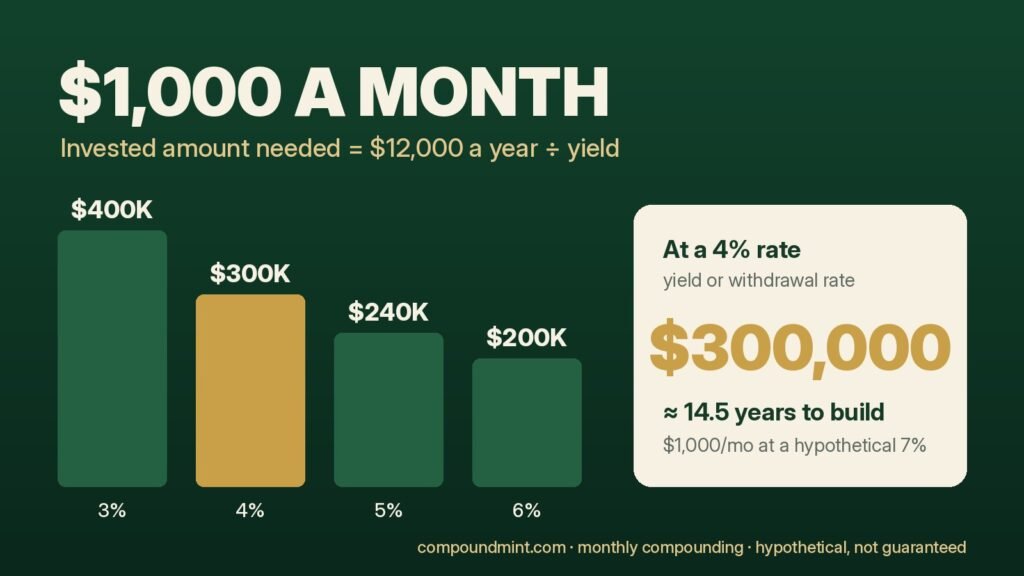
Short answer: $1,000 a month is $12,000 a year, so divide $12,000 by the yearly rate your money pays out. At 4% you need about $300,000 invested; at 3%, $400,000; at 5%, $240,000. Building $300,000 from zero with $1,000 a month at a hypothetical 7% a year takes about 14.5 years. Before tax, hypothetical, not guaranteed. Educational content only. Not financial advice.
“How much do I need to invest to make $1,000 a month?” has a one-line formula behind it. The hard part is picking an honest rate, remembering taxes and inflation, and knowing how long it takes to build the pot. Here is all of it.
The formula: $12,000 ÷ your rate
Amount needed = yearly income you want ÷ yearly payout rate. For $1,000 a month, that is $12,000 ÷ rate. The rate can be an interest rate, a dividend yield, or a withdrawal rate you plan to take from a portfolio.
| Yearly rate (hypothetical) | Invested amount needed | Income per year |
|---|---|---|
| 2% | $600,000 | $12,000 |
| 3% | $400,000 | $12,000 |
| 4% | $300,000 | $12,000 |
| 5% | $240,000 | $12,000 |
| 6% | $200,000 | $12,000 |
| 8% | $150,000 | $12,000 |
Why 4% is the usual planning number: it comes from the “4% rule,” based on William Bengen’s research (Journal of Financial Planning, October 1994) on historical US stock and bond returns, which found that withdrawals starting at 4% of a portfolio, raised each year for inflation, lasted at least 30 years in every period he studied. It is a rule of thumb, not a promise. We break it down in Coast FIRE and the 4% rule.
Rates on savings accounts, bonds and dividends change all the time, so plug in today’s rate rather than a number from an article. If the money sits in cash, see how high-yield savings accounts work.
Worked example: building the $300,000
Inputs: a $300,000 goal (the 4% number), deposits at the end of each month, a hypothetical 7% average yearly return after inflation, compounded monthly, no taxes or fees. This is the same math the FIRE number calculator uses, so you can rerun it with your own numbers.
| You invest per month | Starting from $0 | Starting from $50,000 |
|---|---|---|
| $500 | about 21 years 7 months | 15 years |
| $1,000 | about 14 years 6 months | about 10 years 10 months |
| $1,500 | about 11 years 1 month | about 8 years 7 months |
| $2,000 | about 9 years 1 month | about 7 years 1 month |
Two takeaways: doubling your monthly amount from $500 to $1,000 cuts about 7 years off, and a $50,000 head start saves anywhere from about 2 years (at $2,000 a month) to about 6½ years (at $500 a month). Because the return here is after inflation, the $300,000 and the $1,000 a month are both in today’s dollars.
Assumptions: end-of-month deposits, monthly compounding at a constant 7% real return, no taxes or fees. Real markets go up and down. Examples are hypothetical, not guaranteed.
Three things that change the number
1. Taxes
Interest, dividends and most retirement-account withdrawals can be taxed. To keep $1,000 a month after a hypothetical 15% tax, you need about $1,176 a month before tax, which takes about $352,941 at 4% (or about $470,588 at 3%). Roth accounts can help here; see Roth IRA vs traditional IRA.
2. Inflation
A fixed $1,000 a month buys less every year. At a hypothetical 3% inflation rate, $1,000 in 25 years buys what about $478 buys today, and you would need about $2,094 a month to match today’s $1,000. That is why the worked example above uses a return after inflation.
3. Spending the principal too
If you are willing to draw the pot down, you need less. Withdrawing $1,000 at the end of each month, with the rest earning a hypothetical 5% a year:
- $240,000 lasts indefinitely (5% of $240,000 is exactly $12,000 a year, so the balance never shrinks).
- $200,000 lasts about 35 years 11 months.
- $150,000 lasts about 19 years 8 months.
At 4% instead, $200,000 lasts about 27 years 7 months. Hypothetical, not guaranteed.
How to get started
Start with the monthly amount you can automate, then let time do the work; how to start investing money walks through the order of steps. To watch a monthly amount grow year by year, open the compound interest calculator, and to set your own income goal, use the FIRE number calculator.
Educational content only. Not financial advice. Examples are hypothetical, not guaranteed. Taxes, rates and account rules vary; check current figures for your situation.
Questions people ask
How much do I need to invest to make $1,000 a month in dividends?
Divide $12,000 by the portfolio's dividend yield. At a 3% yield that is $400,000; at 4%, $300,000. Yields change and dividends can be cut, so use the current yield of what you actually hold. Before tax, hypothetical, not guaranteed.
How much money do I need to make $1,000 a month in interest?
$12,000 a year divided by the interest rate: about $300,000 at 4%, $400,000 at 3% or $240,000 at 5%. Savings and CD rates move with the market, so the amount needed rises when rates fall. Interest is usually taxable.
Is $300,000 enough to make $1,000 a month?
At a 4% yearly rate, yes: 4% of $300,000 is $12,000 a year, or $1,000 a month before tax. That is the 4% rule of thumb from William Bengen's 1994 research. It is a planning guide, not a guarantee.
How long does it take to build $300,000 investing $1,000 a month?
About 14 years 6 months from $0, at a hypothetical 7% average yearly return after inflation, compounded monthly. At $500 a month it takes about 21 years 7 months; at $2,000 a month, about 9 years 1 month. Hypothetical, not guaranteed.
How much do I need to make $1,000 a month after taxes?
More than the pre-tax figure. Assuming a hypothetical 15% tax rate, you need about $1,176 a month before tax, which takes about $352,941 at a 4% rate. Your real rate depends on the account type and your tax bracket.
Run the numbers yourself
Compound interest calculator
“$X a month for Y years”: see exactly what it turns into, with a chart you can share.
Open calculator →$1M or…? dilemma calculator
A lump sum today vs. payments over time (or a penny doubled). The channel’s signature question, with real math.
Open calculator →S&P 500 “what if I invested” calculator
What $100 a month in an S&P 500 index fund would have grown to, using honest historical averages.
Open calculator →