
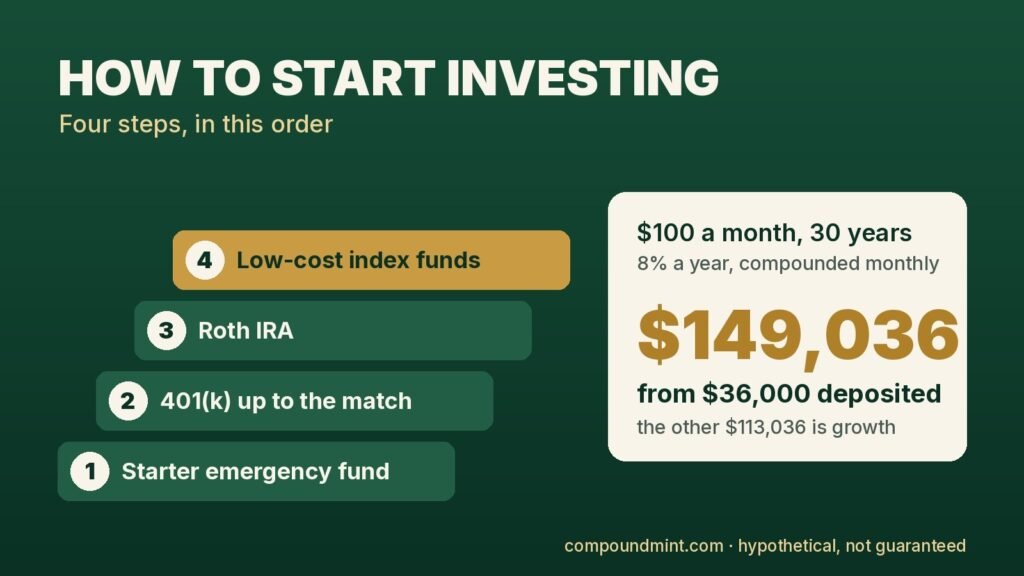
Short answer: To start investing money, do four things in order: build a small emergency fund (and clear high-interest debt), put enough in your 401(k) to get the full employer match, open a Roth or traditional IRA, and buy low-cost, broad index funds automatically every month. You can start with very little: $100 a month for 30 years at a hypothetical 8% a year grows to about $149,036, from $36,000 of deposits. Hypothetical, not guaranteed. Educational content only. Not financial advice.
Investing is simpler than it looks from the outside. You do not need to pick stocks, time the market or have a big lump sum. You need an order of operations and a monthly habit.
How to start investing money: 4 steps
- Build a starter emergency fund, and clear high-interest debt. Even one month of expenses in a high-yield savings account keeps a car repair from becoming credit card debt. Paying off a card that charges over 20% a year is a guaranteed return no investment reliably beats.
- Get the full 401(k) match. If your employer matches contributions, contribute at least enough to get all of it. A 3% match on a $60,000 salary is $1,800 a year ($150 a month) of extra money; invested for 30 years at a hypothetical 8%, that is about $223,554.
- Open an IRA. A Roth IRA (pay tax now, tax-free later) or a traditional IRA (tax break now, taxed later). Our Roth vs traditional IRA guide shows how to choose. Check the current year’s IRS contribution limits before you contribute.
- Buy broad, low-cost index funds, automatically. A total-market or S&P 500 index fund owns hundreds or thousands of companies in one purchase. Set an automatic monthly transfer and investment so you do not have to decide every month. The step-by-step version is in how to invest $100 a month.
Worked example: what a monthly habit becomes
Inputs: a fixed amount invested at the end of each month, a hypothetical 8% average yearly return compounded monthly, before taxes and fees.
| Monthly | 10 years | 20 years | 30 years | Deposited over 30 years |
|---|---|---|---|---|
| $100 | $18,295 | $58,902 | $149,036 | $36,000 |
| $250 | $45,737 | $147,255 | $372,590 | $90,000 |
| $500 | $91,473 | $294,510 | $745,180 | $180,000 |
Two things jump out. First, at 30 years about three-quarters of the balance is growth, not deposits. Second, waiting costs a lot: $100 a month for 20 years is about $58,902, versus $149,036 for 30 years. At a lower 5% return, the 30-year $100-a-month figure would be about $83,226. All of these are hypothetical, not guaranteed.
Try your own numbers in the compound interest calculator (it opens on the $100 a month example above).
Assumptions: end-of-month deposits, monthly compounding at the stated yearly rate, a constant return, no taxes, fees or inflation. Real markets rise and fall, sometimes sharply. Examples are hypothetical, not guaranteed.
Where should a beginner actually invest?
- Account: your workplace 401(k) for the match, then an IRA at a major brokerage. A regular (taxable) brokerage account comes after those.
- Investment: broad index funds or a target-date fund. Both spread your money across many companies, which lowers the risk of any single stock.
- Costs: look at the expense ratio. A fund charging 0.05% a year costs $5 per $10,000 invested; a 1% fund costs $100. Over decades that gap compounds too.
- Time frame: money you need within a few years belongs in savings, not stocks. Investing is for goals five or more years away.
Common beginner mistakes
- Waiting for the “right time.” Steady monthly investing (dollar-cost averaging) removes the guesswork.
- Selling after a drop. Falls are normal; selling locks them in.
- Chasing hot stocks or tips. Concentrated bets can go to zero; index funds cannot single-handedly do that.
- Ignoring fees. High fees quietly take a share of every year’s growth.
Not sure if you are on track for your age? See how much money you should have saved by 30, and why time beats amount in simple vs compound interest. Then run your plan in the compound interest calculator.
Educational content only. Not financial advice. Examples are hypothetical, not guaranteed. Investing involves risk, including loss of money. Check the current year’s IRS figures for 401(k) and IRA limits.
Questions people ask
How to start investing money as a beginner?
Build a small emergency fund, get your full 401(k) match, open a Roth or traditional IRA, and invest in low-cost broad index funds with an automatic monthly contribution. Start with any amount; consistency matters more than size. Educational content only, not financial advice.
How much money do I need to start investing?
Very little. Many brokerages have no account minimum and let you buy fractional shares, so you can start with a few dollars. As a hypothetical example, $100 a month for 30 years at 8% a year grows to about $149,036. Hypothetical, not guaranteed.
Where should I start investing as a beginner?
Usually your employer's 401(k) up to the match, then an IRA at a major brokerage, holding a broad index fund or a target-date fund. A taxable brokerage account comes after those.
How much money do I need to invest to make $1,000 a month?
Using the 4% rule of thumb, about $300,000: 4% of $300,000 is $12,000 a year, or $1,000 a month. That is a planning rule, not a guarantee; returns and withdrawals can vary.
Is it better to save or invest?
Both. Save first for emergencies and goals a few years away, then invest money for goals five or more years out. Savings protect you from short-term surprises; investing has historically grown faster over long periods, with more ups and downs.
Run the numbers yourself
Compound interest calculator
“$X a month for Y years”: see exactly what it turns into, with a chart you can share.
Open calculator →$1M or…? dilemma calculator
A lump sum today vs. payments over time (or a penny doubled). The channel’s signature question, with real math.
Open calculator →S&P 500 “what if I invested” calculator
What $100 a month in an S&P 500 index fund would have grown to, using honest historical averages.
Open calculator →