
Short answer: 7 figures is any amount from $1,000,000 to $9,999,999: seven digits before the decimal point. So a “7-figure salary” means at least $1 million a year, and a “7-figure net worth” means you own at least $1 million more than you owe. 6 figures starts at $100,000; 8 figures starts at $10,000,000.
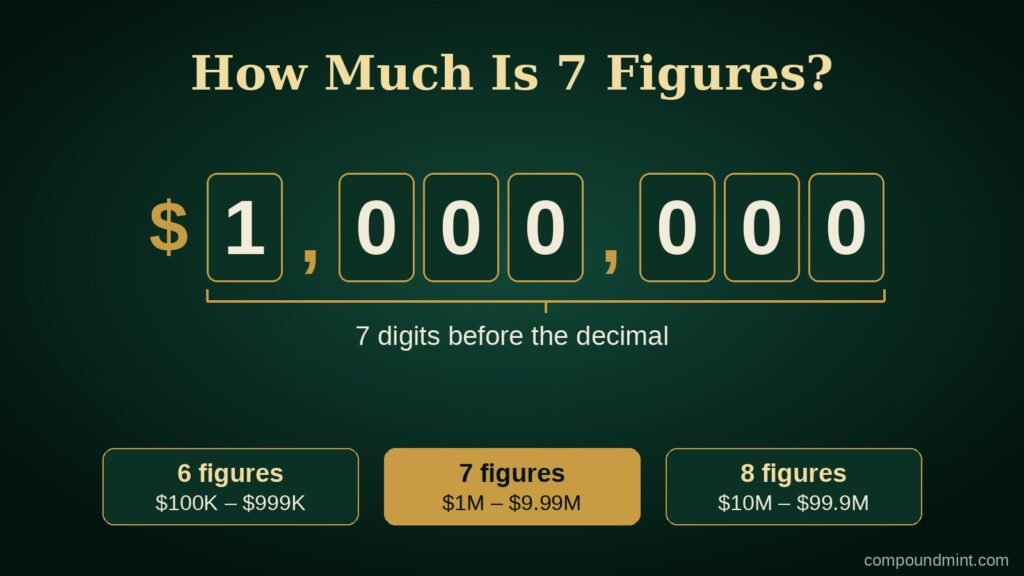
“Figures” just means digits. You count the digits to the left of the decimal point and ignore the cents, so $1,000,000.00 is 7 figures and $999,999.99 is still 6. Here is the full ladder, what people usually mean when they say it, and how long it takes to get there with a monthly investment.
How many figures is each amount?
| Figures | Range | Example |
|---|---|---|
| 4 figures | $1,000 to $9,999 | $4,500 |
| 5 figures | $10,000 to $99,999 | $62,000 |
| 6 figures | $100,000 to $999,999 | $250,000 |
| 7 figures | $1,000,000 to $9,999,999 | $1,500,000 |
| 8 figures | $10,000,000 to $99,999,999 | $25,000,000 |
| 9 figures | $100,000,000 to $999,999,999 | $400,000,000 |
A quick way to remember it: every extra figure is ten times more money. One million has six zeros plus the 1, which makes seven digits.
You will also hear “low,” “mid” and “high” 7 figures. There is no official cut-off, but in everyday use low 7 figures usually means roughly $1 million to $3 million, mid 7 figures about $4 million to $6 million, and high 7 figures $7 million up to just under $10 million.
7 figures of what? Salary, net worth or revenue
The number of digits is simple; what the number measures is where people get confused.
- 7-figure salary or income: $1,000,000 or more per year. That works out to about $83,333 a month, about $19,231 a week, or about $481 an hour over a 2,080-hour work year, before tax.
- 7-figure net worth: assets minus debts of at least $1,000,000. A $1.2 million house with a $700,000 mortgage counts as $500,000 toward net worth, not $1.2 million. This is the usual definition of a millionaire.
- 7-figure business: usually means $1 million or more in yearly revenue (sales), not profit. A business that sells $1,000,000 a year at a 10% profit margin keeps about $100,000, which is a 6-figure profit.
So “7 figures” on a business ad and “7 figures” in a retirement account can be very different amounts of money in your pocket.
Worked example: how long to reach 6, 7 and 8 figures
Inputs: you start from $0, invest the same amount at the end of every month, and earn a hypothetical 8% average yearly return, compounded monthly, with no taxes or fees. The same math powers the millionaire calculator, so you can rerun it with your own age and rate.
| Goal | $500 a month | $1,000 a month |
|---|---|---|
| 6 figures ($100,000) | 10 years 8 months | 6 years 5 months |
| 7 figures ($1,000,000) | 33 years 5 months | 25 years 7 months |
| 8 figures ($10,000,000) | 61 years 6 months | 52 years 11 months |
At $500 a month, the first $100,000 takes almost 11 years, but the jump from 6 to 7 figures (ten times more money) takes only about 23 more years, because by then growth is doing most of the work. Of the roughly $1,002,000 you would have after 33 years 5 months, only $200,500 is money you put in; the other $801,500 or so is compound growth. For more on why the curve bends upward, see how compound interest works.
Assumptions: end-of-month deposits, monthly compounding at a constant 8% yearly return, no taxes, fees or inflation. Real markets go up and down. Examples are hypothetical, not guaranteed.
What it takes to hit 7 figures by 65
Flip the question around: how much would you need to invest each month to reach $1,000,000 by age 65? Same assumptions, hypothetical 8% a year, starting from $0:
| Start at age | Monthly amount needed | Total you put in |
|---|---|---|
| 25 | about $286 | about $137,500 |
| 30 | about $436 | about $183,100 |
| 35 | about $671 | about $241,600 |
| 40 | about $1,052 | about $315,400 |
| 45 | about $1,698 | about $407,500 |
Waiting from 25 to 45 makes the monthly amount almost six times bigger. Hypothetical, not guaranteed. Try your own numbers in the millionaire calculator, or watch a monthly amount grow year by year in the compound interest calculator.
Inflation matters here too: $1 million in 30 or 40 years will buy less than $1 million buys today. To plan in today’s dollars, use a lower, after-inflation rate in the calculator.
Where to go from here
If 7 figures is the long-term goal, the first milestones are the 5- and 6-figure ones. See how much money you should have saved by 30 for a realistic checkpoint, and how to start investing money for the order of steps (emergency fund, employer match, Roth IRA, index fund).
Educational content only. Not financial advice. Examples are hypothetical, not guaranteed. Returns, taxes and account rules vary; check current figures for your situation.
Questions people ask
Is 7 figures a million?
Yes. 7 figures means any amount from $1,000,000 to $9,999,999, because $1,000,000 has seven digits before the decimal point. $999,999 is the largest 6-figure amount.
How much is 6 figures?
6 figures is any amount from $100,000 to $999,999. A 6-figure salary means you earn at least $100,000 a year before tax.
What is a 7-figure salary?
A salary of $1,000,000 or more a year. That is about $83,333 a month or about $481 an hour over a 2,080-hour work year, before tax.
Is $1.5 million 7 figures?
Yes. $1,500,000 has seven digits, so it is 7 figures (often called low 7 figures). Anything from $1,000,000 up to $9,999,999 counts.
How much is 8 figures?
8 figures is $10,000,000 to $99,999,999. At a hypothetical 8% a year, $1,000,000 left alone with no new deposits takes about 29 years to grow to 8 figures. Hypothetical, not guaranteed.
Run the numbers yourself
Compound interest calculator
“$X a month for Y years”: see exactly what it turns into, with a chart you can share.
Open calculator →$1M or…? dilemma calculator
A lump sum today vs. payments over time (or a penny doubled). The channel’s signature question, with real math.
Open calculator →S&P 500 “what if I invested” calculator
What $100 a month in an S&P 500 index fund would have grown to, using honest historical averages.
Open calculator →