
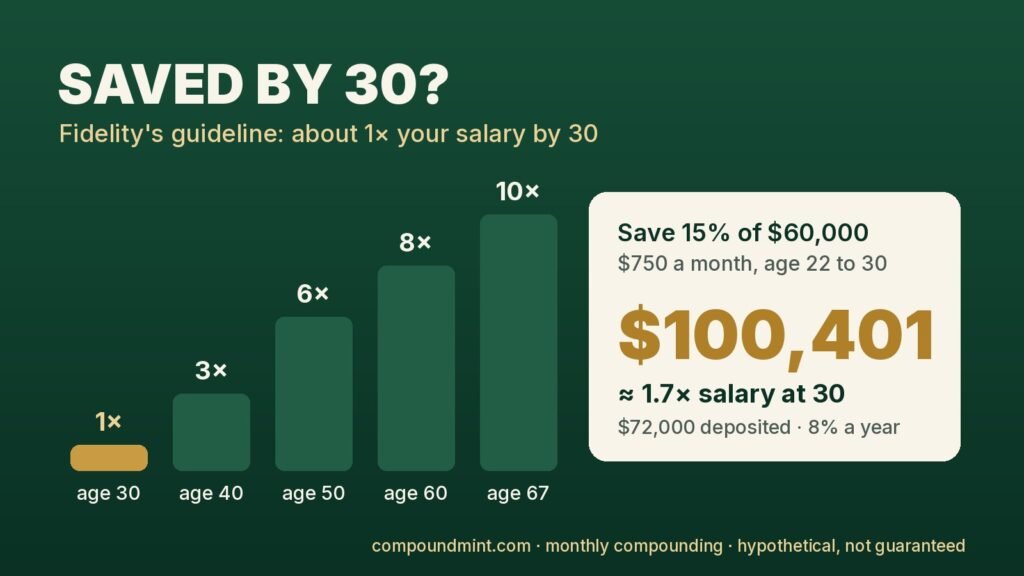
Short answer: A common rule of thumb, from Fidelity’s retirement guideline, is to have about 1× your yearly salary saved for retirement by 30. On a $60,000 salary that is about $60,000. Saving 15% of that salary ($750 a month) from age 22 at a hypothetical 8% a year gets you to about $100,401 by 30; starting at 25 gets you about $55,108. These are hypothetical examples, not guaranteed. Educational content only. Not financial advice.
“How much should I have by 30?” is really two questions: what is a sensible target, and how far off are you. Here is the target, the math behind it, and what to do if you are behind (most people are).
The 1× salary by 30 rule
Fidelity’s widely quoted guideline is to aim for retirement savings of about 1× your salary by 30, 3× by 40, 6× by 50, 8× by 60 and 10× by 67. It assumes you save roughly 15% of your income each year (your contributions plus any employer match) starting in your 20s.
| Salary | Target by 30 (1×) | Monthly 15% savings |
|---|---|---|
| $40,000 | $40,000 | $500 |
| $60,000 | $60,000 | $750 |
| $80,000 | $80,000 | $1,000 |
| $100,000 | $100,000 | $1,250 |
What counts: money set aside for retirement, like a 401(k), an IRA, or a brokerage account you are saving for the long term. Your emergency fund and home equity are useful, but they are usually kept separate from this number.
Worked example: $60,000 salary, saving 15%
Inputs: $750 a month (15% of $60,000), deposited at the end of each month, a hypothetical 8% average yearly return compounded monthly, before taxes and fees, salary held flat for simplicity.
| Start saving at | Years to 30 | You deposit | Balance at 30 (8%) | Balance at 30 (5%) |
|---|---|---|---|---|
| 22 | 8 | $72,000 | $100,401 (≈1.7×) | $88,305 |
| 25 | 5 | $45,000 | $55,108 (≈0.9×) | $51,005 |
| 27 | 3 | $27,000 | $30,402 (≈0.5×) | $29,065 |
Starting at 22 instead of 25 adds $27,000 of deposits but about $45,000 of balance, because the early dollars have more time to compound. To hit exactly 1× ($60,000) by 30 starting at 25, you would need about $817 a month at 8%; starting at 22, about $448 a month. Projected balances are hypothetical, not guaranteed.
Want to run your own age, target and return? The millionaire calculator works backward from a goal to the monthly amount you need.
Assumptions: end-of-month deposits, monthly compounding at the stated yearly rate, a constant return, no taxes or fees. Real markets go up and down. Examples are hypothetical, not guaranteed.
Why the 30 checkpoint matters
Money saved by 30 has decades to grow. If $60,000 at 30 were left alone, with nothing added, at a hypothetical 8% compounded monthly it would grow to about $1,146,560 by 67. That is the idea behind Coast FIRE: once enough is invested early, time can do most of the work. See your own coast number in the Coast FIRE calculator, and the mechanics in how compound interest works.
What people actually have by 30: Federal Reserve data
The newest official numbers come from the Federal Reserve’s 2025 Survey of Consumer Finances, released in October 2026. It groups everyone under 35 together (figures in 2025 dollars, Fed historical tables and report):
- 48.8% of families under 35 have a retirement account.
- Median balance for those who do: $21,000. The average is $48,400, pulled up by a few large accounts.
- Median in checking and savings: $5,000.
- Median net worth: $33,000, down 23% from 2022 after inflation.
So the 1× target ($60,000 on a $60,000 salary) is almost three times what the typical under-35 saver with an account has. Starting from that $21,000 median at 30 and adding nothing, a hypothetical 7% a year compounded monthly grows it to about $277,827 by 67. Adding a monthly amount is what closes the gap: try your numbers in the compound interest calculator, or find your coast number in the Coast FIRE calculator. Full age-by-age tables and charts: average savings by age (2026). Picking an account? The Roth vs Traditional IRA calculator runs both. Hypothetical, not guaranteed.
Behind at 30? What to do next
Most people in their 20s have far less than 1× salary saved, and many have no retirement account at all. The rule of thumb is a checkpoint, not a pass/fail grade. What matters is the monthly number from here:
- Starting from $0 at 30: about $368 a month reaches $1 million by 67 at a hypothetical 8% (about $671 a month to get there by 60).
- Starting from $60,000 at 30: about $231 a month reaches $1 million by 60 at 8%.
- Grab any employer match first. It is part of the 15%, and it is money you would otherwise leave behind. Then choose between a Roth and a traditional account; our Roth vs traditional IRA breakdown runs the numbers.
- Keep short-term cash separate. An emergency fund in a high-yield savings account keeps a surprise bill from forcing you to sell investments.
- Keep card debt and your credit in check. High card balances cost interest and pull your credit score down; see how to improve your credit score fast.
- Raise the rate with raises. Bumping your savings 1% each time your pay goes up is a painless way to catch up.
New to investing altogether? Start with how to start investing money, or see what a fixed monthly amount turns into on the $500 a month for 30 years page. To check your own numbers, open the millionaire calculator.
Looking further ahead? See how much money you should have saved by 35, where the checkpoint becomes about 2× your salary.
Educational content only. Not financial advice. Examples are hypothetical, not guaranteed. Savings guidelines are rules of thumb; your right number depends on your income, goals, debts and retirement plans.
5 days, 5 money moves
One short email a day: your money map, the debt rule, your emergency fund, Roth or traditional, and putting it all on autopilot. Free. Unsubscribe any time.
Questions people ask
How much do most 30-year-olds have saved?
Usually much less than 1x their salary. Federal Reserve survey data show the typical household under 35 has a small retirement balance, and many have no retirement account yet. Being behind at 30 is common, and the fix is the monthly amount you save from here.
At what age should you have $100,000 saved?
There is no fixed age; it depends on income and how early you start. As a hypothetical example, saving $750 a month from age 22 at 8% a year reaches about $100,401 by 30. Starting at 25 with the same $750 a month gets you about $55,108 by 30. Hypothetical, not guaranteed.
Is having $100k saved at 30 good?
Yes, for most incomes it is ahead of the 1x-salary-by-30 guideline. Left alone at a hypothetical 8% a year, $100,000 at 30 would grow to about $1.9 million by 67. Real returns vary; hypothetical, not guaranteed.
What if I have nothing saved at 30?
Start with the monthly number. At a hypothetical 8% a year, about $368 a month from 30 reaches $1 million by 67, and about $671 a month reaches it by 60. Take any employer 401(k) match first. Educational content only, not financial advice.
Does my emergency fund count toward savings by 30?
The 1x-salary guideline is about retirement savings (401(k), IRA, long-term investments). An emergency fund of a few months of expenses is usually kept separate, in a savings account, so you do not have to sell investments when something goes wrong.
What is the median retirement savings for people under 35?
In the Federal Reserve's 2025 Survey of Consumer Finances (released October 2026), families under 35 that have a retirement account hold a median of $21,000; the average is $48,400. Only 48.8% of families under 35 have such an account (2025 dollars).
How much should you have saved by 30?
A common guideline from Fidelity is about 1x your yearly salary in retirement savings by 30, assuming you save about 15% of income including any employer match. On a $60,000 salary that is $60,000. It is a rule of thumb, not a requirement; educational content only.
Run the numbers yourself
Compound interest calculator
“$X a month for Y years”: see exactly what it turns into, with a chart you can share.
Open calculator →$1M or…? dilemma calculator
A lump sum today vs. payments over time (or a penny doubled). The channel’s signature question, with real math.
Open calculator →S&P 500 “what if I invested” calculator
What $100 a month in an S&P 500 index fund would have grown to, using honest historical averages.
Open calculator →