
Short answer: To retire at 50, you need investments of roughly 25 times the amount you plan to spend each year, plus a plan to cover the years before retirement accounts open up at 59 and a half and Medicare starts at 65. Spending $50,000 a year means a target of about $1.25 million. Starting from zero at 30, that takes about $2,400 a month for 20 years at a hypothetical 7% return. Because a retirement that starts at 50 can last 40 years or more, many planners aim higher, closer to 28 times spending. Examples are hypothetical, not guaranteed. Educational content only. Not financial advice.
Retiring at 50 is mostly a math problem with three parts: how big the pile has to be, how fast you can build it, and how you reach the money before the usual retirement ages. Here is each part with real numbers, so you can see whether 50 is realistic for you or whether 52 or 55 is the better target.
Step 1: Find your number
Start with what you expect to spend in a year, not what you earn. Then divide by a withdrawal rate. The classic 4% rule says a portfolio of 25 times your yearly spending has historically lasted about 30 years. A retirement that starts at 50 has to last longer, so a lower rate such as 3.5% (about 28.6 times spending) adds a cushion.
| Yearly spending | Target at 4% (25x) | Target at 3.5% (about 28.6x) |
|---|---|---|
| $40,000 | $1,000,000 | $1,142,857 |
| $50,000 | $1,250,000 | $1,428,571 |
| $60,000 | $1,500,000 | $1,714,286 |
| $80,000 | $2,000,000 | $2,285,714 |
Run your own spending and withdrawal rate in the FIRE number calculator. Want the background on where the 4% figure comes from? Read Coast FIRE and the 4% rule, explained, and see how its creator recently raised it in our guide to the Bill Bengen 4.7 percent rule (which was built for 30-year retirements, not 40).
Housing is often the biggest line in that spending. If you still carry a mortgage, a shorter term can clear it sooner; the 15 vs 30 year mortgage calculator shows what each term costs per month and in total interest.
Step 2: Worked example, the monthly math by starting age
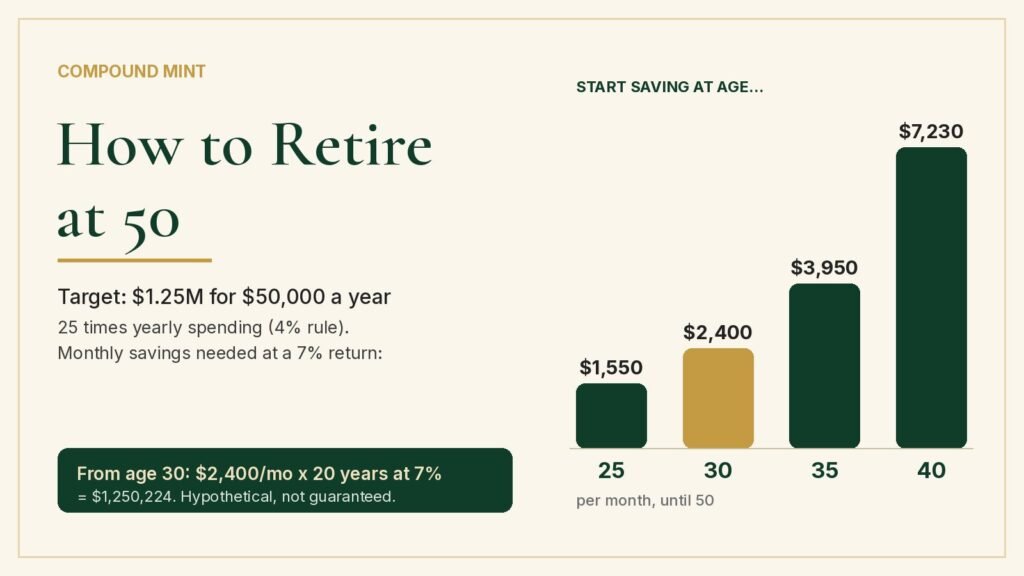
Inputs: a $1,250,000 target ($50,000 a year at 4%), starting from $0, deposits at the end of each month, monthly compounding, a constant hypothetical 7% yearly return, before taxes and fees.
| Start saving at | Years until 50 | Monthly to reach $1.25M | Monthly to reach $1.43M (3.5%) |
|---|---|---|---|
| 25 | 25 | $1,550 | $1,770 |
| 30 | 20 | $2,400 | $2,750 |
| 35 | 15 | $3,950 | $4,510 |
| 40 | 10 | $7,230 | $8,260 |
Here is how the age-30 path grows, year by year:
| Age | You put in | Growth | Balance |
|---|---|---|---|
| 35 | $144,000 | $27,823 | $171,823 |
| 40 | $288,000 | $127,404 | $415,404 |
| 45 | $432,000 | $328,710 | $760,710 |
| 50 | $576,000 | $674,224 | $1,250,224 |
The lesson in the table: more than half of the final balance is growth, and most of that growth arrives in the last 5 years. Waiting from 30 to 35 adds about $1,550 a month to the bill, and waiting from 35 to 40 adds about $3,280 more. Already have savings? $50,000 invested at 35 cuts the monthly need for the same goal to about $3,500 over 15 years. Check any of these in the FIRE number calculator or the compound interest calculator.
Assumptions: end-of-month deposits, monthly compounding, a constant 7% yearly return, no taxes, fees or inflation adjustments. Real returns vary year to year. Examples are hypothetical, not guaranteed.
Step 3: Plan the bridge from 50 to 59 and a half
This is the part most early retirement plans skip. Money in a 401(k) or traditional IRA taken out before 59 and a half usually owes a 10% additional tax on top of regular income tax. So you need a way to cover about 9 years. Common bridges:
- A taxable brokerage account. No age rules at all, which is why many early retirees build one alongside their retirement accounts.
- Roth IRA contributions. The amount you put into a Roth IRA (not the earnings) can be taken out at any time without tax or penalty. Our Roth vs. traditional IRA guide covers how the two accounts differ.
- Roth conversion ladder. Convert some traditional money to Roth each year; each conversion can come out penalty-free after its own 5-year waiting period.
- Substantially equal periodic payments, known as 72(t). A fixed IRS-approved withdrawal schedule that avoids the 10% tax, but it must continue for 5 years or until 59 and a half, whichever is later.
- The Rule of 55 does not help at 50 for most people. It lets you take money from your current employer’s 401(k) without the 10% tax if you leave that job in or after the year you turn 55 (50 for some public safety workers).
Step 4: Budget for health insurance and Social Security
Medicare starts at 65, so retiring at 50 means about 15 years of buying your own coverage, often through the ACA marketplace, where premiums depend partly on your income. Put that cost in your yearly spending before you calculate your number. Social Security can start at 62 at the earliest, at a reduced amount, and full retirement age is 67 for anyone born in 1960 or later. Many early retirement plans treat Social Security as a bonus that lowers withdrawals later rather than counting on it from day one.
Is retiring at 50 realistic?
For a household spending $50,000 a year, it usually means saving somewhere between 30% and 50% of income for 15 to 25 years. Three levers move the date the most: spending less (each $10,000 a year of spending removes $250,000 from the 4% target), starting earlier, and investing consistently through downturns. If the full number feels far away, look at Coast FIRE: once you have enough invested to grow into your target on its own, you only need to cover your current bills. The Coast FIRE calculator shows that point by age, and how much should you save a month breaks the savings rate down by income. To compare yourself with real households, see average savings by age.
Books that explain this well
- Quit Like a Millionaire by Kristy Shen and Bryce Leung (affiliate link): how one couple reached early retirement, with the withdrawal math explained.
- Your Money or Your Life by Vicki Robin and Joe Dominguez (affiliate link): the original book on spending by life energy and reaching financial independence.
- The Simple Path to Wealth by JL Collins (affiliate link): a complete, simple index fund plan, including how to draw it down later.
As an Amazon Associate I earn from qualifying purchases.
Educational content only. Not financial advice. Examples are hypothetical, not guaranteed. Tax rules, penalties and Social Security ages can change; check the current year’s IRS figures and SSA.gov, or ask a qualified professional about your own situation.
Questions people ask
How much money do you need to retire at 50?
A common starting point is 25 times your yearly spending, which is the 4% rule. Spending $50,000 a year means about $1.25 million. Because a retirement that starts at 50 may last 40 years or more, many planners use a lower 3.5% withdrawal rate, which raises the target to about $1.43 million. Add the cost of health insurance until Medicare at 65. Examples are hypothetical, not guaranteed.
Can I retire at 50 with $1 million?
Possibly, if your yearly spending is around $35,000 to $40,000. At a 4% withdrawal rate, $1 million supports about $40,000 in the first year; at a more cautious 3.5% it supports about $35,000. Social Security from 62 or later can reduce how much you need to withdraw. Examples are hypothetical, not guaranteed. Educational content only, not financial advice.
Can I withdraw from my 401(k) at 50 without a penalty?
Usually not. Withdrawals before 59 and a half generally owe a 10% additional tax. Exceptions include substantially equal periodic payments under 72(t), and the Rule of 55, which applies if you leave your employer in or after the year you turn 55 (50 for some public safety workers). Check the current IRS rules before acting.
Is retiring at 50 too early?
Not if the money is there and the bridge years are planned. The main risks are a longer retirement for your savings to cover, about 15 years of health insurance before Medicare, and a smaller Social Security benefit if you stop working early. Planning with a lower withdrawal rate and a taxable or Roth bridge account helps address all three.
How much should I save a month to retire at 50?
Starting from $0 and aiming for $1.25 million at a hypothetical 7% return, it is about $1,550 a month from age 25, $2,400 from 30, $3,950 from 35 and $7,230 from 40. Existing savings lower these amounts. Examples are hypothetical, not guaranteed.
Run the numbers yourself
Compound interest calculator
“$X a month for Y years”: see exactly what it turns into, with a chart you can share.
Open calculator →$1M or…? dilemma calculator
A lump sum today vs. payments over time (or a penny doubled). The channel’s signature question, with real math.
Open calculator →S&P 500 “what if I invested” calculator
What $100 a month in an S&P 500 index fund would have grown to, using honest historical averages.
Open calculator →