
Short answer: A good target is to save 20% of your take-home pay each month, the “savings” slice of the 50/30/20 budget. On $5,000 a month after tax, that is $1,000 a month. For retirement alone, a common guideline is about 15% of your gross pay, including any employer match. If 20% is out of reach today, start with what you can (even 5%) and raise it by 1% every few months. At a hypothetical 8% a year, $1,000 a month grows to about $1.49 million in 30 years. Examples are hypothetical, not guaranteed. Educational content only. Not financial advice.
“How much should I save?” has two honest answers. One is a percentage of what you earn, which keeps saving in step with your income. The other starts from a goal, like an emergency fund or $1 million by 60, and works backward to a monthly number. Both are below, with the math done for you.
The 20% rule: how much to save by income
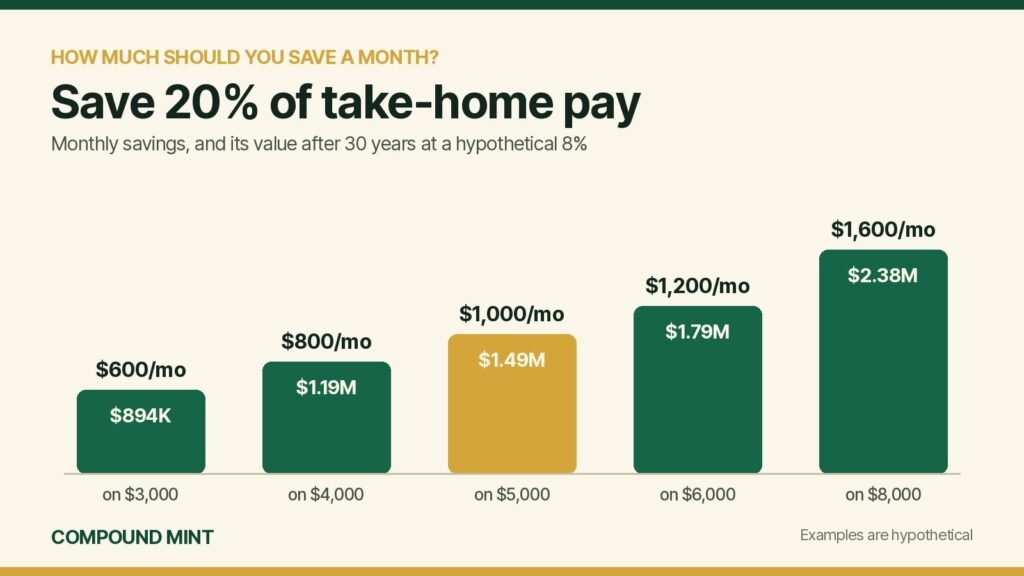
The 50/30/20 budget splits take-home pay into 50% for needs (rent, groceries, insurance, minimum debt payments), 30% for wants, and 20% for savings and extra debt payoff. Here is what 20% looks like at common take-home incomes, and what that monthly amount could grow to if invested for 30 years:
| Monthly take-home pay | Save 20% a month | Value after 30 years at 8% |
|---|---|---|
| $3,000 | $600 | $894,216 |
| $4,000 | $800 | $1,192,288 |
| $5,000 | $1,000 | $1,490,359 |
| $6,000 | $1,200 | $1,788,431 |
| $8,000 | $1,600 | $2,384,575 |
Assumptions: deposits at the end of each month, a hypothetical 8% annual return compounded monthly, no taxes or fees, no raises. Real returns vary year to year and can be negative. Try your own numbers in the compound interest calculator.
Worked example: $5,000 a month take-home
Say you bring home $5,000 a month. The 50/30/20 split gives $2,500 for needs, $1,500 for wants and $1,000 for savings. One way to split that $1,000:
- $500 to retirement (401(k) or IRA). At a hypothetical 8% for 30 years, that is about $745,180, from $180,000 of your own deposits.
- $300 to an emergency fund until it covers 3 to 6 months of needs. In one year that is $3,600 of deposits, or about $3,667 in a savings account paying 4%.
- $200 to a short-term goal, like a car, a trip or a home down payment.
The math check: $500 + $300 + $200 = $1,000, which is 20% of $5,000. Once the emergency fund is full, that $300 can move to retirement or the goal fund.
Goal-first: work backward from the number you want
If you have a specific target, the monthly amount depends mostly on time. Here is what it takes to reach $1 million at a hypothetical 8% a year:
| Years to go | Monthly savings needed | Your total deposits |
|---|---|---|
| 30 years | $671 | $241,560 |
| 25 years | $1,052 | $315,600 |
| 20 years | $1,698 | $407,520 |
Waiting 10 years makes the monthly number about 2.5 times bigger. That is compounding at work, and it is why starting small and early usually beats starting big and late. The millionaire calculator runs this for any age and goal.
For an emergency fund, the math is simpler: multiply your monthly needs by 3 to 6 and divide by the months you want to reach it in. With $3,000 a month of essentials, a 3-month fund is $9,000, or $750 a month for 12 months.
If your long-term goal is financial independence, the FIRE number calculator turns your yearly spending into a target and shows how long your monthly savings could take to reach it.
Is saving $500 or $1,000 a month good?
Yes, for most people both are strong numbers. Here is how each could grow at a hypothetical 8%:
| Monthly savings | 10 years | 20 years | 30 years |
|---|---|---|---|
| $500 | $91,473 | $294,510 | $745,180 |
| $1,000 | $182,946 | $589,020 | $1,490,359 |
Whether it is “enough” depends on your age, income and goals. See where you stand with average savings by age and how much you should have saved by 30.
Saving for a home? Once you buy, the loan term matters too: the 15 vs 30 year mortgage calculator compares the monthly payment and total interest of each term.
How to save more each month
- Pay yourself first. Set an automatic transfer for payday, so the savings leave before you can spend them.
- Get the full 401(k) match. A match is part of your pay; skipping it leaves money on the table.
- Raise your rate 1% at a time. Small steps are easier to live with, especially right after a raise.
- Park short-term money where it earns. An emergency fund in a high-yield savings account earns far more than a 0.01% account.
- Invest the long-term money. Our guide on how to start investing money walks through the order: emergency fund, match, Roth IRA, index funds.
Helpful books and tools
- I Will Teach You to Be Rich by Ramit Sethi (affiliate link): automating savings, a 401(k) and investing in a few weekends.
- Monthly budget planner (affiliate link): a paper planner for tracking bills, spending and savings goals.
As an Amazon Associate I earn from qualifying purchases.
Educational content only. Not financial advice. Examples are hypothetical, not guaranteed. Returns are not guaranteed and can be negative; taxes, fees and inflation are not included.
Questions people ask
How much money should I be saving a month?
A common target is 20% of your take-home pay, which is $1,000 a month on $5,000 after tax. For retirement alone, many guides suggest about 15% of gross pay, including any employer match. If that is too much right now, start smaller and raise it 1% at a time. Educational content only, not financial advice.
Is saving $1,000 a month good?
Yes. $1,000 a month is 20% of a $5,000 take-home income. At a hypothetical 8% annual return it could grow to about $182,946 in 10 years and about $1.49 million in 30 years. Returns are not guaranteed.
Is saving $500 a month a lot?
It is a solid amount for many budgets. At a hypothetical 8% a year, $500 a month could grow to about $91,473 in 10 years and about $745,180 in 30 years, from $180,000 of deposits. Examples are hypothetical, not guaranteed.
What is the 50/30/20 rule?
It is a simple budget that splits take-home pay into 50% for needs, 30% for wants and 20% for savings and extra debt payments. On $4,000 a month, that is $2,000 for needs, $1,200 for wants and $800 for savings.
What is the 70/20/10 rule for money?
It is a variation that puts 70% of take-home pay toward living costs, 20% toward savings and investing, and 10% toward debt payoff or giving. The savings share is still 20%, the same as the 50/30/20 rule.
Run the numbers yourself
Compound interest calculator
“$X a month for Y years”: see exactly what it turns into, with a chart you can share.
Open calculator →$1M or…? dilemma calculator
A lump sum today vs. payments over time (or a penny doubled). The channel’s signature question, with real math.
Open calculator →S&P 500 “what if I invested” calculator
What $100 a month in an S&P 500 index fund would have grown to, using honest historical averages.
Open calculator →