
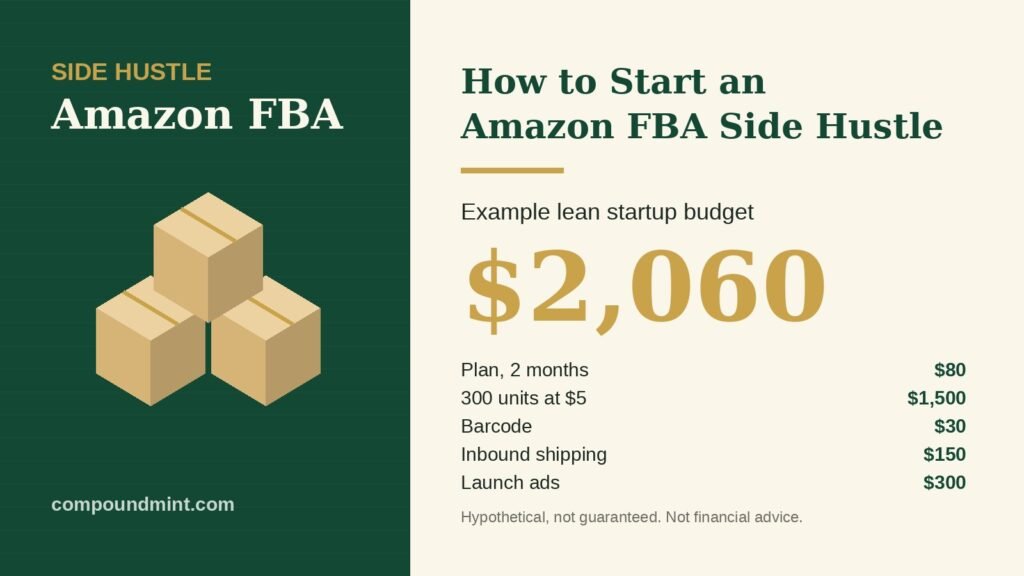
Short answer: To start an Amazon FBA side hustle, open a seller account, pick one small product with proven demand, order a modest first batch, send it to Amazon’s warehouses and let Amazon pick, pack and ship each order. Most sellers start small: in a Jungle Scout seller survey, 62% started with $5,000 or less, and a lean example budget below comes to about $2,060. Profit is not guaranteed, and fees, ads and unsold stock decide whether it pays. Examples are hypothetical, not guaranteed. Educational content only. Not financial advice.
Disclosure: this post contains an affiliate link to Helium 10, labeled where it appears. If you sign up through it we may earn a commission at no extra cost to you. See our affiliate disclosure.
FBA stands for Fulfillment by Amazon. You find and buy the product, Amazon stores it and handles shipping, returns and customer service for a fee. That is why it suits a side hustle: the daily packing is not on you. The work that is on you is choosing a product, getting the numbers right and keeping stock in.
Step 1: Know the real startup costs
These are the costs almost every new FBA seller meets, with the official price where one exists:
- Selling plan: the Individual plan costs $0.99 per item sold, and the Professional plan costs $39.99 a month (source: Amazon selling fees).
- Referral fee: a percentage of each sale, 15% in many categories such as Home and Kitchen and Sports and Outdoors, with a $0.30 minimum (Amazon referral fee table).
- FBA fulfillment fee: charged per unit by size and weight, roughly $3.50 to $7 for typical standard-size items, plus monthly storage (Cart.com, 2026 FBA fees). Check your exact product in Amazon’s Revenue Calculator before you order.
- Barcode: a single GS1 US GTIN costs $30 (GS1 US).
- Trademark (optional): needed later for Amazon Brand Registry; the USPTO base application fee is $350 per class (USPTO).
How much do sellers actually start with? In Jungle Scout’s seller survey, 14% started with $500 or less, 9% with $501 to $1,000, 16% with $1,001 to $2,500 and 23% with $2,501 to $5,000. Added up, that is 62% at $5,000 or less.
Worked example: a lean first-batch budget
Here is one hypothetical budget for a small, light product sold under the Professional plan. Your numbers will differ.
| Item | Example cost |
|---|---|
| Professional plan, first 2 months ($39.99 x 2) | $79.98 |
| 300 units at $5.00 landed cost (product plus shipping to you) | $1,500.00 |
| One GS1 barcode | $30.00 |
| Shipping the batch into Amazon’s warehouses | $150.00 |
| Launch ads budget | $300.00 |
| Total without a trademark | $2,059.98 |
| Optional trademark, one class | $350.00 |
| Total with a trademark | $2,409.98 |
Now the per-unit math, the part that decides whether the side hustle pays. Say the product sells for $24.99 in a 15% category:
| Per unit | Ads at $2 a sale | Ads at $5 a sale |
|---|---|---|
| Sale price | $24.99 | $24.99 |
| Referral fee (15%) | -$3.75 | -$3.75 |
| FBA fulfillment fee (assumed) | -$4.50 | -$4.50 |
| Landed product cost | -$5.00 | -$5.00 |
| Shipping into Amazon, per unit | -$0.50 | -$0.50 |
| Ad cost per sale | -$2.00 | -$5.00 |
| Left per unit | $9.24 | $6.24 |
That is before storage fees, returns, the monthly plan fee and income tax. Notice how much the ad cost moves the result: $3 more per sale cuts a third of what is left. Unsold units are the other big risk, because money stuck in stock earns nothing. Examples are hypothetical, not guaranteed.
Step 2: Pick a product with real demand
Beginners usually do better with a product that is small, light, not fragile, not seasonal and not in a restricted category. Look for steady searches and competing listings with few reviews or weak photos, so a better listing has room to win.
A research tool saves a lot of guessing here. Helium 10 (affiliate link) shows estimated monthly sales for listings, the search terms shoppers use and how competitive each one is, and it helps you write the listing later. New customers can use code SELLERSPLASH10 for 10% off every month, or 26OCT30OFFP for 30% off Platinum for 6 months (limited time, through Oct 30, 2026).
Step 3: Order a small first batch
Ask suppliers for samples before a bulk order, and check quality yourself. Keep the first order small enough that you could sell through it, or absorb the loss, without touching your emergency fund. A sinking fund for stock reorders keeps the side hustle from borrowing from your household budget.
Step 4: Build the listing and send stock to Amazon
Write a clear title with the main search phrase, five bullets that answer buyer questions and at least six sharp photos. Then create a shipment in Seller Central, label the boxes as Amazon instructs and send them in. Once units are received, the listing goes live with Prime shipping.
Step 5: Track profit and set money aside for taxes
Treat it like a small business from day one. Track every fee, and remember that self-employment tax generally applies once your net earnings from self-employment are $400 or more in a year (IRS). If the side hustle does produce extra cash, putting even part of it to work matters. For example, $100 a month invested at a hypothetical 7% return grows to about $17,308 in 10 years (monthly deposits and compounding). Try your own numbers in the compound interest calculator, and see how to start investing money for where to put it. Returns are hypothetical, not guaranteed.
Helpful tools
- 4×6 thermal label printer (affiliate link): prints shipping labels without ink, handy once orders pick up.
- Digital shipping scale (affiliate link): weighs boxes so shipping costs are right before you send.
As an Amazon Associate I earn from qualifying purchases.
Educational content only. Not financial advice. Examples are hypothetical, not guaranteed. Amazon fees, barcode prices, trademark fees and tax rules change; check the current figures before you act.
Questions people ask
How much money do you need to start Amazon FBA?
Many sellers start with a few thousand dollars. In a Jungle Scout seller survey, 62% started with $5,000 or less and 14% with $500 or less. A lean hypothetical budget for a small product (Professional plan for 2 months, 300 units, a barcode, inbound shipping and launch ads) comes to about $2,060.
Can you do Amazon FBA as a side hustle?
Yes. Because Amazon stores, packs and ships each order, the daily work is lighter than shipping orders yourself. You still need time each week for product research, reorders, ads and checking your numbers.
Is Amazon FBA still worth it?
It can be, but it is not guaranteed. Referral fees (often 15%), fulfillment fees, ads and unsold stock can take most of a sale. Run the per-unit math before you order, and start with a batch you can afford to lose.
Do you need an LLC to sell on Amazon?
No. Amazon lets individuals register a seller account. Some sellers form an LLC later for liability or tax reasons; that is a question for a local accountant or attorney.
Do I pay taxes on Amazon side hustle income?
Yes, profit is taxable income. The IRS says self-employment tax generally applies when net earnings from self-employment are $400 or more in a year. Set part of each payout aside for taxes.
Run the numbers yourself
Compound interest calculator
“$X a month for Y years”: see exactly what it turns into, with a chart you can share.
Open calculator →$1M or…? dilemma calculator
A lump sum today vs. payments over time (or a penny doubled). The channel’s signature question, with real math.
Open calculator →S&P 500 “what if I invested” calculator
What $100 a month in an S&P 500 index fund would have grown to, using honest historical averages.
Open calculator →