
Short answer: Sinking funds are small savings buckets for expenses you know are coming, like car insurance, holiday gifts or a new phone. You take the bill, divide it by the months until it is due, and save that amount every month. A $1,200 car insurance bill due in 12 months is a $100 a month sinking fund, so when the bill arrives the cash is already waiting and nothing goes on a credit card. Educational content only. Not financial advice.
Most budgets do not break on the regular bills. They break on the bills that show up once or twice a year and feel like a surprise, even though they were on the calendar the whole time. Sinking funds turn those big, lumpy costs into small, boring monthly ones.
What is a sinking fund?
A sinking fund is money you set aside a little at a time for one specific, planned expense. The name comes from corporate and government finance, where a company sets aside money over time to pay off a bond when it comes due. In personal finance the idea is the same, just smaller: you “sink” a fixed amount into a bucket each month so a known cost is fully paid for by the time it lands.
The formula is one line:
Monthly amount = (cost of the expense minus what you have saved) ÷ months until it is due
Worked example: a 5-bucket starter set
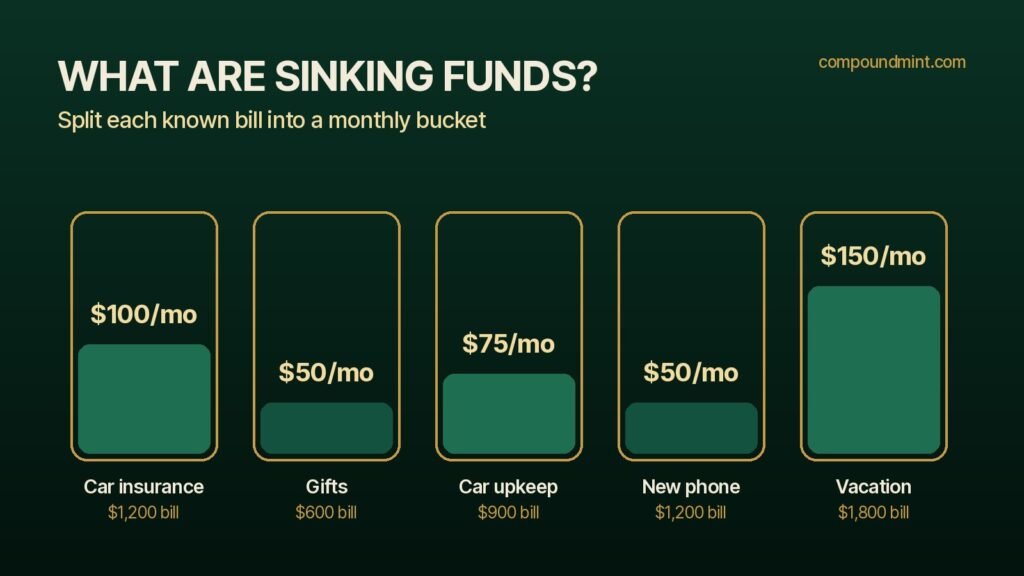
Here is a typical first set of sinking funds. The amounts are examples; swap in your own bills.
| Sinking fund | Expected cost | Months to save | Monthly amount |
|---|---|---|---|
| Car insurance (annual premium) | $1,200 | 12 | $100 |
| Holiday and birthday gifts | $600 | 12 | $50 |
| Car maintenance and tires | $900 | 12 | $75 |
| Phone or laptop replacement | $1,200 | 24 | $50 |
| Vacation | $1,800 | 12 | $150 |
| Total | $5,700 | $425 a month |
Not sure what your gifts bucket should be? The holiday budget calculator adds up gifts, travel, food and decor and shows how much to set aside each week; see also how much to spend on Christmas gifts.
That is $5,100 saved over a year ($425 × 12), plus the phone bucket keeps going into year two to reach its $1,200. None of these costs are emergencies. They are just expensive, and now each one is paid in advance.
Starting late? If the $1,200 insurance bill is due in 7 months and you have $0 set aside, the same formula gives $1,200 ÷ 7 = about $171.43 a month. Starting a bucket as soon as you know about a cost keeps the monthly number small.
Where to keep sinking funds
Sinking fund money needs to be safe and easy to reach, because you will spend it within months. That rules out the stock market. The usual home is a high-yield savings account, kept separate from your checking account so the money does not quietly get spent. Many banks let you create several named savings “buckets” or sub-accounts inside one account, which makes tracking each fund easy. A simple spreadsheet with one row per fund works just as well.
What the interest adds: if the full $425 a month sat in savings for a whole year at a hypothetical 4% rate (monthly compounding), you would have about $5,194.55, roughly $95 more than the $5,100 you put in. In real life you spend some buckets during the year, so expect a bit less. It is a small bonus, not the point; the point is that the bills are covered. You can check the math in the compound interest calculator. Examples are hypothetical, not guaranteed.
Sinking fund vs emergency fund vs regular savings
- Sinking fund: a known expense with a rough date and amount. You plan to spend it.
- Emergency fund: an unknown expense, like a job loss or a medical bill. You hope never to touch it.
- Long-term savings and investing: goals years away, like retirement, where money can ride out market swings.
Keeping them apart matters. When the car needs tires, the tire bucket pays, and your emergency fund stays whole for a real emergency.
How to set up sinking funds in 4 steps
- List every non-monthly cost from the past year. Bank and card statements are the easiest place to find annual premiums, renewals, gifts and repairs.
- Put a cost and a due month on each one. Round up a little; prices tend to rise.
- Divide to get the monthly amount and add up the total.
- Automate it. Set a transfer for payday into savings so the buckets fill without willpower.
If the total feels too big for your budget, start with the one or two bills that hurt most, often car insurance and car repairs, and add buckets as you free up money. Our guide on how to save money fast on a low income shows where that extra room usually comes from, and how much you should save a month helps you size the rest of your plan.
Helpful tools
- Sinking funds savings binder (affiliate link): labeled envelopes for saving toward set goals.
- Monthly budget planner (affiliate link): a paper planner for tracking bills, spending and savings goals.
As an Amazon Associate I earn from qualifying purchases.
Educational content only. Not financial advice. Examples are hypothetical, not guaranteed. Interest rates on savings accounts change; check the current rate with your bank.
Questions people ask
What is a sinking fund example?
A common example is car insurance. If your annual premium is $1,200, you save $100 a month for 12 months, so the full amount is ready when the bill is due. Gifts, car repairs, a vacation and replacing a phone are other popular sinking funds.
What is the difference between savings and sinking funds?
A sinking fund is savings with one job: it is set aside for a specific planned expense and you expect to spend it. General savings, like an emergency fund or long-term savings, is not tied to one bill.
How much should you have in a sinking fund?
Enough to cover the expense by its due date. Divide the expected cost by the months until it is due: a $600 gift budget 12 months away needs $50 a month. A fund is full when it equals the cost of the bill.
Is a sinking fund the same as an emergency fund?
No. An emergency fund covers costs you cannot predict, like a job loss. A sinking fund covers costs you can predict, like an annual insurance premium. Keeping them separate means a planned bill never drains your emergency money.
Where should I keep my sinking funds?
Somewhere safe and easy to reach, usually a high-yield savings account separate from checking. Many banks let you split one savings account into named buckets so you can track each fund. Avoid investing money you plan to spend within months.
Run the numbers yourself
Compound interest calculator
“$X a month for Y years”: see exactly what it turns into, with a chart you can share.
Open calculator →$1M or…? dilemma calculator
A lump sum today vs. payments over time (or a penny doubled). The channel’s signature question, with real math.
Open calculator →S&P 500 “what if I invested” calculator
What $100 a month in an S&P 500 index fund would have grown to, using honest historical averages.
Open calculator →