
Short answer: Spend what you can pay in cash by December 25: your holiday savings plus what you can set aside each week, minus travel, food and decor, split across your gift list. For most budgets that lands between $25 and $100 per person. For scale, Americans expected to spend an average of $1,007 on holiday gifts in Gallup’s October 2025 survey. Educational content only. Not financial advice.
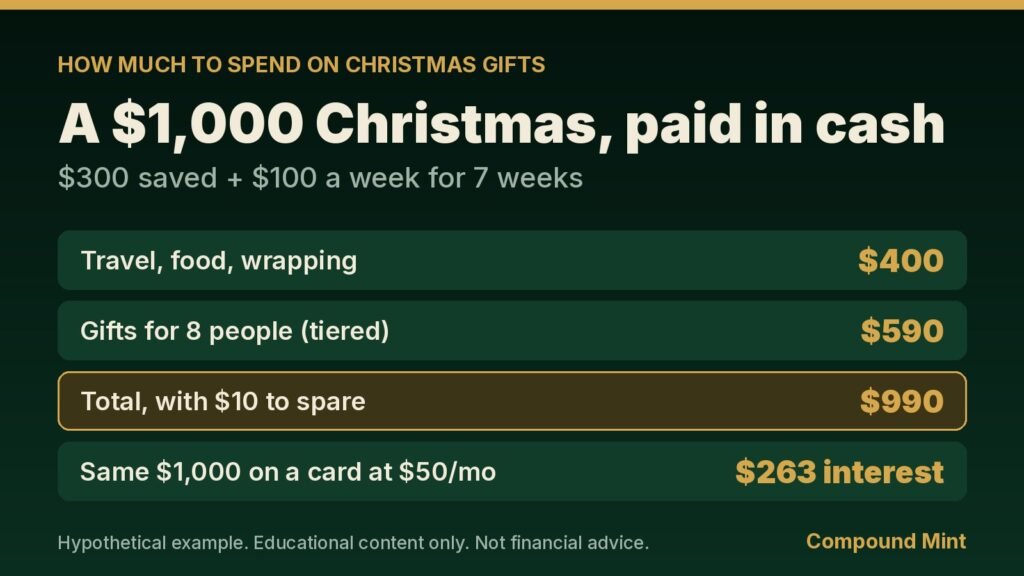
There is no correct dollar amount for a Christmas gift. There is a correct order: decide the total first, then split it. Shopping person by person and adding it up in January is how a $600 plan becomes a $1,400 credit card bill.
What the average person spends
| Survey | What it measured | Average |
|---|---|---|
| Gallup, October 2025 | Expected spending on holiday gifts | $1,007 |
| NRF, October 2025 | Gifts for family and friends | $627.93 |
| NRF, October 2025 | Food, decorations, cards and other seasonal items | $262.56 |
| NRF, October 2025 | Total holiday spending per person | $890.49 |
Sources: Gallup’s October 2025 survey and NRF’s 2025 holiday survey. NRF says it is not releasing a per-person figure for 2026. Averages include people with much higher and lower incomes than yours, so treat them as context, not a target.
How to set your Christmas gift budget in 4 steps
- Count the cash you will have. What you have saved now, plus what you can save each week until the holidays.
- Take out everything that is not a gift. Travel, food and hosting, wrapping, cards and decor.
- Split the rest into tiers. One amount for your closest people, a smaller one for everyone else.
- Write it down before you shop. A list with a number next to each name is the whole system.
The holiday budget calculator does steps 1 and 2 for you and shows the per-person amount that fits.
Worked example: a $1,000 Christmas
Hypothetical inputs: $4,000 a month of take-home pay, $300 already saved, $100 saved per week for 7 weeks.
- Cash by the holidays: $300 + $100 × 7 = $1,000.
- Not gifts: $200 travel + $150 food + $50 wrapping and cards = $400.
- Left for gifts: $1,000 minus $400 = $600.
| Tier | People | Per person | Subtotal |
|---|---|---|---|
| Partner | 1 | $150 | $150 |
| Kids | 2 | $100 | $200 |
| Parents | 2 | $60 | $120 |
| Siblings and close friends | 3 | $40 | $120 |
| Total gifts | 8 | $590 |
Gifts of $590 plus $400 of other costs is $990, or 24.75% of one month’s take-home pay, with $10 to spare. Everything is paid in cash, so January starts at zero.
What overspending really costs
Credit card accounts that were charged interest averaged 22.36% in August 2026, according to the Federal Reserve. Put $1,000 of gifts on a card at that rate and:
- Pay $100 a month: 12 months to clear it and about $117 in interest.
- Pay $50 a month: 26 months and about $263 in interest.
At $50 a month, last Christmas is still being paid off the Christmas after next. If you are carrying a balance already, see whether to pay off debt or invest.
Ways to spend less without looking cheap
- Draw names. Each adult buys one gift for one person instead of everyone buying for everyone.
- Set a family limit out loud. Most people are relieved when someone suggests $25 or $30.
- Give one useful thing. A good book or a small tool they will use beats three items they will not. Our list of gifts for someone who is bad with money has ideas.
- Start next year now. $1,000 over 52 weeks is $19.23 a week in a sinking fund.
Helpful picks for a holiday budget
- Christmas gift list planner (affiliate link): track names, the budget per person and what you already bought, so nothing gets bought twice.
- Cash envelope wallet (affiliate link): put the gift money in an envelope; when it is empty, shopping is done.
- Monthly budget planner (affiliate link): a paper planner for bills and savings goals, handy for starting next year’s holiday fund in January.
- The Psychology of Money by Morgan Housel (affiliate link): a well-liked book on money habits that works as a gift for almost anyone.
- I Will Teach You to Be Rich by Ramit Sethi (affiliate link): a practical plan for automating money, a good gift for a new graduate.
- Broke Millennial by Erin Lowry (affiliate link): a friendly first money book for someone in their twenties.
- Digital coin counting bank (affiliate link): a coin jar with a running total, a small gift that starts a savings habit for kids.
As an Amazon Associate I earn from qualifying purchases. More picks by goal: personal finance books and money tools.
Educational content only. Not financial advice. Examples are hypothetical, not guaranteed. Survey figures are averages from the sources linked above.
Questions people ask
How much should I spend on Christmas gifts?
Spend what you can pay in cash by December 25 after travel, food and decor. In our example, $1,000 of cash minus $400 of other costs leaves $600 for gifts, split as $150 for a partner, $100 per child, $60 per parent and $40 for close friends.
What is the average amount spent on Christmas gifts?
Americans expected to spend an average of $1,007 on holiday gifts in Gallup’s October 2025 survey. NRF’s 2025 survey put gifts at $627.93 per person, out of $890.49 of total holiday spending.
How much should you spend on a gift for a friend?
Many people use $20 to $50 for friends and coworkers and save larger amounts for partners, kids and parents. Pick a tier amount before you shop and keep it the same for everyone in that tier.
How much should parents spend on Christmas per child?
There is no standard amount. Decide the total you can pay in cash first, then divide it. In our hypothetical budget, two children at $100 each is $200 of a $600 gift budget.
Is it OK to put Christmas gifts on a credit card?
Only if you can pay the full balance when the bill comes. At an average of 22.36% (Federal Reserve, August 2026), $1,000 paid off at $50 a month takes 26 months and costs about $263 in interest.
Run the numbers yourself
Compound interest calculator
“$X a month for Y years”: see exactly what it turns into, with a chart you can share.
Open calculator →$1M or…? dilemma calculator
A lump sum today vs. payments over time (or a penny doubled). The channel’s signature question, with real math.
Open calculator →S&P 500 “what if I invested” calculator
What $100 a month in an S&P 500 index fund would have grown to, using honest historical averages.
Open calculator →