
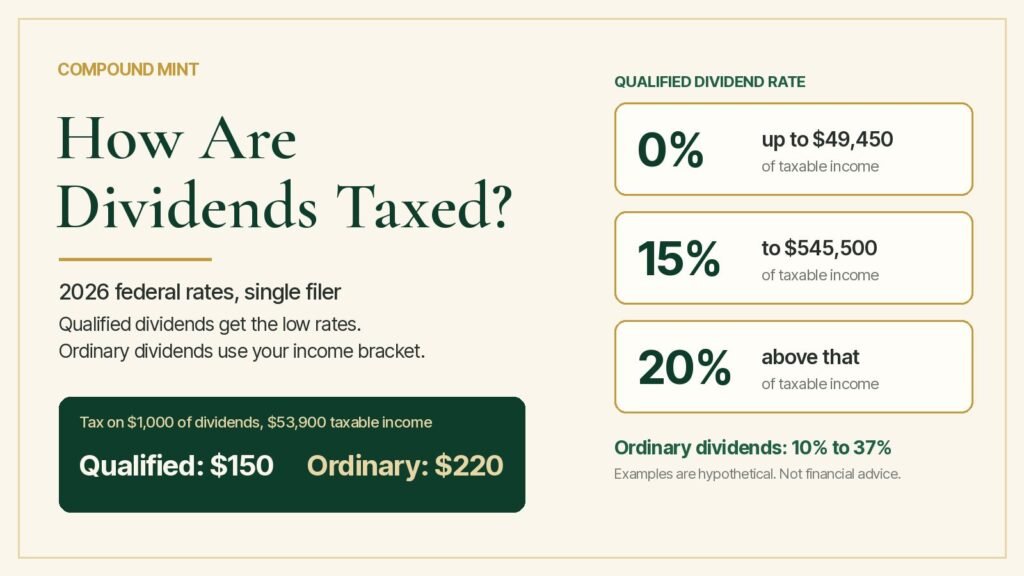
Short answer: Dividends are taxed in one of two ways. Qualified dividends get the lower long-term capital gains rates of 0%, 15% or 20%, and ordinary (nonqualified) dividends are taxed at your regular income tax rate, from 10% to 37%. For 2026, a single filer pays 0% on qualified dividends while taxable income stays under $49,450. On $1,000 of dividends with $53,900 of other taxable income, that is $150 if qualified versus $220 if ordinary. Dividends inside an IRA or 401(k) are not taxed in the year they are paid. Examples are hypothetical, not guaranteed. Educational content only. Not financial advice.
If you own a stock, an index fund or an ETF in a regular brokerage account, the dividends it pays usually show up on your tax return, even if you never touched the cash. How much you owe depends on two things: what kind of dividend it is, and how much other income you have. Here is how both work, with the math done for you.
Qualified vs. ordinary dividends
Your broker sorts this out for you on Form 1099-DIV. Box 1a shows total ordinary dividends, and Box 1b shows the part of that total that is qualified.
- Qualified dividends come from US companies (or qualifying foreign ones) whose shares you held long enough. Broad US stock index funds pay mostly qualified dividends. They are taxed at 0%, 15% or 20%.
- Ordinary dividends that are not qualified are taxed like wages. Common examples: most REIT dividends, money market fund payouts, dividends on shares you held only briefly, and payouts from bond funds (which are really interest).
The holding period rule: to count as qualified, you must hold the shares for more than 60 days during the 121-day period that starts 60 days before the ex-dividend date. Buy a stock a week before the dividend and sell it a week after, and that dividend is taxed as ordinary income.
2026 qualified dividend tax rates
These brackets use your taxable income (income after deductions), with qualified dividends counted on top of your other income. Always check the current year’s IRS figures, since the thresholds rise with inflation each year.
| Rate | Single | Married filing jointly |
|---|---|---|
| 0% | Up to $49,450 | Up to $98,900 |
| 15% | $49,451 to $545,500 | $98,901 to $613,700 |
| 20% | Over $545,500 | Over $613,700 |
Higher earners may also owe the 3.8% net investment income tax when modified adjusted gross income is above $200,000 (single) or $250,000 (married filing jointly). Those two thresholds are not adjusted for inflation. Many states tax dividends as regular income too.
Worked example: $1,000 of dividends at different incomes
Inputs: a single filer in 2026, $1,000 of dividends added on top of other taxable income, federal tax only. “Qualified” uses the 0%, 15% and 20% brackets above; “ordinary” uses the 2026 income tax brackets (12% up to $50,400, 22% up to $105,700, 24% up to $201,775, 32% up to $256,225).
| Other taxable income | Tax if qualified | Tax if ordinary | You keep (qualified) |
|---|---|---|---|
| $30,000 | $0 (0%) | $120 (12%) | $1,000 |
| $49,000 | $82.50 (mixed) | $120 (12%) | $917.50 |
| $53,900 | $150 (15%) | $220 (22%) | $850 |
| $90,000 | $150 (15%) | $220 (22%) | $850 |
| $150,000 | $150 (15%) | $240 (24%) | $850 |
| $250,000 | $188 (15% + 3.8%) | $358 (32% + 3.8%) | $812 |
How the $49,000 row works: only $450 of the dividends fits under the $49,450 line, so $450 is taxed at 0% and the other $550 at 15%: $550 × 15% = $82.50. Qualified dividends stack on top of your other income, so only the part above the line is taxed.
Where $53,900 comes from: a $70,000 salary minus the 2026 standard deduction of $16,100 for a single filer. At that income, a qualified dividend saves $70 per $1,000 compared with an ordinary one.
The 0% bracket is bigger than it looks. A single retiree with $30,000 of other taxable income could receive $10,000 of qualified dividends and still owe $0 federal tax on them, because the total ($40,000) stays under $49,450. The same $10,000 as ordinary income would cost $1,200 at 12%.
Assumptions: 2026 federal brackets for a single filer, dividends added on top of other taxable income, no state tax, no credits. The $250,000 row assumes modified AGI is more than $1,000 above $200,000. Your own return may differ. Examples are hypothetical, not guaranteed.
Reinvested dividends are still taxed
Turning on automatic dividend reinvestment does not delay the tax. The IRS counts a reinvested dividend as income in the year it is paid, exactly as if you had taken the cash. The upside: each reinvested amount adds to your cost basis, so you are not taxed on it a second time when you sell.
Over decades that yearly tax adds up. Say you invest $50,000 for 20 years at a hypothetical 8% a year total return, 2% of which comes as dividends:
| Account | Dividend tax each year | Effective growth rate | Value after 20 years |
|---|---|---|---|
| Roth IRA (tax-free if rules are met) | None | 8.0% | $233,048 |
| Taxable account, 15% on dividends | 15% of the 2% | 7.7% | $220,437 |
That is about $12,611 lost to dividend tax alone, before any tax on the price gains when you sell. Annual compounding, hypothetical returns, not guaranteed. Run your own numbers in the compound interest calculator, or see how real S&P 500 returns with dividends reinvested would have grown in the S&P 500 calculator.
Legal ways to pay less tax on dividends
- Use tax-advantaged accounts. Dividends inside a 401(k), traditional IRA or Roth IRA are not taxed each year. Traditional accounts are taxed when you withdraw; qualified Roth withdrawals are tax-free. Our Roth vs. traditional IRA guide runs both.
- Put the highest-taxed holdings in those accounts. REITs and bond funds pay mostly ordinary income, so they often fit best inside an IRA, while broad stock index funds with mostly qualified dividends sit more comfortably in a taxable account.
- Mind the holding period. Holding shares more than 60 days around the ex-dividend date keeps qualified dividends qualified.
- Use the 0% bracket. In a low-income year, such as early retirement or a gap between jobs, qualified dividends may be tax-free up to the threshold.
Planning to live on dividends one day? See how much you need to invest to make $1,000 a month, and if you are just getting started, how to start investing money covers account types step by step. Want to test a long-term plan? The S&P 500 calculator shows any amount a month over real market history.
Books that explain this well
- Taxes Made Simple by Mike Piper (affiliate link): a short, plain-English explainer of how US income tax works.
- The Bogleheads’ Guide to Investing by Taylor Larimore, Mel Lindauer and Michael LeBoeuf (affiliate link): how to build and keep a simple index portfolio, including IRAs and 401(k)s.
As an Amazon Associate I earn from qualifying purchases.
Educational content only. Not financial advice. Examples are hypothetical, not guaranteed. Tax rules and thresholds change; check the current year’s IRS figures or ask a tax professional about your own situation.
Questions people ask
Do you have to pay taxes on dividends?
Yes, if they are paid in a regular taxable brokerage account. Qualified dividends are taxed at 0%, 15% or 20% depending on your taxable income, and ordinary dividends at your regular income tax rate. Dividends earned inside a 401(k), IRA or Roth IRA are not taxed in the year they are paid. Educational content only, not financial advice.
How much can you make in 2026 and still pay 0% tax on dividends?
For 2026, qualified dividends are taxed at 0% while taxable income stays at or below $49,450 for a single filer or $98,900 for married couples filing jointly. Taxable income is your income after deductions, so a single filer with the $16,100 standard deduction could have about $65,550 of total income. Check the current year's IRS figures before relying on them.
Are reinvested dividends taxable?
Yes. In a taxable account, a reinvested dividend is income in the year it is paid, the same as if you took the cash. The reinvested amount is added to your cost basis, so it is not taxed again when you sell those shares.
How do I avoid paying taxes on dividends?
You cannot avoid them in a taxable account, but you can reduce them legally: hold dividend payers inside a 401(k), IRA or Roth IRA, keep REITs and bond funds in tax-advantaged accounts, hold shares long enough for dividends to be qualified, and use the 0% qualified bracket in low-income years.
Are dividends taxed twice?
In a sense. The company pays corporate income tax on its profits (21% federal), then shareholders pay tax on the dividends it distributes. The lower qualified dividend rates of 0%, 15% and 20% exist partly to soften that double layer. You are not taxed twice on the same dividend yourself.
Run the numbers yourself
Compound interest calculator
“$X a month for Y years”: see exactly what it turns into, with a chart you can share.
Open calculator →$1M or…? dilemma calculator
A lump sum today vs. payments over time (or a penny doubled). The channel’s signature question, with real math.
Open calculator →S&P 500 “what if I invested” calculator
What $100 a month in an S&P 500 index fund would have grown to, using honest historical averages.
Open calculator →