
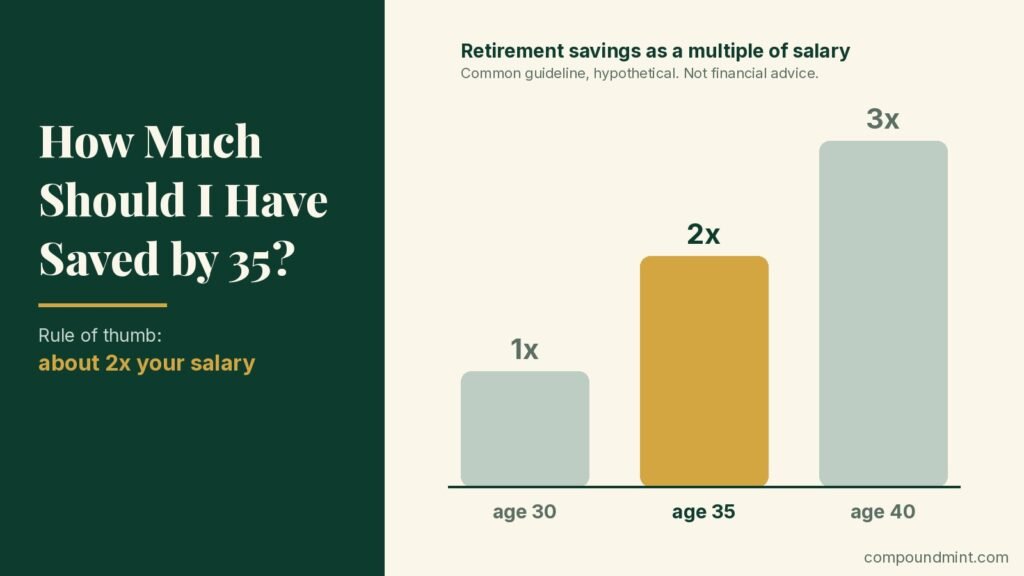
Short answer: A common rule of thumb is to have about 2× your yearly salary saved for retirement by 35. It sits halfway between Fidelity’s guideline of 1× by 30 and 3× by 40; T. Rowe Price uses a slightly lower range of 1× to 1.5× by 35. On a $70,000 salary, 2× is $140,000. Saving 15% of that salary ($875 a month) from age 25 at a hypothetical 8% a year gets you to about $160,078 by 35. These are hypothetical examples, not guaranteed. Educational content only. Not financial advice.
Thirty-five is a good moment to check in. You have probably had a few raises, maybe a mortgage or kids, and retirement still feels far away. Here is the target, the math behind it, and the monthly number that matters if you are behind.
The 2× salary by 35 rule
Two big retirement firms publish savings checkpoints by age. Both assume you save about 15% of your income every year (your contributions plus any employer match), starting in your mid 20s:
- Fidelity: 1× your salary by 30, 3× by 40, 6× by 50, 8× by 60, 10× by 67. Halfway between 30 and 40 gives the popular 2× by 35.
- T. Rowe Price: 1× to 1.5× your salary by 35, 1.5× to 2.5× by 40.
| Salary | T. Rowe Price range by 35 | 2× by 35 | Monthly 15% savings |
|---|---|---|---|
| $50,000 | $50,000 to $75,000 | $100,000 | $625 |
| $70,000 | $70,000 to $105,000 | $140,000 | $875 |
| $90,000 | $90,000 to $135,000 | $180,000 | $1,125 |
| $120,000 | $120,000 to $180,000 | $240,000 | $1,500 |
What counts: money saved for retirement, like a 401(k), an IRA or a long-term brokerage account. Your emergency fund and home equity matter, but they are usually kept out of this number.
Worked example: $70,000 salary, saving 15%
Inputs: $875 a month (15% of $70,000), deposited at the end of each month, a hypothetical average return of 8% a year compounded monthly, before taxes and fees, salary held flat for simplicity.
| Start saving at | Years to 35 | You deposit | Balance at 35 (8%) | Balance at 35 (5%) |
|---|---|---|---|---|
| 22 | 13 | $136,500 | $238,805 (≈3.4×) | $191,721 |
| 25 | 10 | $105,000 | $160,078 (≈2.3×) | $135,872 |
| 28 | 7 | $73,500 | $98,099 (≈1.4×) | $87,788 |
| 30 | 5 | $52,500 | $64,292 (≈0.9×) | $59,505 |
Starting at 25 instead of 30 means $52,500 more in deposits but about $95,800 more in balance, because the early dollars have five extra years to compound. To land exactly on 2× ($140,000) by 35:
- starting at 25 from $0: about $765 a month at 8%
- starting at 30 from $0: about $1,905 a month
- starting at 30 with 1× ($70,000) already saved: about $486 a month
That last line is why the age 30 checkpoint matters so much; see how much money you should have saved by 30. Projected balances are hypothetical, not guaranteed.
Want to plug in your own age, goal and return? The millionaire calculator works backward from a target to the monthly amount you need.
Assumptions: end-of-month deposits, monthly compounding at the stated yearly rate, a constant return, no taxes or fees. Real markets go up and down. Examples are hypothetical, not guaranteed.
Why 2× at 35 is such a strong position
Money in place by 35 still has about three decades to grow. If $140,000 at 35 were left alone, with nothing added, at a hypothetical 8% compounded monthly it would pass $1 million at about age 60 and reach about $1,795,694 by 67. That is the idea behind Coast FIRE: once enough is invested early, time can carry it the rest of the way. Find your own coast number with the Coast FIRE calculator, and see what a seven-figure balance really means in how much is 7 figures.
Behind at 35? What to do next
Most people are. Federal Reserve survey data show many households in their 30s are well below these multiples, and some have no retirement account yet. A benchmark is a checkpoint, not a grade. What counts is the monthly number from here:
- Starting from $0 at 35: about $564 a month reaches $1 million by 67 at a hypothetical 8%, or about $1,051 a month to get there by 60.
- Take the full employer match first. It counts toward the 15%, and skipping it leaves part of your pay on the table. Then pick the account type; our Roth vs traditional IRA breakdown runs both.
- Raise your rate with every raise. Adding 1% of pay each time your salary goes up closes the gap without a lifestyle cut.
- Keep short-term cash separate. A few months of expenses in a high-yield savings account keeps a surprise bill from forcing you to sell investments.
- Clear high-interest card debt. A 20%+ card rate beats almost any expected return, so paying it down is often the best “investment” at 35.
To check your own path, open the millionaire calculator with your age and goal, or watch a fixed amount grow in the compound interest calculator.
Educational content only. Not financial advice. Examples are hypothetical, not guaranteed. Savings benchmarks are rules of thumb; your right number depends on your income, goals, debts and retirement plans.
Questions people ask
How much should a 35 year old have saved in a 401k?
A common rule of thumb is about 2x your salary across all retirement accounts by 35, so about $140,000 on a $70,000 salary. T. Rowe Price uses a lower range of 1x to 1.5x. Your 401(k), IRA and long-term brokerage money all count toward it. Rules of thumb only, not financial advice.
Is $100,000 in retirement savings at 35 good?
For many incomes, yes. It meets or beats T. Rowe Price's 1x to 1.5x range for anyone earning up to $100,000. Left alone at a hypothetical 8% a year compounded monthly, $100,000 at 35 would grow to about $1.28 million by 67. Hypothetical, not guaranteed.
What if I have nothing saved at 35?
Start with the monthly number. At a hypothetical 8% a year, about $564 a month from 35 reaches $1 million by 67, and about $1,051 a month reaches it by 60. Take any employer 401(k) match first. Educational content only, not financial advice.
Is 2x salary by 35 realistic?
It is if you save about 15% of pay from your mid 20s. In our example, $875 a month from age 25 on a $70,000 salary grows to about $160,078 by 35 at a hypothetical 8%, about 2.3x. Starting at 30 with nothing saved, you would need about $1,905 a month to hit 2x by 35. Hypothetical, not guaranteed.
Does home equity count toward savings by 35?
Usually not. The salary multiples from Fidelity and T. Rowe Price are about retirement savings like a 401(k), an IRA and long-term investments. Home equity and an emergency fund are valuable, but they are kept separate because you cannot easily spend your house in retirement.
Run the numbers yourself
Compound interest calculator
“$X a month for Y years”: see exactly what it turns into, with a chart you can share.
Open calculator →$1M or…? dilemma calculator
A lump sum today vs. payments over time (or a penny doubled). The channel’s signature question, with real math.
Open calculator →S&P 500 “what if I invested” calculator
What $100 a month in an S&P 500 index fund would have grown to, using honest historical averages.
Open calculator →