
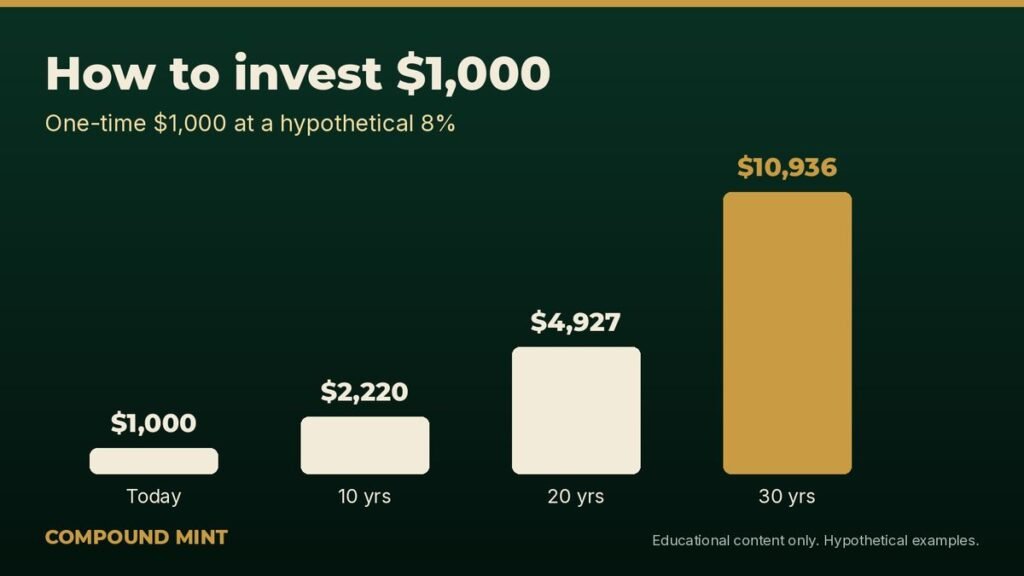
Short answer: To invest 1,000 dollars, first clear any high-interest debt and keep a small emergency cushion. Then pick one of three routes: a high-yield savings account for money you need within about 3 years, a low-cost index fund in a brokerage account for long-term growth, or a Roth IRA for retirement. Left alone for 30 years at a hypothetical 8% return, $1,000 could grow to about $10,936; add $100 a month and it could reach about $159,972. Examples are hypothetical, not guaranteed. Educational content only. Not financial advice.
$1,000 will not make you rich on its own. What it can do is get you started, and starting early matters more than starting big. The right home for it depends on one question: when will you need the money?
Before you invest: three quick checks
- High-interest debt. Credit card rates often run around 20% or more. Paying off a card balance is a guaranteed saving at that rate, which no investment can promise.
- A starter emergency fund. If one car repair would land on a credit card, a cushion comes first. A high-yield savings account is the usual place for it.
- Free money at work. If your employer matches 401(k) contributions, getting the full match is often the best first “investment.” See does employer match count towards the 401k limit for how the match works.
The three beginner routes
| Route | Best for | Risk | Access to money |
|---|---|---|---|
| High-yield savings account | Goals within about 3 years, emergency fund | Low; FDIC insured up to $250,000 per depositor, per bank, per ownership category | Anytime |
| Broad index fund or ETF in a brokerage account | Goals 5+ years away | Market risk; can fall sharply in a bad year | Anytime, but selling in a downturn locks in losses |
| Roth IRA (invested in an index fund) | Retirement | Same market risk as the fund inside it | Contributions can come out anytime; earnings have rules |
A Roth IRA is an account, not an investment: you open it, then buy a fund inside it. For 2026 you can put in up to $7,500 ($8,600 at age 50 or older) if your income qualifies, per the IRS IRA contribution limits; check the current year’s IRS figures. Our guide to opening a brokerage account covers the setup step by step, and how to start investing money gives the bigger picture.
Worked example: what $1,000 could become
A one-time $1,000, no more deposits, monthly compounding, hypothetical annual returns:
| Return | 10 years | 20 years | 30 years |
|---|---|---|---|
| 4% (savings-like) | $1,491 | $2,223 | $3,313 |
| 8% | $2,220 | $4,927 | $10,936 |
| 10% | $2,707 | $7,328 | $19,837 |
Now the same $1,000 plus $100 a month (end-of-month deposits) at a hypothetical 8%:
| Years | You put in | Could grow to |
|---|---|---|
| 10 | $13,000 | $20,514 |
| 20 | $25,000 | $63,829 |
| 30 | $37,000 | $159,972 |
Returns are hypothetical, not guaranteed, and ignore fees and taxes. The lesson: the first $1,000 matters, but the habit that follows it matters more. Check these numbers or try your own in the compound interest calculator, and see how to invest $100 a month for the next step.
What really happened to $1,000 in the S&P 500
History shows both sides. Using calendar-year total returns with dividends reinvested, $1,000 invested in January 2016 would have been worth about $3,983 by December 2025, roughly 14.8% a year. But $1,000 invested in January 2022 would have been worth about $819 a year later, after the index fell 18.11% that year. Test any start year in the S&P 500 calculator. The past is not a forecast, which is why money you need soon belongs in savings, not stocks.
Turning a one-time $1,000 into a monthly habit changes the scale. See if you invest $1,000 a month for 20 years, year by year at 5%, 7%, 8% and 10%.
Watch the fees
Fees come out every year, so they compound against you. At a hypothetical 8% return, $1,000 grows to about $10,936 in 30 years. Knock 1 point off for fees (7%) and it is about $8,116, roughly $2,820 less. Broad index funds often charge a small fraction of 1%, so compare the expense ratio before you buy.
Books that explain this well
- The Little Book of Common Sense Investing by John C. Bogle (affiliate link): the case for low-cost index funds, from the founder of Vanguard.
- I Will Teach You to Be Rich by Ramit Sethi (affiliate link): automating savings, a 401(k) and investing in a few weekends.
- Broke Millennial by Erin Lowry (affiliate link): a plain, beginner-friendly guide to budgets, credit and first investments.
As an Amazon Associate I earn from qualifying purchases. Want more picks by goal? See our personal finance books and money tools.
Educational content only. Not financial advice. Examples are hypothetical, not guaranteed. Past returns do not predict future results; rates, limits and account rules change, so check current details before you act.
Questions people ask
What is the best investment for $1,000?
There is no single best one; it depends on when you need the money. For money you need within about 3 years, a high-yield savings account is the usual choice. For goals 5 or more years away, a low-cost broad index fund, held in a brokerage account or a Roth IRA, is a common beginner route.
How can I quickly turn $1,000 into $10,000?
Not safely. At a hypothetical 8% a year with monthly compounding, $1,000 takes about 29 years to grow to $10,000 on its own. Anything that promises a 10x in months is gambling or a scam. Adding money every month is the realistic shortcut: $1,000 plus $100 a month at 8% passes $20,000 in 10 years.
Is $1,000 enough to start investing?
Yes. Many brokerages have no account minimum and offer fractional shares, so $1,000 can buy a slice of a broad index fund. Clear high-interest debt and keep a small emergency fund first.
How much will $1,000 be worth in 10 years?
At a hypothetical 8% annual return with monthly compounding, about $2,220. At 4%, about $1,491, and at 10%, about $2,707. These are illustrations, not guarantees, and they ignore fees and taxes.
Should I pay off debt or invest $1,000?
If the debt has a high interest rate, such as a credit card around 20%, paying it off usually comes first, because that saving is guaranteed. Low-rate debt is less urgent, and many people invest while paying it down. Getting a full employer 401(k) match is often worth doing either way.
Run the numbers yourself
Compound interest calculator
“$X a month for Y years”: see exactly what it turns into, with a chart you can share.
Open calculator →$1M or…? dilemma calculator
A lump sum today vs. payments over time (or a penny doubled). The channel’s signature question, with real math.
Open calculator →S&P 500 “what if I invested” calculator
What $100 a month in an S&P 500 index fund would have grown to, using honest historical averages.
Open calculator →