
Short answer: No. Your employer’s match does not count toward the $24,500 employee contribution limit for 2026. It counts toward a separate, bigger cap: $72,000 a year for everything that goes into your 401(k) from you and your employer combined (catch-up contributions are extra). So a match never “uses up” your own room to save. Limits change every year, so check the current year’s IRS figures. Educational content only. Not financial advice.
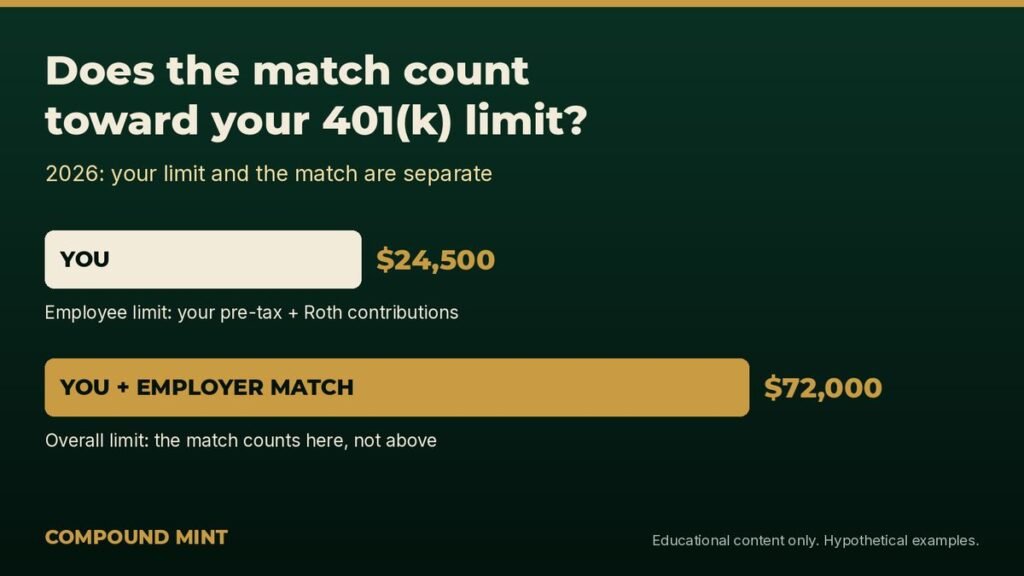
This trips up a lot of people because there are really two limits on a 401(k), and they measure different things. One caps what comes out of your paycheck. The other caps the total that lands in the account. Once you see them side by side, the answer is simple.
The two 401(k) limits for 2026
| Limit (2026) | What it covers | Amount |
|---|---|---|
| Employee deferral limit | Your own pre-tax plus Roth 401(k) contributions | $24,500 |
| Catch-up, age 50 and over | Extra employee contributions | +$8,000 (total $32,500) |
| Catch-up, age 60 to 63 | Higher catch-up, if your plan offers it | +$11,250 (total $35,750) |
| Overall annual additions limit | You plus employer match, profit sharing and after-tax money | $72,000 |
| Overall limit with catch-up | Age 50+ / age 60 to 63 | $80,000 / $83,250 |
Source: the IRS announcement 401(k) limit increases to $24,500 for 2026 and the IRS page on 401(k) contribution limits. These numbers are adjusted for inflation most years, so check the current year’s IRS figures before you set your contribution.
Worked example: where the match fits
Maya earns $60,000 and puts 6% of her pay into her 401(k). Her employer matches 50 cents per dollar on the first 6% of pay.
| Item | Per year | Per month |
|---|---|---|
| Maya’s contribution (6% of $60,000) | $3,600 | $300 |
| Employer match (50% of 6%) | $1,800 | $150 |
| Total into the 401(k) | $5,400 | $450 |
| Counts against the $24,500 employee limit | $3,600 only | |
| Room Maya still has as an employee | $20,900 | |
| Counts against the $72,000 overall limit | $5,400 |
Now a high earner. Jordan makes $200,000, contributes the full $24,500, and gets a dollar-for-dollar match on the first 4% of pay, which is $8,000. Jordan’s total is $32,500. The match did not shrink Jordan’s $24,500 at all, and there is still $39,500 of room under the $72,000 overall limit. Some plans let you fill part of that gap with after-tax contributions. That is different from the traditional IRA conversion described in our backdoor Roth IRA guide; when a plan allows a 401(k) conversion, people often call it a mega backdoor Roth. Not every plan permits it, so read your plan documents first.
What the match is worth over time
A match is part of your pay, and it compounds like the rest of your money. Here is Maya’s $150 a month match on its own, next to her own $300, at a hypothetical 7% annual return (end-of-month deposits, monthly compounding):
| Years | Match put in | Match grows to | Maya’s $300/mo grows to | Total account |
|---|---|---|---|---|
| 10 | $18,000 | $25,963 | $51,925 | $77,888 |
| 20 | $36,000 | $78,139 | $156,278 | $234,417 |
| 30 | $54,000 | $182,996 | $365,991 | $548,987 |
Returns are hypothetical, not guaranteed, and ignore fees, taxes and raises. Skipping the match would leave about $183,000 of that 30-year total on the table. Run your own numbers in the compound interest calculator by entering your monthly match.
Three details that catch people out
- Front-loading can cost you match. If you hit $24,500 by September, your contributions stop, and some plans stop matching for the rest of the year. Ask HR whether your plan does a “true-up.” If it does not, spread your contributions across every paycheck.
- The $24,500 limit is per person, not per plan. Change jobs mid-year and contributions at both employers add up toward one limit. The overall $72,000 limit, by contrast, applies to each unrelated employer’s plan.
- Vesting. Your own contributions are always yours, but matched money can follow a vesting schedule. Leave before you are vested and you may forfeit part of the match.
Where an IRA fits
An IRA has its own limit, separate from your 401(k): $7,500 for 2026, or $8,600 if you are 50 or older, per the IRS page on IRA contribution limits. A common order is: contribute enough to get the full match, then fund an IRA, then go back and raise your 401(k). Our Roth IRA vs traditional IRA guide covers which IRA fits, and how to start investing money walks through the full order. Starting from a smaller amount? See how to invest 1,000 dollars.
Books that explain this well
- I Will Teach You to Be Rich by Ramit Sethi (affiliate link): automating savings, a 401(k) and investing in a few weekends.
- The Bogleheads’ Guide to Investing by Taylor Larimore, Mel Lindauer and Michael LeBoeuf (affiliate link): how to build and keep a simple index portfolio, including IRAs and 401(k)s.
As an Amazon Associate I earn from qualifying purchases.
Educational content only. Not financial advice. Examples are hypothetical, not guaranteed. Contribution limits and plan rules change; check the current year’s IRS figures and your plan documents before you act.
Questions people ask
Do 401k limits include employer matching?
Only the overall limit does. The $24,500 employee limit for 2026 covers just your own pre-tax and Roth contributions. Employer matching counts toward the overall limit of $72,000 a year (before catch-up). Check the current year's IRS figures, since both limits usually change each year.
How do I avoid going over the 401k limit?
Divide the limit by your pay periods: $24,500 over 26 biweekly paychecks is about $942 per paycheck. If you changed jobs this year, add up what you put in at both employers, because the employee limit is per person. If you do go over, ask the plan to return the excess before April 15 of the next year so it is not taxed twice.
Is a 6% 401k match good?
Yes, a 6% match is generous. A dollar-for-dollar match on 6% of a $60,000 salary adds $3,600 a year, and even a 50% match on 6% adds $1,800. Contributing at least enough to get the full match is usually the first step before other investing.
Does a Roth 401k count toward the same limit?
Yes. Pre-tax and Roth 401(k) contributions share one employee limit: $24,500 combined for 2026, not $24,500 each. Employer matches do not count toward it, whether your plan makes them pre-tax or, where allowed, Roth.
Can I contribute to a 401k and an IRA in the same year?
Yes. An IRA has its own limit of $7,500 for 2026 ($8,600 at age 50 or older), separate from your 401(k). If you are covered by a workplace plan, the tax deduction for a traditional IRA can phase out at higher incomes, and Roth IRA eligibility has its own income limits.
Run the numbers yourself
Compound interest calculator
“$X a month for Y years”: see exactly what it turns into, with a chart you can share.
Open calculator →$1M or…? dilemma calculator
A lump sum today vs. payments over time (or a penny doubled). The channel’s signature question, with real math.
Open calculator →S&P 500 “what if I invested” calculator
What $100 a month in an S&P 500 index fund would have grown to, using honest historical averages.
Open calculator →