
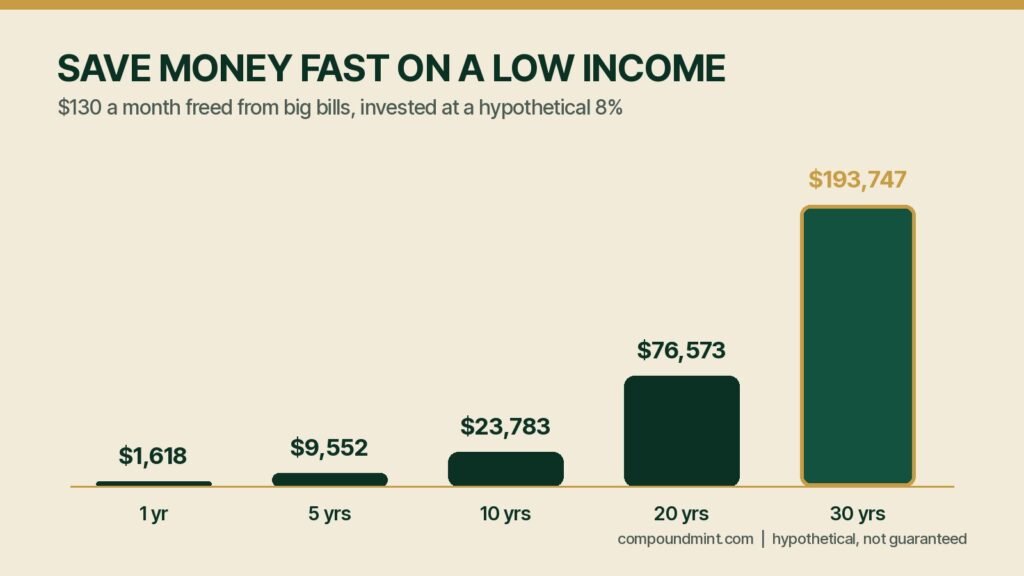
Short answer: The fastest way to save money on a low income is to cut the few biggest bills (housing, transportation, food, phone and insurance) rather than chasing tiny habits, then automate a small amount into a separate savings account every payday. Freeing up just $130 a month gives you $1,560 in a year, and the same $130 invested for 30 years at a hypothetical 8% return could grow to about $193,747. Examples are hypothetical, not guaranteed. Educational content only. Not financial advice.
When money is tight, “skip the latte” advice can feel insulting. The coffee is rarely the problem. The fixed bills are, because they repeat every month without you deciding anything. Lower one of those once and you save every month after, with no daily willpower needed.
Step 1: Go after the five biggest line items first
For most households the largest costs are housing, transportation, food, phone and internet, and insurance. A small cut to one big bill usually beats a dozen small cuts. A few ideas that need one phone call or one afternoon:
- Phone and internet: compare your plan with prepaid or low-cost carriers, and ask your provider about low-income plans. The federal Lifeline program lowers phone or internet bills for eligible households.
- Insurance: get fresh quotes for car and renters insurance once a year and raise the deductible only if you have savings to cover it.
- Food: plan meals around what is on sale, cook in batches, and cut delivery fees first; they add up faster than groceries.
- Subscriptions: list every recurring charge on your statement and cancel what you have not used in a month.
- Housing and transportation: the biggest levers, and the hardest. A roommate, a cheaper lease at renewal, or one less car payment can free hundreds a month.
Worked example: finding $130 a month
Here is one hypothetical way a tight budget could free up $130 a month without touching rent:
| Change | Monthly savings |
|---|---|
| Switch the phone plan to a cheaper prepaid plan | $45 |
| Meal plan and cut two delivery orders | $40 |
| Cancel two unused subscriptions | $25 |
| Re-shop car insurance | $20 |
| Total freed up | $130 a month |
Here is what that $130 a month could become (end-of-month deposits, monthly compounding):
| Time | Cash saved | In savings at 4% | Invested at 8% |
|---|---|---|---|
| 1 year | $1,560 | $1,589 | $1,618 |
| 5 years | $7,800 | $8,619 | $9,552 |
| 10 years | $15,600 | $19,142 | $23,783 |
| 20 years | $31,200 | $47,681 | $76,573 |
| 30 years | $46,800 | $90,226 | $193,747 |
Returns are hypothetical, not guaranteed. Money you may need in the next few years belongs in savings, not the market. Fun fact: $130 a month is the same as $6 a day, 5 days a week, which is the default in our daily habit cost calculator. Plug in your own number there to see what any cut is really worth.
Step 2: Pay yourself first, even if it is $10
Set an automatic transfer into a separate savings account for the day your paycheck lands. Start with an amount you will not miss, even $10 or $25, and raise it each time you lower a bill. At a hypothetical 4%, $25 a month is about $306 after a year and $50 a month is about $611. Small, but it is a habit that grows with your income. A high-yield savings account earns more than a typical checking account while keeping the money easy to reach.
Step 3: Build a starter emergency fund, then sinking funds
On a low income, one surprise bill can push you onto a credit card. Aim first for a small cushion, such as $500 to $1,000, then cover predictable costs with sinking funds so annual bills stop turning into debt.
The holidays are the biggest predictable cost of the year for many people. The holiday budget calculator shows the most you can spend in cash by December 25, so nothing goes on a card.
Step 4: Do not leave free money on the table
- Employer match: if your job offers a retirement plan match, contributing enough to get it is often the highest return available.
- Saver’s Credit: lower-income workers who save for retirement may qualify for a federal tax credit. Rules and income limits change each year, so check the current year’s IRS figures on the IRS Saver’s Credit page.
- Tax refund and windfalls: send part of any refund, bonus or side income straight to savings before it blends into everyday spending.
What about saving $10,000 fast?
The popular “$27.40 rule” says saving $27.40 a day adds up to $10,001 in a year ($27.40 × 365). That is real math, but on a low income $822 a month is a lot. Saving $10,000 in 3 months takes about $3,333 a month, which is out of reach for most people on a small paycheck. A realistic version: $5 a day is $1,825 a year, and $1 a day is $365. Pick the number your budget can actually hold, automate it, and raise it as bills come down. When you are ready to put longer-term money to work, see how to start investing money.
Helpful books and tools
- Cash envelope budget system (affiliate link): zipper envelopes and category cards for running a cash budget.
- Monthly budget planner (affiliate link): a paper planner for tracking bills, spending and savings goals.
- Your Money or Your Life by Vicki Robin and Joe Dominguez (affiliate link): the original book on spending by life energy and reaching financial independence.
As an Amazon Associate I earn from qualifying purchases. Want more picks by goal? See our personal finance books and money tools.
Educational content only. Not financial advice. Examples are hypothetical, not guaranteed. Program rules, tax credits and interest rates change; check current details before you act.
Questions people ask
What is the $27.40 rule?
It is a savings challenge: put aside $27.40 every day and you will have about $10,001 after a year ($27.40 x 365). On a low income a smaller daily amount, like $5 a day for $1,825 a year, is often more realistic.
How can I save $10,000 in 3 months?
You would need to save about $3,333 a month, or roughly $770 a week. That usually takes a large income jump, selling something valuable, or very low living costs. On a low income, a longer timeline with automatic savings is more realistic.
What is the best way to save money if I have a low income?
Lower your biggest fixed bills first (housing, transportation, food, phone, insurance), then automate a small transfer to a separate savings account every payday. Build a $500 to $1,000 starter emergency fund before anything else.
How much should I save on a low income?
Start with any amount you can automate without missing a bill, even $10 or $25 a paycheck, and raise it every time you cut an expense. The habit matters more than the size at first.
Is it worth saving small amounts of money?
Yes. $130 a month is $1,560 a year in cash, and it could grow to about $193,747 over 30 years if invested at a hypothetical 8% return. Small, steady amounts also keep surprise bills off credit cards.
Run the numbers yourself
Compound interest calculator
“$X a month for Y years”: see exactly what it turns into, with a chart you can share.
Open calculator →$1M or…? dilemma calculator
A lump sum today vs. payments over time (or a penny doubled). The channel’s signature question, with real math.
Open calculator →S&P 500 “what if I invested” calculator
What $100 a month in an S&P 500 index fund would have grown to, using honest historical averages.
Open calculator →