
Short answer: If you max out a Roth IRA every year ($7,500 in 2026, about $625 a month) and earn a hypothetical 8% a year, you could reach about $2.18 million by 65 starting at 25, about $1.43 million starting at 30 and about $931,475 starting at 35. Start at 45 and the same habit reaches about $368,138. The chart below shows every starting age. These are hypothetical examples, not guaranteed. Educational content only. Not financial advice.
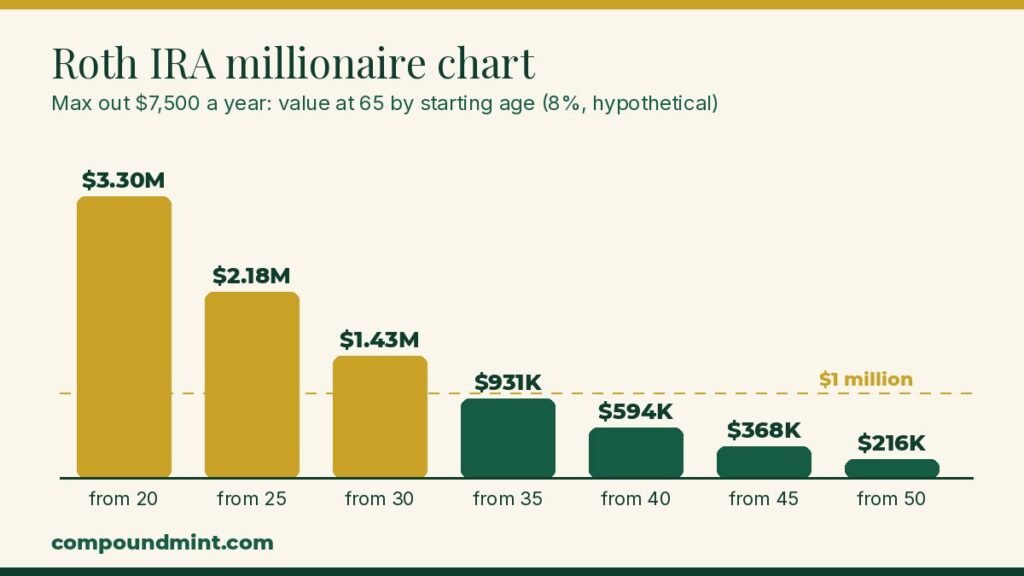
A Roth IRA is one of the few places where a regular person can build a seven-figure balance that comes out tax-free in retirement. The catch is time. The chart makes the point better than any lecture: the same $625 a month is worth millions or hundreds of thousands depending only on when you start.
The Roth IRA millionaire chart
Inputs: $625 a month ($7,500 a year, the 2026 limit under age 50), deposited at the end of each month until age 65, monthly compounding, constant returns, no fees. All balances are hypothetical, not guaranteed.
| Start at | Years | You put in | At 6% | At 8% | At 10% |
|---|---|---|---|---|---|
| 20 | 45 | $337,500 | $1,722,495 | $3,296,587 | $6,551,564 |
| 25 | 40 | $300,000 | $1,244,682 | $2,181,880 | $3,952,550 |
| 30 | 35 | $262,500 | $890,444 | $1,433,677 | $2,372,899 |
| 35 | 30 | $225,000 | $627,822 | $931,475 | $1,412,805 |
| 40 | 25 | $187,500 | $433,121 | $594,391 | $829,271 |
| 45 | 20 | $150,000 | $288,776 | $368,138 | $474,606 |
| 50 | 15 | $112,500 | $181,762 | $216,274 | $259,044 |
The 2026 limits are $7,500 a year, or $8,600 if you are 50 or older, per the IRS IRA contribution limits. You also need earned income at least equal to what you put in, and the amount you can contribute to a Roth phases out at higher incomes; check the current year’s IRS figures on the IRS Roth IRA page. Run any row yourself in the compound interest calculator.
When does a maxed Roth IRA hit $1 million?
At a hypothetical 8%, $625 a month takes about 30 years and 10 months to pass $1 million. At 10%, it takes about 26 years and 9 months. So:
- start at 25: a Roth IRA millionaire at about 55 (8%) or about 51 (10%)
- start at 30: about 60 (8%) or about 56 (10%)
- start at 35: just past 65 at 8%, or about 61 at 10%
To reach exactly $1 million by 65 at 8%, someone starting at 35 needs about $671 a month, a little over today’s limit. Someone starting at 45 needs about $1,698 a month, which no longer fits inside one Roth IRA. Work out your own number in the millionaire calculator. Hypothetical, not guaranteed.
Worked example: 10 years early beats 30 years late
Two savers, both maxing out at $625 a month, hypothetical 8% compounded monthly:
| Saver | Contributes | Total put in | Value at 65 |
|---|---|---|---|
| Early Emma | Age 25 to 35, then stops | $75,000 | $1,250,405 |
| Late Leo | Age 35 to 65, never stops | $225,000 | $931,475 |
Emma’s $75,000 grows to about $114,341 by 35. She never adds another dollar, yet 30 more years of compounding carry it past Leo, who put in three times as much. The check: $114,341 × (1 + 0.08/12)360 ≈ $1,250,400. Hypothetical, not guaranteed. This is the same idea behind Coast FIRE; our Coast FIRE and the 4% rule guide explains it.
Why the Roth part matters
With a Roth IRA you pay tax on the money before it goes in. In return, qualified withdrawals, generally after age 59½ once the account has been open at least five years, come out tax-free, growth included. On a $2.18 million balance, almost $1.9 million is growth, so the tax treatment can matter as much as the return. Contributions (not earnings) can also come out at any time without tax or penalty. If you are deciding between account types, our Roth IRA vs traditional IRA breakdown and the Roth vs traditional IRA calculator run both side by side. Higher earners locked out by the income limits often look at the backdoor Roth IRA.
Catch-up contributions after 50
From 50, the 2026 limit rises to $8,600, about $717 a month. Adding catch-up years changes the chart a little, not a lot: starting at 35 and switching to $717 a month at 50 reaches about $963,195 by 65 at 8%, versus $931,475 without it. Starting at 45 it is about $399,858 versus $368,138. Early years still do most of the work. Hypothetical, not guaranteed.
Ready to see your own row? Plug your age and monthly amount into the compound interest calculator, or work backward from $1 million in the millionaire calculator.
Books that explain this well
- The Bogleheads’ Guide to Investing by Taylor Larimore, Mel Lindauer and Michael LeBoeuf (affiliate link): how to build and keep a simple index portfolio, including IRAs and 401(k)s.
- The Simple Path to Wealth by JL Collins (affiliate link): a complete, simple index fund plan, including how to draw it down later.
As an Amazon Associate I earn from qualifying purchases.
Educational content only. Not financial advice. Examples are hypothetical, not guaranteed. Past returns do not predict future results; contribution limits, income limits and withdrawal rules change, so check the current year’s IRS figures before you act.
Questions people ask
Can you become a millionaire with a Roth IRA?
Yes, with enough time. Maxing out at $7,500 a year (about $625 a month) at a hypothetical 8% compounded monthly passes $1 million in about 30 years and 10 months, so starting at 25 could get you there by about 55. Hypothetical, not guaranteed.
How much will my Roth IRA be worth if I max it out for 30 years?
At $625 a month for 30 years, you put in $225,000. At a hypothetical 8% a year compounded monthly it could grow to about $931,475; at 6% about $627,822 and at 10% about $1,412,805. Hypothetical, not guaranteed.
How long does it take to become a millionaire with a Roth IRA?
At the 2026 limit of $7,500 a year, about 30 years and 10 months at a hypothetical 8%, or about 26 years and 9 months at 10%. A lower return or skipped years make it longer. Hypothetical, not guaranteed.
Is it too late to start a Roth IRA at 40 or 45?
No, but it changes the target. Maxing out from 40 to 65 could reach about $594,391 at a hypothetical 8%, and from 45 about $368,138. Catch-up contributions from 50 add a little, and a workplace plan can add more. Hypothetical, not guaranteed. Educational content only, not financial advice.
What is the Roth IRA contribution limit for 2026?
The IRS limit for 2026 is $7,500, or $8,600 if you are 50 or older, across all your traditional and Roth IRAs, and no more than your taxable compensation. Roth contributions also phase out at higher incomes. Check the current year's IRS figures before contributing.
Run the numbers yourself
Compound interest calculator
“$X a month for Y years”: see exactly what it turns into, with a chart you can share.
Open calculator →$1M or…? dilemma calculator
A lump sum today vs. payments over time (or a penny doubled). The channel’s signature question, with real math.
Open calculator →S&P 500 “what if I invested” calculator
What $100 a month in an S&P 500 index fund would have grown to, using honest historical averages.
Open calculator →