
Short answer: To open a brokerage account, pick the account type, choose a broker, apply online with your Social Security number, ID and bank details, fund it, then choose your investments. The application usually takes a few minutes, and many large online brokers have no account minimum. Starting with $500 and adding $100 a month at a hypothetical 8% a year could grow to about $154,504 in 30 years. Examples are hypothetical, not guaranteed. Educational content only. Not financial advice.
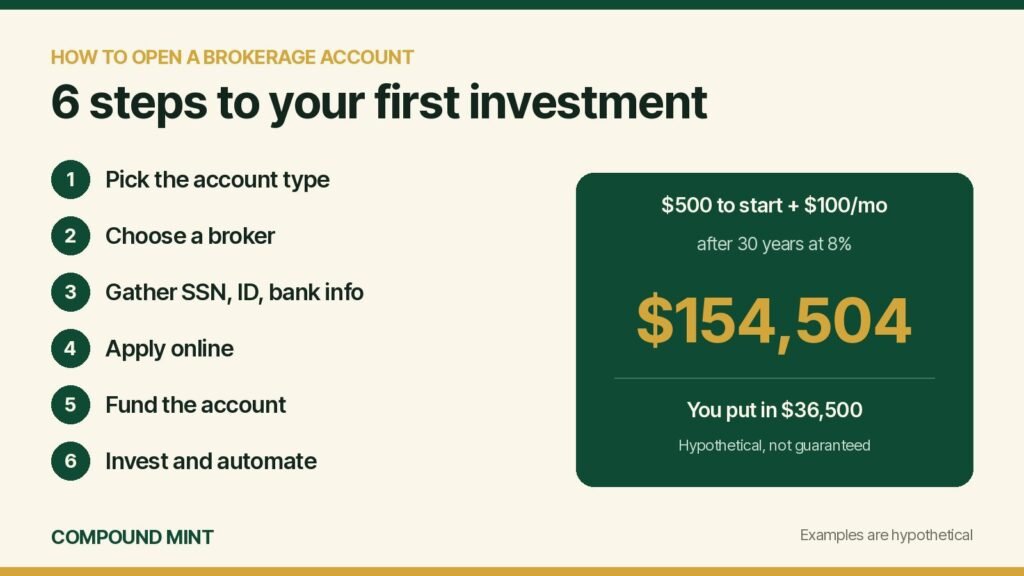
A brokerage account is an investment account you open with a broker. You put money in, then buy stocks, bonds, index funds or ETFs with it. A regular (taxable) brokerage account has no yearly contribution limit and no withdrawal rules, which makes it the natural next step after your 401(k) match and IRA. Here is the whole process, start to finish.
Step 1: Pick the account type
- Individual taxable account: the standard brokerage account. Put in any amount, take money out any time, and pay tax on dividends and gains each year.
- Joint account: the same thing, owned by two people, often spouses.
- Retirement accounts (IRA or Roth IRA): most brokers open these too. They come with tax breaks but yearly limits and withdrawal rules. See Roth vs. traditional IRA to compare.
- Custodial account: for a child under 18, managed by a parent or guardian.
Step 2: Choose a broker
Compare a few brokers on what you will actually use:
- Costs: trading commissions on stocks and ETFs, account fees, and the expense ratios of the funds you plan to buy.
- Minimums: many large online brokers have a $0 account minimum, but some mutual funds still require a minimum first purchase.
- Fractional shares and automatic investing: handy if you plan to invest a fixed dollar amount every month.
- Protection and record: check the firm is a SIPC member, and look it up on FINRA BrokerCheck. The SEC also suggests reading the firm’s relationship summary (Form CRS) before you sign up.
Step 3: Gather what you need
The application asks for the same things at almost every broker:
- Social Security number (or ITIN) and date of birth
- A government ID, like a driver’s license or passport
- Home address, phone and email
- Employment details (employer name, or retired, student, and so on)
- Your bank’s routing and account number, to move money in
You generally need to be 18 or older to open an account in your own name.
Step 4: Apply online
Fill in the application on the broker’s website or app. You will also answer a few questions about your investing experience and goals; that is a standard requirement, not a test. Approval is often instant, though some applications take a business day or two to verify.
Step 5: Fund the account
Link your bank account and transfer money in. A standard bank transfer often takes 1 to 3 business days to settle. You can also roll over money from an old account by moving it straight from broker to broker, so you never touch the cash.
Step 6: Choose investments and automate
Many beginners start with one low-cost, broad index fund, such as an S&P 500 or total market fund, then turn on automatic monthly investing and dividend reinvestment. Our guide to investing $100 a month shows how that works in practice.
Worked example: $500 to start, $100 a month
Say you open an account with $500 and set up an automatic $100 every month. At a hypothetical 8% a year, compounded monthly:
| Years | Your total deposits | Hypothetical value |
|---|---|---|
| 20 years | $24,500 | $61,365 |
| 30 years | $36,500 | $154,504 |
The math check: 20 years is $500 + (240 x $100) = $24,500 deposited, and 30 years is $500 + (360 x $100) = $36,500. Everything above that is growth. See how real S&P 500 history would have treated a monthly plan in the S&P 500 calculator, or test any rate in the compound interest calculator.
Why fees matter more than they look
Two investors each put $200 a month into a fund for 30 years. Both funds earn a hypothetical 8% before fees. One charges 0.03% a year, the other 1%:
| Yearly fund fee | Hypothetical value after 30 years |
|---|---|
| 0.03% | $296,263 |
| 1.00% | $243,994 |
Same deposits ($72,000 each), but the higher fee costs about $52,269. (Simplified: the fee is subtracted from the yearly return.) That is why the fund’s expense ratio deserves a look before you buy.
Brokerage account vs. IRA
| Taxable brokerage | IRA or Roth IRA | |
|---|---|---|
| Yearly limit | None | Set by the IRS each year |
| Withdrawals | Any time | Rules and possible penalties before 59 and a half |
| Taxes | On dividends and gains as you go | Deferred (traditional) or tax-free if rules are met (Roth) |
Many people fill tax-advantaged accounts first, then use a brokerage account for extra savings or goals before retirement. Read how dividends are taxed to see what a taxable account costs each year, and how to start investing money for the full order of steps.
Books that explain this well
- The Little Book of Common Sense Investing by John C. Bogle (affiliate link): the case for low-cost index funds, from the founder of Vanguard.
- The Bogleheads’ Guide to Investing by Taylor Larimore, Mel Lindauer and Michael LeBoeuf (affiliate link): how to build and keep a simple index portfolio, including IRAs and 401(k)s.
As an Amazon Associate I earn from qualifying purchases.
Educational content only. Not financial advice. Examples are hypothetical, not guaranteed. Investing involves risk, including loss of principal; check each broker’s current fees and terms before opening an account.
Questions people ask
How much money do I need to open a brokerage account?
Often nothing. Many large online brokers have a $0 account minimum, and fractional shares let you buy part of a fund share with a few dollars. Some mutual funds still require a minimum first purchase, so check the fund before you buy.
Can I open a brokerage account myself?
Yes. If you are 18 or older, you can open one online in a few minutes with your Social Security number, a government ID and your bank details. A parent or guardian can open a custodial account for a child.
How long does it take to open a brokerage account?
The online application usually takes a few minutes, and approval is often instant. A bank transfer to fund it often takes 1 to 3 business days to settle before you can invest the money.
What is the downside to a brokerage account?
There is no tax break. You pay tax on dividends and on gains when you sell, and investments can lose value. Unlike a bank deposit, it is not FDIC insured; SIPC protects you if the broker fails, not against market losses.
Is my money safe in a brokerage account?
At a SIPC member firm, SIPC protects up to $500,000 per customer, including up to $250,000 in cash, if the broker fails. It does not protect against investments falling in value. Educational content only, not financial advice.
Run the numbers yourself
Compound interest calculator
“$X a month for Y years”: see exactly what it turns into, with a chart you can share.
Open calculator →$1M or…? dilemma calculator
A lump sum today vs. payments over time (or a penny doubled). The channel’s signature question, with real math.
Open calculator →S&P 500 “what if I invested” calculator
What $100 a month in an S&P 500 index fund would have grown to, using honest historical averages.
Open calculator →