
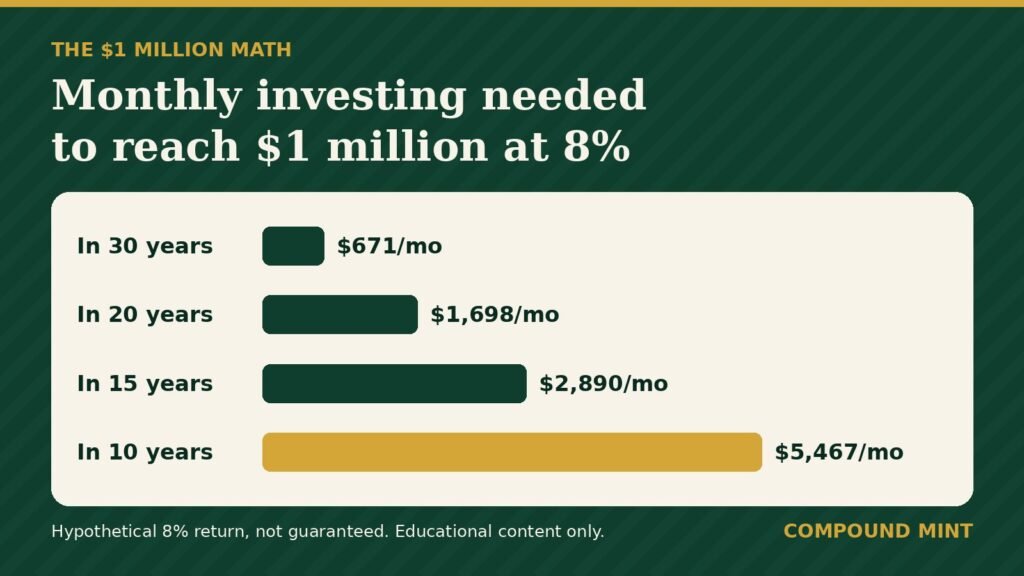
Short answer: Starting from $0, you would need to invest about $5,467 a month for 10 years at a hypothetical 8% yearly return to reach $1 million. That is $65,604 a year, so for most people it takes a high income, a big head start or two earners. Stretch the goal to 15 years and it drops to about $2,890 a month; at 20 years, about $1,698. These are hypothetical examples, not guaranteed. Educational content only. Not financial advice.
Ten years is a short runway for compounding, which means most of a 10-year million has to come from your own deposits, not growth. That does not make it impossible. It makes it a savings-rate problem first and an investing problem second. Here is the honest math, the levers that change it, and the more realistic timelines most people can actually hit.
How much you need to invest each month
Monthly investment needed to reach $1,000,000 from $0, compounded monthly, by hypothetical yearly return:
| Time to $1M | At 6% | At 8% | At 10% |
|---|---|---|---|
| 10 years | $6,103 | $5,467 | $4,882 |
| 15 years | $3,439 | $2,890 | $2,413 |
| 20 years | $2,165 | $1,698 | $1,317 |
| 30 years | $996 | $671 | $443 |
Notice how much time does. At 8%, going from 10 to 20 years cuts the monthly amount by more than two thirds. Plug in your own age, target and rate in the millionaire calculator.
Assumptions: deposits at the end of each month, a constant hypothetical return, monthly compounding, before taxes and fees. Real markets go up and down, sometimes for years. Examples are hypothetical, not guaranteed.
Worked example: $5,467 a month at 8% for 10 years
Here is where a 10-year million actually comes from, compared with longer timelines at the same hypothetical 8%:
| Timeline | Monthly | You deposit | Growth | Ending balance |
|---|---|---|---|---|
| 10 years | $5,467 | $656,040 | $344,126 | $1,000,166 |
| 15 years | $2,890 | $520,200 | $479,850 | $1,000,050 |
| 20 years | $1,698 | $407,520 | $592,637 | $1,000,157 |
| 30 years | $671 | $241,560 | $758,471 | $1,000,031 |
In the 10-year plan, about two thirds of the million is your own money. In the 30-year plan, about three quarters is growth. That is compounding in one table: the longer the runway, the less you have to bring. Check any row in the compound interest calculator.
A head start changes everything
Already have money invested? Here is the monthly amount needed to hit $1 million in 10 years at a hypothetical 8%:
| Already invested | Monthly needed for 10 years |
|---|---|
| $0 | $5,467 |
| $50,000 | $4,860 |
| $100,000 | $4,253 |
| $250,000 | $2,433 |
A $250,000 starting balance more than doubles to about $555,000 in 10 years at 8% on its own, so it does nearly half the work. That is why the people who reach $1 million in 10 years usually were not starting from zero.
Where would $65,000 a year even go?
Tax-advantaged accounts have yearly caps. For 2026 the IRS limit is $24,500 for a 401(k) and $7,500 for an IRA (higher with catch-up contributions at 50+). One person maxing both puts in $32,000 a year, about half of what the 10-year plan needs. A couple who both max a 401(k) and an IRA invest $64,000 a year, about $5,333 a month, which grows to roughly $975,700 in 10 years at a hypothetical 8%. Add any employer match on top and they cross $1 million. Employer money does not count toward your own $24,500 limit; here is how the match fits the limits. Anything beyond the caps goes into a regular taxable brokerage account. Check the current year’s IRS figures before you plan.
5 levers that make a 10-year million more realistic
- Raise income first. At this savings level the gap is usually income, not investing skill. A raise, a side business or a second earner moves the number more than any fund choice.
- Save raises, not just paychecks. Sending each raise straight to investments grows the monthly amount without cutting your current lifestyle.
- Collect every match dollar. A match is part of your monthly total that you do not have to earn twice.
- Keep fees low. At 7% instead of 8%, the 10-year monthly need rises from $5,467 to about $5,778. Fees eat directly into the return.
- Give it 15 or 20 years. If $5,467 a month is out of reach, $1,698 a month for 20 years gets to the same place at the same hypothetical rate.
Avoid anything that promises to shortcut the math with outsized, “guaranteed” returns. Reaching $1 million in 10 years by investing takes a big savings rate, not a secret. For the doubling side of the story, see how to double your money.
What $1 million is worth in 10 years
Inflation matters on a 10-year goal. At a hypothetical 3% a year, $1 million in 10 years buys about what $744,000 buys today. Using the 4% rule as a rough guide, $1 million could support about $40,000 of spending in the first year of retirement; see Coast FIRE and the 4% rule. For what seven figures really means in net worth, read how much is 7 figures, and for the Roth version of the long road, the Roth IRA millionaire chart.
Books that explain this well
- Set for Life by Scott Trench (affiliate link): a step-by-step plan to build savings fast on an ordinary income.
- The Millionaire Next Door by Thomas J. Stanley and William D. Danko (affiliate link): research on how ordinary earners actually build wealth.
- Quit Like a Millionaire by Kristy Shen and Bryce Leung (affiliate link): how one couple reached early retirement, with the withdrawal math explained.
As an Amazon Associate I earn from qualifying purchases.
Educational content only. Not financial advice. Examples are hypothetical, not guaranteed. Returns are not guaranteed and past market performance does not predict future results. Contribution limits change; check the current year’s IRS figures.
Questions people ask
How much do I need to save per month to be a millionaire in 10 years?
About $5,467 a month starting from $0 at a hypothetical 8% yearly return, compounded monthly. At 6% it is about $6,103, and at 10% about $4,882. Examples are hypothetical, not guaranteed.
How long will it take to save $1 million?
It depends on the monthly amount. At a hypothetical 8%, investing $1,000 a month takes about 25 years 7 months, $2,000 a month about 18 years 5 months, and $3,000 a month about 14 years 9 months. Examples are hypothetical, not guaranteed.
How much will $1,000,000 be worth in 10 years?
In buying power, less than today. At a hypothetical 3% yearly inflation, $1 million in 10 years buys about what $744,000 buys today.
Can you become a millionaire in 10 years on a $100,000 salary?
It is very hard alone. $5,467 a month is about $65,600 a year, roughly two thirds of a $100,000 salary before taxes. It becomes realistic with a head start, a second earner, an employer match or a 15 to 20 year timeline.
Is $1 million enough to retire?
It depends on your spending. The 4% rule of thumb suggests $1 million could support about $40,000 of spending in the first year, plus any Social Security or pension. Examples are hypothetical, not guaranteed.
Run the numbers yourself
Compound interest calculator
“$X a month for Y years”: see exactly what it turns into, with a chart you can share.
Open calculator →$1M or…? dilemma calculator
A lump sum today vs. payments over time (or a penny doubled). The channel’s signature question, with real math.
Open calculator →S&P 500 “what if I invested” calculator
What $100 a month in an S&P 500 index fund would have grown to, using honest historical averages.
Open calculator →