
Short answer: A wealth multiplier is how many dollars one dollar invested today could grow into by retirement. At a hypothetical 8% a year, $1 invested at 25 grows to about $21.72 by 65, $1 invested at 35 grows to about $10.06, and $1 invested at 50 grows to about $3.17. The younger the dollar, the bigger the multiplier. These are hypothetical examples, not guaranteed. Educational content only. Not financial advice.
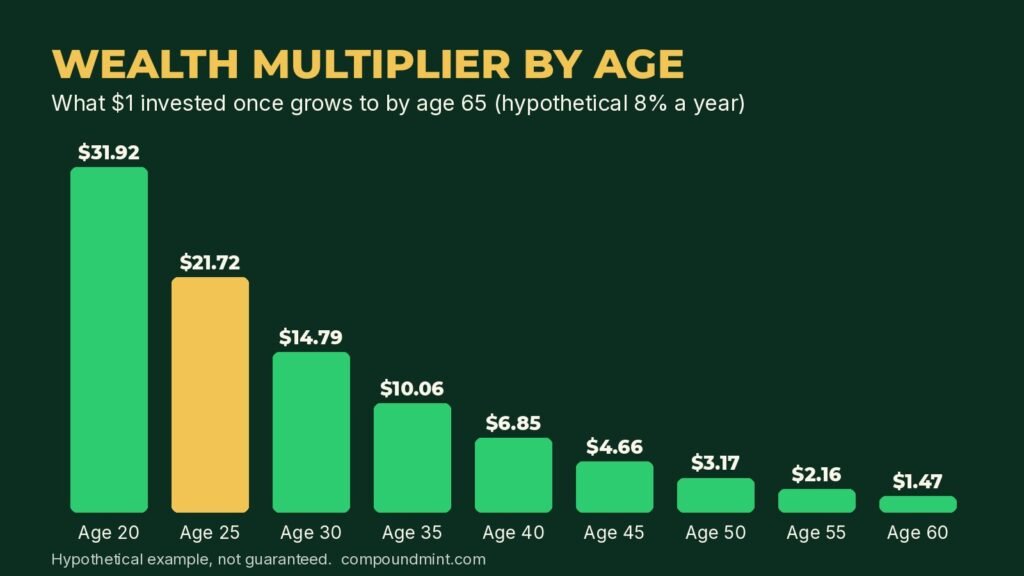
The idea, a term popularized by the Money Guy Show podcast, is simple: before you spend a dollar, picture what it could become if you invested it instead. At 25 that dollar is not really a dollar. It is closer to $20 of future money. At 60 it is about $1.50. Here is the full table, the math behind it, and how to use it without letting it make you miserable.
Wealth multiplier by age: the table
What $1 invested once, with nothing added, grows to by age 65 at three hypothetical yearly returns, compounded yearly, before taxes, fees and inflation:
| Age you invest $1 | Years to 65 | At 6% | At 8% | At 10% |
|---|---|---|---|---|
| 20 | 45 | $13.76 | $31.92 | $72.89 |
| 25 | 40 | $10.29 | $21.72 | $45.26 |
| 30 | 35 | $7.69 | $14.79 | $28.10 |
| 35 | 30 | $5.74 | $10.06 | $17.45 |
| 40 | 25 | $4.29 | $6.85 | $10.83 |
| 45 | 20 | $3.21 | $4.66 | $6.73 |
| 50 | 15 | $2.40 | $3.17 | $4.18 |
| 55 | 10 | $1.79 | $2.16 | $2.59 |
| 60 | 5 | $1.34 | $1.47 | $1.61 |
The formula is one line: multiplier = (1 + return) ^ years. At 8% for 40 years that is 1.08 ^ 40 ≈ 21.72. Notice how the gap between columns widens with time: the return matters a little at 60 and enormously at 20. Some versions of this chart use a higher return, which is why you may see bigger multipliers elsewhere. The shape is the same.
Worked example: one $1,000 decision at 25
Say you are 25 and choosing between a $1,000 upgrade and investing the $1,000. At a hypothetical 8% a year:
- Invested at 25, the $1,000 grows to about $21,725 by 65.
- Invested at 35 instead, it grows to about $10,063.
- Invested at 45, it grows to about $4,661.
Waiting just one year costs more than it feels like. A dollar invested at 25 becomes about $21.72 by 65; the same dollar invested at 26 becomes about $20.12. That one year of delay shaves off about 7% of the end result.
The same math works for a yearly habit. Investing $7,500 once at 25 (about one year of the 2026 IRA limit) grows to about $162,934 by 65 at 8%. The same $7,500 invested at 35 grows to about $75,470. To see what investing every single year from different ages does, look at the Roth IRA millionaire chart.
Monthly saving tells the same story. $100 a month from 25 to 65, at a hypothetical 8% compounded monthly, grows to about $349,101 on $48,000 of deposits. Starting at 35 grows to about $149,036 on $36,000 of deposits. Ten more years of $100 deposits ($12,000) adds about $200,000 to the end balance. Try your own numbers in the compound interest calculator.
Assumptions: a constant hypothetical return, yearly compounding for one-time amounts and monthly compounding for monthly deposits, no taxes or fees. Real markets go up and down. Examples are hypothetical, not guaranteed.
What about inflation?
The table shows future dollars, and future dollars buy less. If prices rise 3% a year, $1 invested at 25 at a hypothetical 8% is worth about $6.66 in today’s money at 65, not $21.72. That is still a big number. A simple way to think in today’s dollars is to use a lower “real” return, like 5%, which gives a multiplier of about 7.04 over 40 years.
How to use the wealth multiplier (without guilt)
- Use it on big and repeat purchases, not coffee. A car payment, a subscription bundle or rent you can trim moves the needle. Our daily habit cost calculator shows what a recurring cost adds up to.
- Front-load when you can. Every dollar in your 20s and early 30s does several times the work of a dollar in your 50s. That is why the early benchmarks matter; see how much money you should have saved by 30.
- Never skip free money. An employer match adds dollars on top of yours before any growth happens.
- Do not invest money you need soon. The multiplier assumes decades of growth. An emergency fund belongs somewhere safe and easy to reach.
- Late is still worth it. A multiplier of 3 at 50 still triples a dollar. The best time to start is the next paycheck.
The engine behind all of this is doubling: at 8%, money doubles about every 9 years, so 40 years holds a bit over 4 doublings. Learn the shortcut in how to double your money, or see the basics in how compound interest works.
Books that explain this well
- The Psychology of Money by Morgan Housel (affiliate link): short chapters on why behavior and time matter more than picking winners.
- The Simple Path to Wealth by JL Collins (affiliate link): a complete, simple index fund plan, including how to draw it down later.
As an Amazon Associate I earn from qualifying purchases.
Educational content only. Not financial advice. Examples are hypothetical, not guaranteed. Returns are not guaranteed and past market performance does not predict future results.
Questions people ask
What is the wealth multiplier?
It is how many dollars one dollar invested today could grow into by retirement. At a hypothetical 8% a year, $1 invested at 25 grows to about $21.72 by 65, so its multiplier is about 21.7. Examples are hypothetical, not guaranteed.
How do you calculate the wealth multiplier by age?
Use (1 + return) raised to the number of years until retirement. For age 30 and retirement at 65 at a hypothetical 8%, that is 1.08 ^ 35, or about 14.79.
What is the wealth multiplier at age 30?
At a hypothetical 8% a year to age 65, about 14.79. At 6% it is about 7.69, and at 10% it is about 28.10. Examples are hypothetical, not guaranteed.
What is the wealth multiplier at age 40?
At a hypothetical 8% a year to age 65, about 6.85, so $1,000 invested at 40 could grow to about $6,848. At 10% the multiplier is about 10.83.
Does the wealth multiplier include inflation?
The basic table shows future dollars. With 3% inflation, $1 invested at 25 at a hypothetical 8% is worth about $6.66 in today's money by 65. Using a lower real return, such as 5%, gives a multiplier in today's dollars.
Run the numbers yourself
Compound interest calculator
“$X a month for Y years”: see exactly what it turns into, with a chart you can share.
Open calculator →$1M or…? dilemma calculator
A lump sum today vs. payments over time (or a penny doubled). The channel’s signature question, with real math.
Open calculator →S&P 500 “what if I invested” calculator
What $100 a month in an S&P 500 index fund would have grown to, using honest historical averages.
Open calculator →