
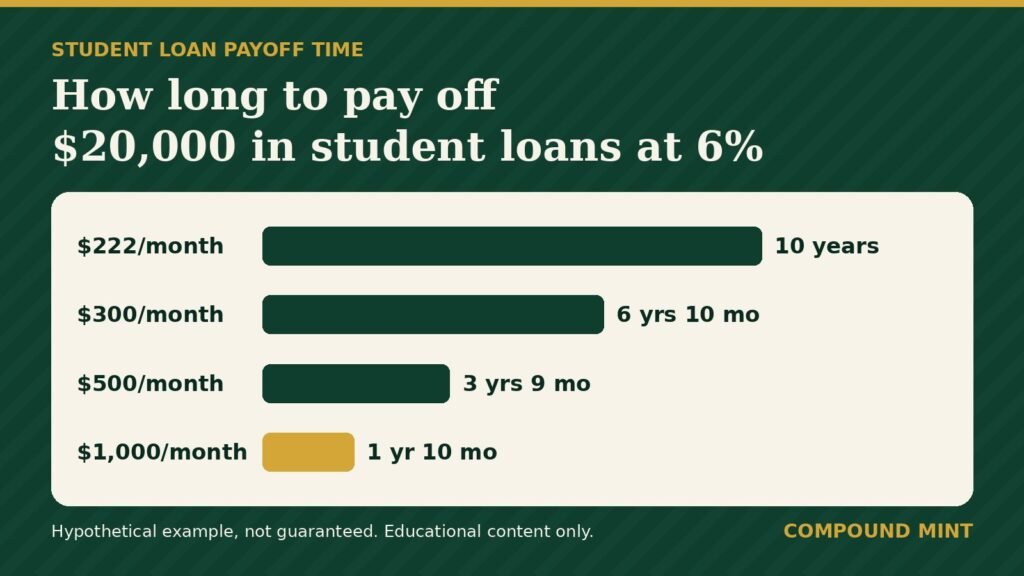
Short answer: On the federal Standard Repayment Plan, student loans take up to 10 years to pay off. Federal loans made on or after July 1, 2026 use the newer Tiered Standard Plan, which runs 10, 15, 20 or 25 years depending on how much you borrowed. Paying extra shortens it fast: a hypothetical $20,000 loan at 6% takes 10 years at $222 a month, but only 22 months at $1,000 a month. Examples are hypothetical, not guaranteed. Educational content only. Not financial advice.
Student debt feels endless mostly because the minimum payment is designed to be comfortable, not fast. The good news is that the payoff date is just math, and you control the biggest input: the monthly payment. Below are the official repayment terms, a full payoff table, and what changes when you add a little extra each month.
How long the federal repayment plans last
The term depends on when your loans were made and which plan you are on:
| Plan | Who it applies to | Payoff time |
|---|---|---|
| Standard Repayment Plan | Most federal loans made before July 1, 2026 | Up to 10 years (up to 30 for consolidation loans) |
| Tiered Standard Plan | Federal loans made on or after July 1, 2026, under $25,000 borrowed | 10 years |
| Tiered Standard Plan | $25,000 to $49,999 borrowed | 15 years |
| Tiered Standard Plan | $50,000 to $99,999 borrowed | 20 years |
| Tiered Standard Plan | $100,000 or more borrowed | 25 years |
| Extended Repayment Plan | Eligible borrowers with older loans | Up to 25 years |
Sources: Federal Student Aid’s pages on the Standard Repayment Plan, the Tiered Standard Plan and the Extended Repayment Plan. Income-driven plans base the payment on income instead, which often stretches repayment much longer. Rules change, so confirm your own options with your servicer and check the current year’s figures on studentaid.gov.
In real life, many people take longer than the plan says because they pause payments, switch to income-driven plans or go back to school. The Education Data Initiative estimates the average borrower takes about 20 years to repay.
Worked example: $20,000 at 6%
Say you owe $20,000 at a hypothetical 6% fixed rate. On a 10-year schedule the payment is about $222.05 a month. Here is what happens if you pay more each month, with interest calculated monthly:
| Monthly payment | Time to pay off | Total interest | Interest saved vs 10 years |
|---|---|---|---|
| $222.05 (10-year schedule) | 10 years | $6,645 | $0 |
| $300 | 6 years 10 months | $4,389 | $2,256 |
| $400 | 4 years 10 months | $3,072 | $3,573 |
| $500 | 3 years 9 months | $2,370 | $4,275 |
| $1,000 | 1 year 10 months | $1,125 | $5,520 |
Adding just $78 a month (from $222 to $300) cuts more than three years off the loan. Going to $500 cuts it to under four years and saves over $4,000 in interest. The extra money goes straight to principal, so every month after that you are paying interest on a smaller balance.
Assumptions: a fixed hypothetical 6% rate, interest calculated monthly, on-time payments, no fees, forbearance or rate discounts. Federal loans actually accrue interest daily, so your servicer’s numbers will differ slightly. Examples are hypothetical, not guaranteed.
A bigger balance: $40,000 on the 15-year tier
For new undergraduate federal loans first disbursed from July 1, 2026 to June 30, 2027, the fixed rate is 6.52% (studentaid.gov interest rates). A $40,000 balance at that rate on the 15-year tier works out like this:
| Monthly payment | Time to pay off | Total interest |
|---|---|---|
| $348.89 (15-year schedule) | 15 years | $22,798 |
| $448.89 (+$100) | 10 years 3 months | $14,838 |
| $548.89 (+$200) | 7 years 10 months | $11,064 |
| $1,000 | 3 years 10 months | $5,224 |
An extra $100 a month takes almost five years off and saves about $8,000. That is the real lever: the longer the term, the more each extra dollar is worth.
Pay it off fast or invest the difference?
This depends on your rate. Here is a quick comparison with the same $500 a month budget for 10 years on the $20,000, 6% loan:
- Pay it off first: $500 a month clears the loan in 45 months. Investing the full $500 for the remaining 75 months at a hypothetical 7% leaves about $46,874 at the 10-year mark.
- Pay the minimum and invest the rest: paying $222.05 and investing $277.95 a month for 10 years at a hypothetical 7% leaves about $48,109.
Investing wins by about $1,235 in this example, but only if the market actually delivers 7%. The 6% you save by paying off debt is guaranteed. When a loan rate is close to what you hope to earn, it is nearly a tie, and peace of mind is a fair tiebreaker. At 8% or more, paying the loan down usually comes out ahead. Take any employer 401(k) match first either way, since that is an instant return (see how the employer match works). Run the investing side yourself in the compound interest calculator.
We worked through a real two-method payoff on our channel: I paid off $18K two ways.
5 ways to pay off student loans faster
- Pay a set amount above the minimum. Even $50 to $100 a month moves the payoff date by years, as the tables show. Ask your servicer to apply extra payments to principal.
- Target the highest rate first. If you have several loans, extra money on the highest-rate loan saves the most interest.
- Use windfalls. Tax refunds, raises and bonuses sent straight to the loan shorten it without changing your monthly budget.
- Set up autopay. Federal servicers have offered a small rate discount for autopay, and you never miss a payment.
- Free up cash first. A lean budget helps more than any trick; see how to save money fast on a low income.
Interest works against you exactly the way compounding works for you when you invest. See simple interest vs compound interest for the difference, and how to improve your credit score for why on-time loan payments matter beyond the payoff date.
Recommended reading
Books that help with a payoff plan:
- The Total Money Makeover by Dave Ramsey (affiliate link): Baby Steps and the debt snowball.
- Broke Millennial by Erin Lowry (affiliate link): student loans, credit and money basics for your 20s.
- I Will Teach You to Be Rich by Ramit Sethi (affiliate link): automating payments, saving and investing so debt stops growing.
More picks by goal: best personal finance books. As an Amazon Associate we earn from qualifying purchases. Educational content only. Not financial advice.
Educational content only. Not financial advice. Examples are hypothetical, not guaranteed. Loan terms, rates and plan rules change; check the current year’s figures on studentaid.gov and with your loan servicer.
Questions people ask
How long does it take to pay off $50,000 in student loans?
On a 10-year schedule at a hypothetical 6.52%, the payment is about $568 a month and the loan is gone in 10 years. On the 20-year Tiered Standard term for new federal loans, the payment drops to about $373, but you pay roughly twice the interest. Examples are hypothetical, not guaranteed.
What is the average monthly payment for a $70,000 student loan?
At a hypothetical 6.52%, about $796 a month on a 10-year schedule, or about $523 a month over 20 years. The shorter term costs more each month but saves about $30,000 in interest. Examples are hypothetical, not guaranteed.
How long does the average person take to pay off student loans?
Much longer than 10 years for many people. The Education Data Initiative estimates the average borrower takes about 20 years, mostly because of income-driven plans, pauses and going back to school.
Can you pay off federal student loans early?
Yes. There is no prepayment penalty on federal student loans, so you can pay extra at any time. Ask your servicer to apply the extra to principal so it shortens the loan.
Is it better to pay off student loans early or invest?
It depends on the rate. Paying off a loan is a guaranteed return equal to its interest rate, while investing returns are not guaranteed. Near 6% it is close to a tie; on higher rates, paying the loan down usually wins. Take any employer 401(k) match first.
Run the numbers yourself
Compound interest calculator
“$X a month for Y years”: see exactly what it turns into, with a chart you can share.
Open calculator →$1M or…? dilemma calculator
A lump sum today vs. payments over time (or a penny doubled). The channel’s signature question, with real math.
Open calculator →S&P 500 “what if I invested” calculator
What $100 a month in an S&P 500 index fund would have grown to, using honest historical averages.
Open calculator →